Irish Examiner view: Racism is not a minority problem
Victims are expected to show resilience, as if toughness were the appropriate response to racism rather than the minimum requirement of decent administration
Irish Examiner view: Racism is not a minority problem

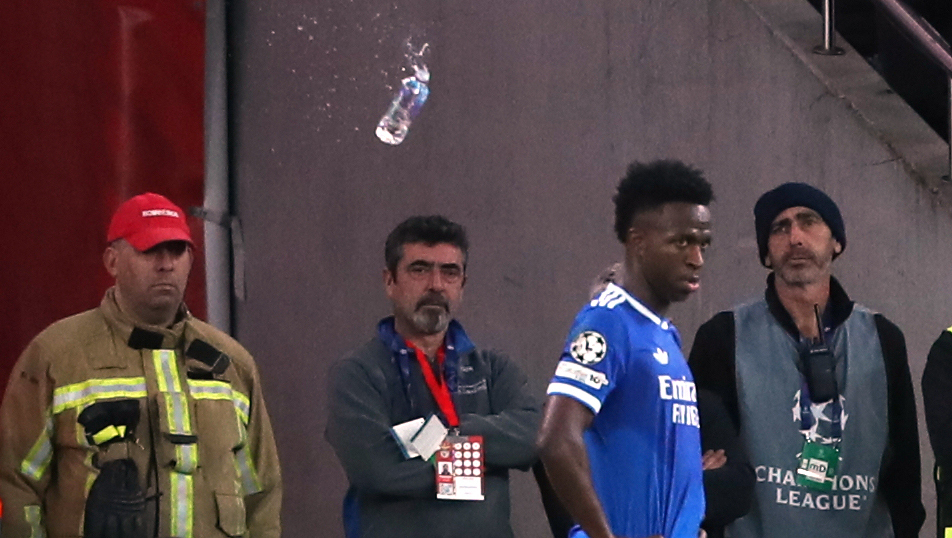
A plastic bottle filled with water is thrown from the stands toward Real Madrid's VinĂ­cius JĂșnior during a Champions League playoff soccer match between Benfica and Real Madrid in Lisbon, Portugal, on Tuesday. Picture: Pedro Rocha/AP

As in society, racism is not a “minority problem” in sport; it is sport’s problem. Yet again this week, football and rugby offered the same weary script: A black athlete performs, a loud cohort responds with dehumanising abuse, and institutions reach for slow-moving processes.

On Tuesday night in Lisbon, Real Madrid’s VinĂ­cius JĂșnior alleged he was again racially abused during a Champions League match against Benfica, prompting a stoppage and a Uefa investigation. Whether the allegation concerns a player, supporters, or both, the wider point is inescapable: VinĂ­cius has been forced, repeatedly to be both footballer and campaigner, asked to prove what he says he heard, to relive it publicly, and to keep playing regardless.

The reflex to frame his complaint as provocation — even to suggest racism “always happens” where he plays — is not merely wrong; it is the social permission structure that keeps this ugliness alive.

Ireland is not immune. Edwin Edogbo’s Six Nations debut against Italy should have been a simple sporting milestone. Instead, racist replies appeared under social media posts celebrating him, prompting condemnation and an IRFU investigation. It is telling that the abuse did not require a stadium, a crowd, or anything beyond a username.

So, is enough being done? Too often, enough is being said. Clubs and unions issue statements. Platforms “review” accounts. Governing bodies appoint ethics inspectors. Meanwhile, victims are expected to show resilience, as if toughness were the appropriate response to racism rather than the minimum requirement of decent administration.

Ebun Joseph’s first annual report as Ireland’s special rapporteur for racial equality and racism lands at a moment when complacency is dangerous. Published this week by the Department of Justice, it points to accountability gaps and uneven engagement across Government in tackling racism, warning that a whole-of-government approach cannot work when parts of Government opt out.

Sport sits within that wider ecosystem. When leadership is patchy at the top, it becomes easier for bodies lower down to treat racism as a PR problem rather than a rights issue

The truth is that eradicating racism is difficult because it is sustained by ordinary systems: The lack of swift sanctions, the friction of reporting, the absence of visible consequences, and the instinct to protect brands over people. If perpetrators believe they will face little more than a temporary suspension or a deleted post, the message is clear: Carry on.

Real action looks like faster investigations with transparent timelines; meaningful stadium bans; criminal referrals where warranted; unions and clubs funding player support as standard, and social platforms compelled to co-operate quickly with law enforcement, not at their leisure. It also means leaders — managers, commentators, administrators — stopping the rhetorical hedging that turns “alleged” into “doubt” and “context” into excuse.

Sport sells itself as a meritocracy. It cannot keep doing so while allowing racism to remain a recurring subplot. For VinĂ­cius and Edogbo, and for those watching, the question is simple: If this is what happens when you break through, why would you really believe you truly belong?

HSE apology too little, too late after Camhs review

The publication this week of the latest review into Child and Adolescent Mental Health Services (Camhs) in North Kerry is yet another chapter in a shameful saga.

For too many families, the shock at the scale of systemic failure revealed in the report will be matched only by the bitterness that years of anticipation have delivered little confidence that youth mental health care in this country is now fit for purpose.

The review found that more than half of the 374 cases examined showed a potential for significant harm arising from prescribing practices, inadequate assessment and monitoring, and a lack of psychotherapeutic intervention.

The service delivered was far below national standards, but the message from the HSE — an apology and a promise to implement recommendations — is familiar and hollow. It feels painfully like too little, too late. 

Families in North Kerry were told that this report would bring clarity and closure; instead the delays and opacity have deepened mistrust. There is no dedicated redress scheme akin to that established for the South Kerry Camhs scandal, where hundreds of children suffered unnecessary harm and have since applied for compensation following the Maskey findings.

Across Cork and Kerry, long waiting lists — with hundreds of children waited more than a year for an appointment — highlight that this is not an isolated lapse but a crisis of capacity and oversight. An apology cannot be a substitute for accountability, nor can recommendations alone restore faith. The State must now deliver swift, transparent action: Funding, real oversight, and concrete reparations where care has done more harm than good. Our young people deserve nothing less.

US in crisis — to what end?

The world watches in weary disbelief as the US cycles from one geopolitical crisis of its own making to the next under Donald Trump, from Venezuela to Greenland, Cuba and now Iran. What was sold to American voters in 2024 as a promise of “no new wars” and an end to interventionism has instead become a foreign policy defined by raw power projection and near-constant brinkmanship.

This week, the spectre of military strikes on Iran looms large as the US deploys its carriers and combat aircraft to the Middle East, signalling potential offensive operations should nuclear talks falter. For observers, it evokes dĂ©jĂ  vu — a repeat of the same cycle of escalation that has marked this administration’s first year in office.

Critics note that Washington’s interventions — whether in Venezuela’s leadership, Greenland’s sovereignty, or now Iran’s security — resemble an imperial playbook reimagined for the 21st century, driven less by clear strategy than by mood swings and showmanship. It is exhausting, and existential. Nations are not chess pieces; civilians are not collateral for ego-driven geopolitics. If this is only year one, where — or when — does it end?

x

More in this section

Revoiced

Newsletter

Sign up to the best reads of the week from irishexaminer.com selected just for you.

Cookie Policy Privacy Policy Brand Safety FAQ Help Contact Us Terms and Conditions

© Examiner Echo Group Limited