Irish Examiner view: Tourism policy places too much reliance on tech tomorrow
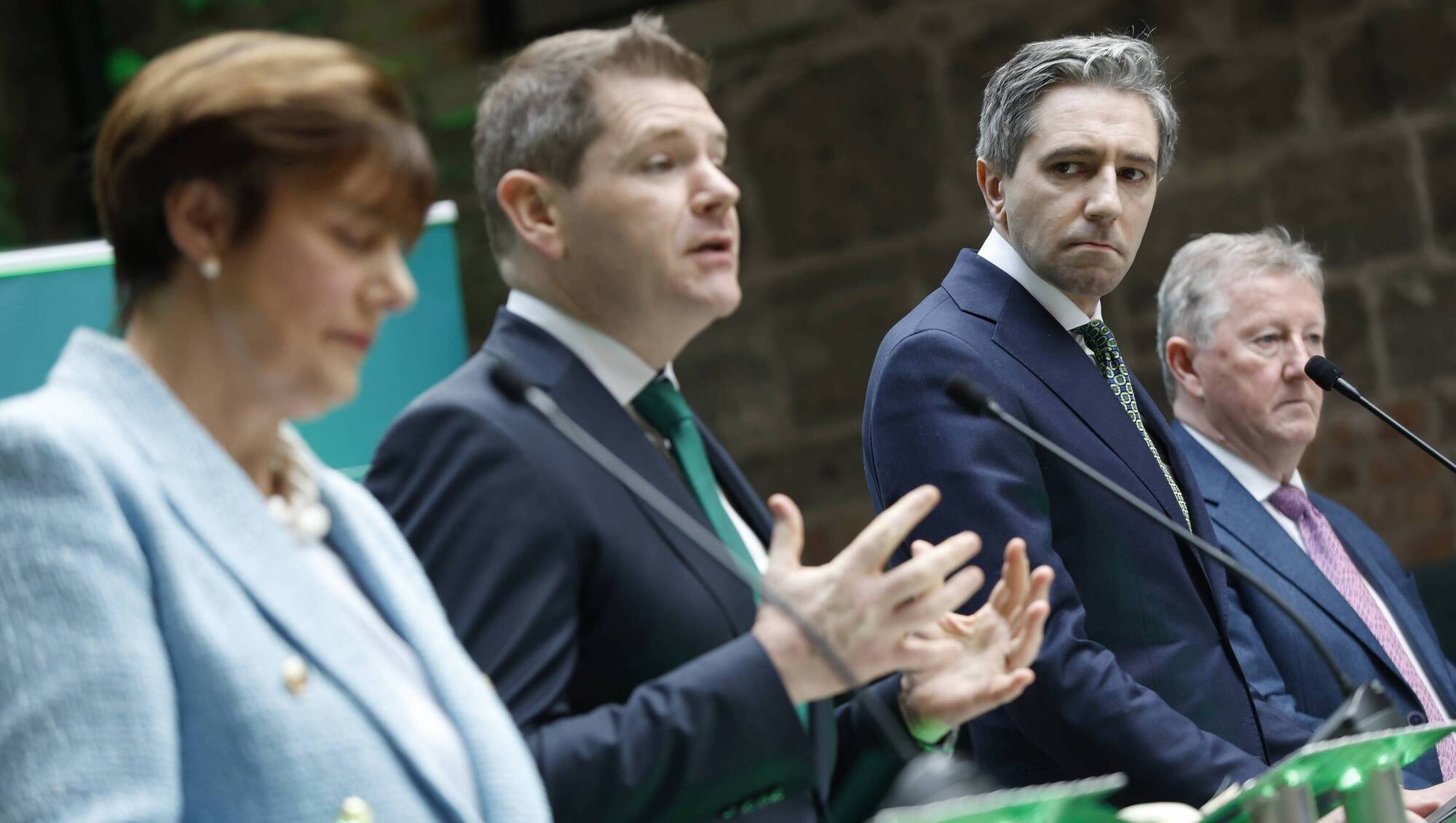
Enterprise, tourism, and employment minister Peter Burke launching Ireland's new National Tourism Policy Statement at Belvedere House, Mullingar, flanked by minister Norma Foley, Tá¡niste Simon Harris, and minister Seán Canney. Picture: Julien Behal Photography
So many acronyms and abbreviations — more than 30 — are used in the Government’s new 92-page National Tourism Policy Statement that it is necessary to open proceedings (after the foreword from the relevant minister Peter Burke) with a glossary to explain them.
Amidst the alphabet soup of CCMAs, DEDPs, EGFSNs, and the like, at least one is notable by its absence. BHAG. We do have what business consultants and tech bros like to describe as a Big Hairy Audacious Goal. It’s just that we’re not vulgar enough to describe it as such.
Within the National Tourism Policy Statement (NTPS) is a target to increase Ireland’s tourism revenues by 50% in six years, a stretching objective that would make even the most gung-ho sales manager blink and check the small print on their bonus scheme.
The NTPS sets out 75 aims to grow Ireland’s take from tourism to €9bn from 2024’s €6bn, with annual compound growth of 6% on average.
The development of state-owned land for tourism use, and new regulations in the currently contentious area of short-term lettings, are two of the levers which business strategists hope to pull.
Much attention has been drawn to eye-catching promises to develop culinary tourism. The report acknowledges that “many overseas visitors arrive with modest expectations”, which is a damning indictment of poor, or under-invested, marketing of this sector to date.
While we plan to “deepen and defend” key North American and British markets, there is renewed attention on attracting visitors from the Gulf and Asia.
After launching the tourism strategy in Westmeath, Mr Burke, accompanied by fellow ministers Darragh O’Brien and Robert Troy, beat a path to Dubai on Wednesday seeking Emirati investment and an expansion of our exports into the UAE to reach a reported €50bn by 2029.
With this emphasis on high-value customers from overseas, it is natural that forecasts are predicated on lifting the constraints at Dublin Airport and ensuring that other airports contain sufficient capacity. And this is one of the areas, like accommodation, where ambition jostles with other realities.
When the masterplan talks of “supporting connectivity” through a new “Strategic Air Access Programme”, it makes the bold claim that tourism-related emissions will be cut by 45% by 2030.
It also suggests that 90% of tourism’s small and medium enterprises will be using “advanced” digital techniques by 2031. It defines these as “booking platforms, customer relationship management, and augmented/virtual reality” before diverting into La La Land and the golden promises of “AI-driven tools for personalisation, automation, or predictive analytics”.
The report’s authors place way too much emphasis on AI as a panacea to the challenges of a vital industry which relies mainly on value, service, a warm welcome, hospitable locals, available bedstock, and natural attractions. Meanwhile, it saddles tourism with much heavy lifting to meet the “broader goals of government”. These include climate action, digital transformation, competitiveness, market diversification, balanced regional development, economic resilience, community wellbeing, sustainability, innovation, and inclusive growth. That’s quite the shopping list for the small B&B in Allihies to deliver.
There are several references proclaiming the need for “evidence-based” policies aligned with broader national priorities. Perhaps a useful, and small, step in that direction would be to bring an end to the bickering over the accuracy of visitor numbers which has prevailed throughout 2025.
The next monthly figures, for November, are likely to drop in the twilight zone between the end of this month and the beginning of 2026. But a good start to the New Year would be to agree on a common way of counting money and visits. If we can’t establish the metric for this, there is little hope of us, or indeed the power-hungry AI, managing the big picture.
With dire reports of hostile drones over the Irish Sea, grim predictions of the impact on food supplies if there was ever an attack on Dublin Port, and warnings that our tech sector has been targeted by what used to be known as “Fifth Columnists”, readers would be forgiven for offering up a sigh and reaching for a restorative of some description as the year peters out.
In truth 2025 has not been a classic year: The situation in Gaza remains deeply depressing, and is likely to continue to be so; the war in Ukraine remains unresolved and will stay that way, and AI has begun to reveal its incipient threat to employment. Donald Trump is doing what Donald Trump does. Domestically, the housing crisis, and the civil unrest which is its bedfellow, run through political life.
And yet we must retain some perspective and proportion. If you ask Chat GPT to define the bleakest years of Irish history it will list 1847, the infamous “Black 47”; 1348 (Black Death); 1798 (the “Year of Rebellion”); 1916-1923 from the Easter Rising to the end of the Civil War and 1972, the worst year of the Troubles. We could say 2008, with economic collapse, and 2021, the moment of peak covid, were the worst of contemporary times. Both are behind us now and it is incumbent to dwell on our many blessings and to set aside the corrosive influence of the aptly-named “rage bait” and its partner in crime, “doom scrolling”. We might also remember the exhortation of the poet Tennyson in his religious poem Ring Out, Wild Bells:
“Ring out false pride in place and blood/ The civic slander and the spite,/ Ring in the love of truth and right,/ Ring in the common love of good.” Sound advice as 2026 waits in the wings.
We will be the happier if we follow it.
Given the competition for captains of industry these days it is perhaps encouraging that RTÉ’s director-general, the Cambridge-educated Englishman Kevin Bakhurst, has confirmed he has not applied for the top job at the BBC, an organisation with which he is hugely familiar and which is badly in want of a steady pair of hands and politically sensitive antennae.
Turning a potentially tricky Oireachtas media committee question into a light joke — “I don’t think I can leave because Marty Morrissey says I’m not allowed to leave” — was one example of this expertise.
So was his other response: “I haven’t applied, and I’m very happy doing this job. That’s all I can say, that’s where we are.”
Given that Mr Bakhurst has been relatively adept so far in keeping RTÉ away from the storm and stress of the sensational headlines which preceded him, and did for his predecessor Dee Forbes, it is easy to imagine that his avowed lack of interest in becoming the 18th BBC DG will come as a relief in Dublin.
Except, as most people know, this is not how top jobs are handed out these days.
There’s something quaint in the concept that interested individuals have to “apply”, dashing off a few pars of self-justification alongside a storied CV and list of achievements followed by a skilful negotiation of the interview process.
Most senior appointments in business and politics tend to begin with a pat on the shoulder; a suggestion that there might be something “of mutual interest” to discuss; a sounding out of terms, conditions, availability and timescales. Only then, “if you’re willing old boy”, will the dialogue progress.
Whether Mr Bakhurst’s ambitions point eventually to Portland Place we have no way of knowing. But this would be a bad moment to lose him.
While the political fallout from the secret payments scandal has been managed into the past there are still way too many people withholding their licence fees.
This is ostensibly an act of protest over previous transgressions but the reality is that this is both a self-serving, and a selfish, argument.
A healthy democracy requires a public service broadcaster, and that organisation must be required to set a gold standard against which others can be measured.
Recovering public confidence is a principal task for Mr Bakhurst and that work has some way to go. It will not be delivered alone by populist gestures such as withdrawing from Eurovision.
He will have to steer the organisation through the stormy waters of restructuring, outsourcing, and a voluntary redundancy programme which could affect as many as 400 workers. Emerging from a financial deficit is but a beginning.
Reforming RTÉ, and saving it from the consequences of decisions made by previous managements, may seem on occasions to be somewhat like cleansing the mythical Augean stables.
Mr Bakhurst and his senior team should be aware that Hercules stayed on in Elis in ancient Greece until the job was complete.
Only then could he move on to his next labour.

CONNECT WITH US TODAY



Be the first to know the latest news and updates