Ireland’s new tourism policy: Experts warn food tourism and revenue targets face challenges
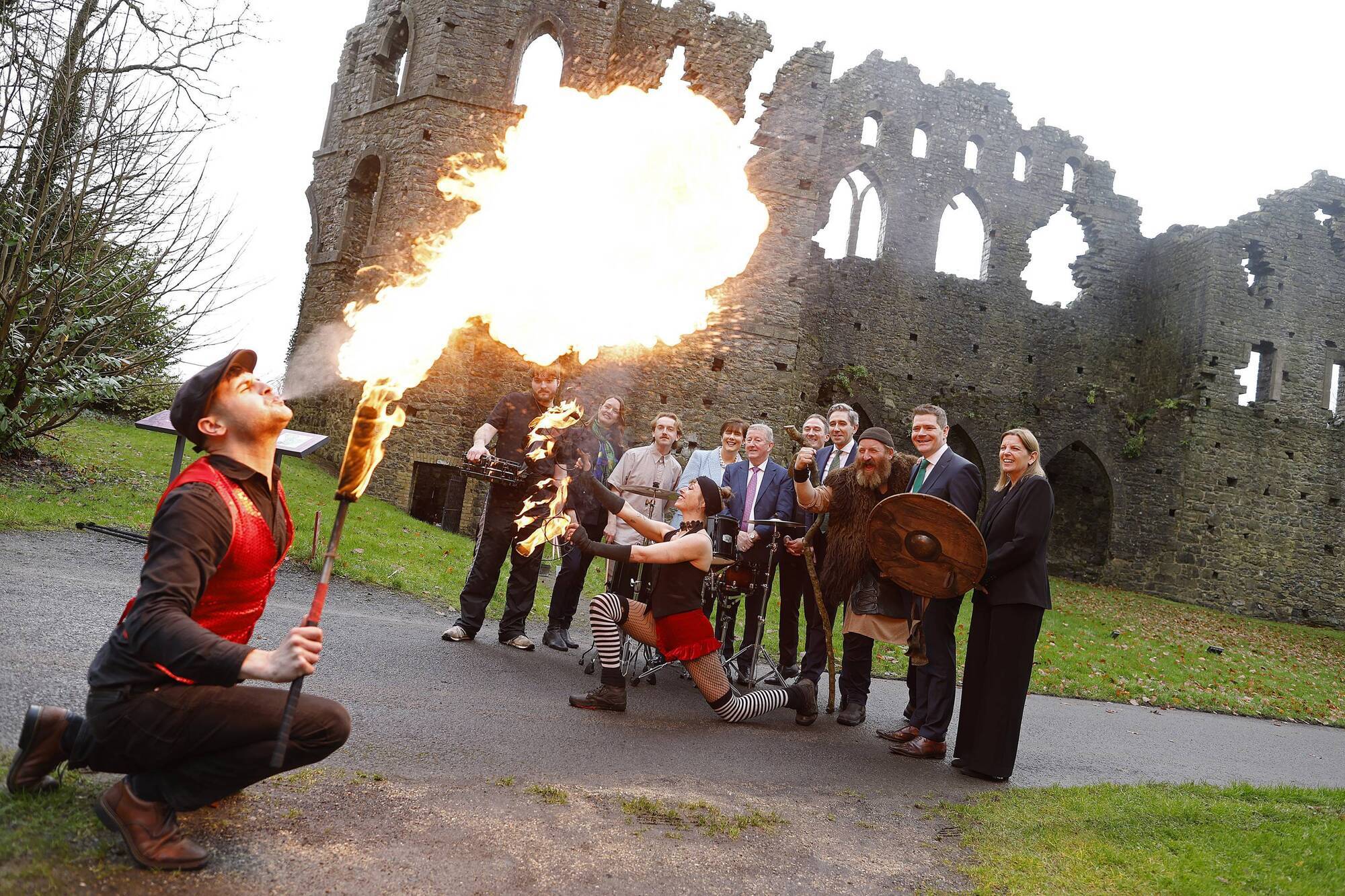
Minister for Enterprise, Tourism and Employment, Peter Burke, launched Ireland’s new National Tourism Policy Statement, A New Era for Irish Tourism, at Belvedere House, Mullingar on Monday. At the launch were perfromers from Broken Theatre with Mr Burke, Tanaiste Simon Harris, Minister for Children, Disabilty and Equality, Norma Foley, and Minister s of State Sean Canney and Alan Dillon. Picture: Julian Behal
Fire breathers, dancers, drummers, and an army of Government ministers. The launch of Ireland’s new National Tourism Policy statement this week lacked nothing in spectacle.
In front of the historic surrounds of 18th-century Belvedere Castle in Mullingar, Co Westmeath, the policy statement A New Era for Irish Tourism was launched with fitting fanfare.
Now grouped under the Department of Enterprise, Tourism and Employment, Minister Peter Burke set out a bold outline for the future direction of the sector.
There was a universal welcome of the targets set out in the document, which includes 71 policy proposals, including developing regional tourism and seasonality. Nevertheless, how the targets are achieved will be the real test.
Developing culinary and food offerings within Irish tourism has been given a renewed focus under the new policy, with a commitment to develop food-related tourism. Food and drink now accounts for 34% of total visitor spend for visitors to Ireland, highlighting its importance in the overall tourism experience and to the income generated by visitors.

It's logical to want to exploit such a valuable income, but UL professor of tourism studies and director of the National Centre for Tourism Policy Studies, Jim Deegan, said there are complications and deeper questions for the industry.
Mr Deegan says culinary and food tourism now faces the unwanted added ingredient in the mix with the rise of weight loss medication. “In the age of drugs like Ozempic and Mounjaro, developing food tourism is going to be an even greater challenge,” he said. “More Americans are going to be coming here who are going to be on a health kick. More of them will be sharing a starter or not having a starter. They won’t be having that dessert.
“When you talk to people in hotels, a lot of the spending that went up in recent years had been on things like wine, like starters. But weight loss drugs mean many won’t be spending on these.”
John D Mulcahy is a gastronomy tourism researcher and advisor, whose book The Encyclopaedia of Food in Ireland is due for publication next year. Mr Mulcahy previously worked as head of food tourism, hospitality education, and standards at Fáilte Ireland.
Like Mr Deegan, he welcomes the new policy statement. Like Mr Deegan, he sees challenges. Mr Mulcahy said that food tourism, as opposed to food tourism, is the clearest way Ireland can develop the industry. "Food tourism, where food is the motivator, is where somebody gets up in the morning and says, I want to go to Naples, and I want to eat pizza or I want to go to Dijon to try out Dijon mustard. Nobody in the world gets up and says I'm going to go to Ireland to eat potatoes or eat bacon, or eat beef. A very small percentage might say I want to try spiced beef. But every tourist has got to eat a couple of times a day - so what are we doing about the quality of the breakfast that you get in some hotels, beyond the buffet that's been there for two hours? How are we elevating the food in tourism?
“Culinary tourism is more niche. It's where you want to do a tour or classes, or you want to visit food producers. Frequently, those small food producers don't see themselves as being in tourism. They see themselves as in the food business - they're in retail.

"What matters to them is the day-to-day business from the locals: that's their bread and butter, because if they don't get that, they won't be there in the summer for the visitors."
The new policy document prepared by the Department of Enterprise, Tourism and Employment does state that Fáilte Ireland will launch a programme of strategic supports for relevant businesses aimed at "improving profit margins, growing demand, and enhancing revenue and brand reputation".
Mr Mulcahy says, "In every parish, small mom and pop operations have got to be encouraged. We've got to find some way of helping them survive. And that doesn't mean increasing the visitor numbers to 9m. It's about elevating those small businesses to survive and then add in the cream of international tourism. And to me that's the key.”
states that the total expenditure of Irish residents travelling overseas exceeds the amount generated by overseas visitors to Ireland. In 2024, Irish residents took 13.7m outbound overnight trips, totalling 81.2m bed nights. "Promoting a substitution of a part of these overseas holiday breaks for a domestic holiday will be a key focus in developing our regional tourism offering, as it would represent a significant boost for the Irish tourism sector," says the new policy document. A target for domestic tourism revenue growth to €5.8bn by 2031, with an annual growth of 7% on average per annum in domestic overnight trip revenue from €3.6bn in 2024 has been set.
Mr Deegan welcomed the targets but said the policy document takes no serious account of the value of a hidden backbone of the Irish tourism industry: daytrippers. The CSO Household Travel Survey for Q1 2025 shows that Irish residents on domestic same-day trips had an estimated expenditure of €317.9m. "Most businesses are heavily reliant on domestic day tourism to survive, particularly visitor attractions," said Mr Deegan.
"The CSO has data on the expenditure of tourism day visits, so I don't see why it has not been included. I live in Killaloe, and it gets a lot of international tourists. But we pray for a sunny day, because then the day trippers come. They eat in restaurants, go to pubs, and have a meal in a hotel. It's vital expenditure.
"Tourism day visits are the lifeblood sustaining tourism visitor attractions. The Irish population has grown so likely we will have more day visitors. I think it's an omission if you have targets without them. An estimate of that tourism is vital."
Mr Deegan believes there is a lack of strategic analysis to back up the targets. Working at UL, he created a tourism dashboard project at the Cliffs of Moher, which gave real-time visitor data through wifi data, ticketing system information, and intensive surveys. Such programmes could be extended in Ireland to give actionable data.
“I would like to have seen a much greater analysis of what has been happening in the Irish tourism industry, in terms of individual markets, and what is causing seasonality," said Mr Deegan. "I personally would like to see more focus on productivity in tourism. Ireland faces competitive challenges, regularly highlighted by Frances Ruane at the National Competitiveness and Productivity Council (NCPC).
"If we had good analysis of our data over time, the competitiveness issue would be much clearer and would have a great line of sight for targets for each market.
“We live in a world now of smart tourism, which reflects connected devices, mobiles, and wearables. These are big data projects, but you need data analysts. Think back to covid and how data analysts were used. The tourism marketplace has changed. I believe universities should be on board, and people who handle big data. Research is mentioned in the strategy but only in context of Fáilte Ireland, not deep research. They need a clear strategy of data and we should not be waiting five years; it should be now.”
Mr Deegan also noted the plan targets an increase of 15% in overseas visitor numbers of up to 1m per annum over the lifetime of the plan but a 50% increase in revenue – another big ask. “I cannot see how a 15% increase in numbers could turn out to be 50% increase in revenue, given constraints in the market, shorter stays, European economic issues, and currency exchange rates. Is the 50% revenue increase in real terms (accounting for factors like inflation) or are we talking nominal revenue - because if it is not real revenue, the target might not be that ambitious at all."
The new policy document for Irish tourism may lack deeper analytic data, so the journey is rocky, but it has set a destination.
Catherine Flanagan, chief executive of the Association of Visitor Experiences and Attractions (AVEA) hailed the renewed focus on delivering the best visitor experiences. Avea represents 120 experiences in Ireland of all sizes; from the Guinness Storehouse to Cobh's Titanic Experience, from Fota to Foynes, Muckross House to Midleton Distillery.
“From a business-owner’s perspective, we are encouraged by the reference to support for tourism SMEs, including digital excellence, to grow their resilience and profitability. Margins in visitor attractions are wafer-thin, and Avea members have to work very hard to keep visitor numbers up, especially outside of the tourist hotspots, and to offer value for money for world-class experiences. Business overheads remain the greatest challenge our members are facing.”
The Irish Hotels Federation chief executive, Paul Gallagher, said on the back of the decision to reduce Vat on food services for hospitality businesses, the new policy statement also builds on the decision earlier this year to move the tourism portfolio to within a reconfigured Department of Enterprise, Tourism and Employment.
John D Mulcahy agrees putting tourism into an economic-focused ministry is a positive development. "Tourism is a kind of an orphan department. It bounces around the place," Mr Mulcahy said. "Look at where it was last - in the ministry for everything: tourism, culture, arts, Gaeltacht, sports, media. The message that sent was that it wasn't valued. It's now seen as an economic ministry; therefore it has value."
As tourism minister, Peter Burke has said the document sets the course of direction and the areas for investment for the next five years. "I firmly believe that untapped potential exists in many parts of the country, and this policy is designed to unlock that opportunity. We want every community, from urban centres to rural heartlands, to benefit from tourism’s growth and ensure Ireland is the best location to visit in Europe," said Mr Burke.
Mr Mulcahy says Ireland's food offering has developed considerably in many ways in the past decade. "There's two Michelin-starred restaurants down in West Cork. If I had said 10 years ago, there was going to be two Michelin restaurants down in West Cork, I would have been laughed out of the door." But he believes developing food tourism needs to be a long-term plan, "even a 10-year plan. A short-term short election cycle of two or three years is not going to swing it. This policy that's been issued by the minister is welcome but might only be alive for as long the government's there."
Tourism Targets
• Overseas tourism revenue to grow to €9 billion by 2031 representing a 50% increase on €6bn in 2024 (+6% on average per annum excluding carrier fares);
• Domestic tourism revenue to grow to €5.8 billion by 2031 with an annual growth of 7% on average per annum in domestic overnight trip revenue from €3.6bn in 2024. The target for overseas and domestic revenues combined is to increase from €9.6bn to €14.8bn by 2031;
• A minimum annual increase of 7% in visitor numbers in less mature tourism destinations;
• At least 250,000 employed in tourism industries by 2031 (up from 228,800 in 2024);
• At least 90% of tourism-related SMEs adopting advanced digital tools by 2031