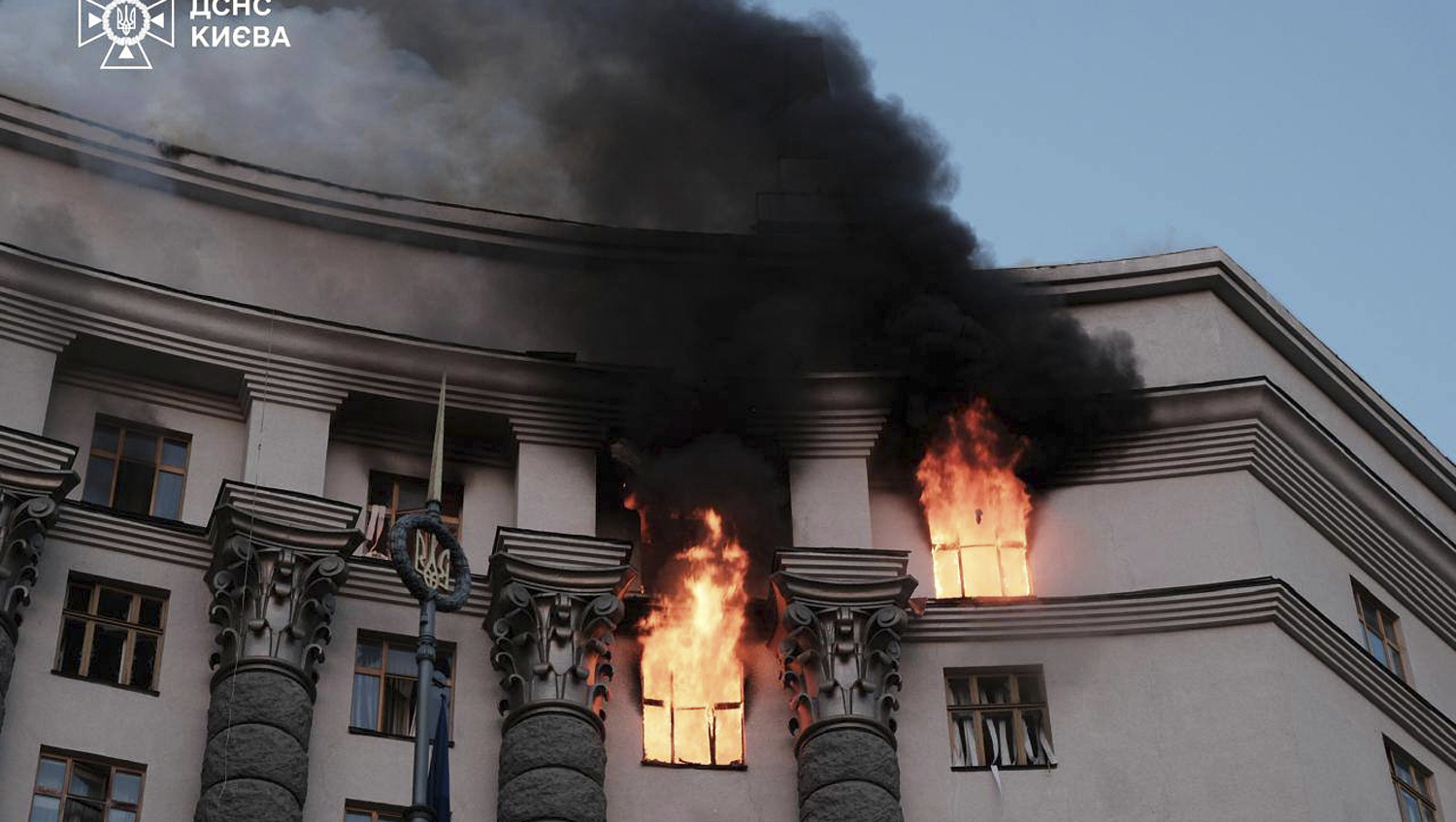
The ongoing conflict in Ukraine has been grinding away for so long now that newer stories, such as the savagery in Gaza, have overtaken it in the popular imagination. Developments this week may soon change any such pecking order in terms of urgency, however.
Following an incursion by Russian drones into his country’s airspace, Polish prime minister Donald Tusk has stated Poland is now closer to war than at any time since the Second World War. Ukraine had warned Poland about the approaching drones, prompting the latter to scramble both war planes of its own as well as Nato aircraft, place air defences and radar on high alert, and temporarily close some airports.
This event does not occur in a vacuum either. Poland was due to close its border with Belarus today because of aggressive manoeuvres by Russian and Belarussian forces.
By any metric, Poland’s response to the drone incursion is a serious mobilisation of its defences, and it is difficult to over-state the significance of this escalation. By intruding into Polish airspace, Russia is confronting not just Poland or Europe as a whole, but Nato itself — a step which would have seemed unimaginable just a few short years ago.
The clue to the significance is in the words which make up the acronym — the North Atlantic Treaty Organisation, with the last two words underlined heavily in red pen. The presence of a treaty means commitments which bind countries to act in concert when faced with aggression.
Historians will no doubt be keen to point out that eastern Poland has a grim history as a global flashpoint, but the future is what will concern observers now. It was only last week that US president Donald Trump was pledging to stand with Warsaw and declaring he had no intention of withdrawing US troops from Poland; this week’s events have now given that commitment a different significance entirely.
At this delicate time, however, it is worrying to contemplate who the world is relying upon to de-escalate this situation.
Systemic change needed in mental health services
A public consultation carried out by the Department of Health recommends an alternative approach to helping those experiencing a mental health crisis.
As reported here by Cormac O’Keeffe, those who have been affected by suicide agree that emergency departments are “dehumanising and retraumatising” for people who are in a suicide crisis.
Those involved in the consultation — about 1,900 people responded — stated that alternative systems should be provided, pointing out the importance of providing proper services to people in a mental health crisis.
Many readers with experience of our health system will no doubt agree that experiencing an emergency department can be challenging — often such departments are understaffed, overcrowded, and chaotic, and it is entirely inappropriate that those should be the first point of contact for people seeking urgent treatment while experiencing a mental health
crisis. (It is worth acknowledging, of course, that such emergency departments, which have patients waiting for hours on chairs and trolleys, are inappropriate for people no matter what they are presenting with.)
There has never been more open, honest discussion of mental health, or more work done to remove any stigma attached to mental illness. That work only serves to make the irony here all the more piercing: Those experiencing a serious
mental health crisis are plunged into a system which is clearly focused on treating those who have been involved in physical accidents rather than those experiencing a mental health emergency.
One positive from this consultation is that alternatives are being proposed, as mentioned above. Those include the recommendation from healthcare professionals that “calm, specialised 24/7 spaces” for suicidal individuals be provided — a sharp contrast to what those professionals described as emergency departments’ “long queues, poor staff training, and a lack of designated safe spaces”.
Such fundamental changes are the key to improved services and outcomes. If we are truly committed to improving mental health, then we must commit to such changes.
What's next?
There was a flicker of hope for Irish soccer fans last weekend when the Boys in Green grabbed a late equaliser against Hungary, which made the despair after Tuesday night’s defeat by Armenia all the worse.
Ranked 105th in the world, Armenia made light of their lowly status to win 2-1 — and it might have been 3-1 if not for a marginal VAR call late in the game. Despair is about right.
The sense of disappointment was shared by the players, to judge by the comments of Ireland midfielder Josh Cullen (“I’m pretty embarrassed to keep coming out and having to say the same thing. I’m angry, disappointed, all those sort of things.”), but an explanation for the defeat is also being sought.
Manager Heimir Hallgrímsson has been in place for just 12 matches, but the defeat by Armenia makes Ireland’s chances of qualifying for next year’s World Cup so remote that there must now be some doubt about Hallgrímsson’s future, as he acknowledged himself this week: “When you have a performance like this, the head coach’s job is under question, that’s just the name of the game.”
The Iceland native’s candour is commendable, but the possibility of his departure also raises a wearying prospect — the hunt for an affordable replacement, an experience which could make the morning after the Armenia defeat look like a honeymoon.

Cancel anytime
CONNECT WITH US TODAY
Be the first to know the latest news and updates