Irish Examiner view: Learning to plan for the ‘dark doldrums’
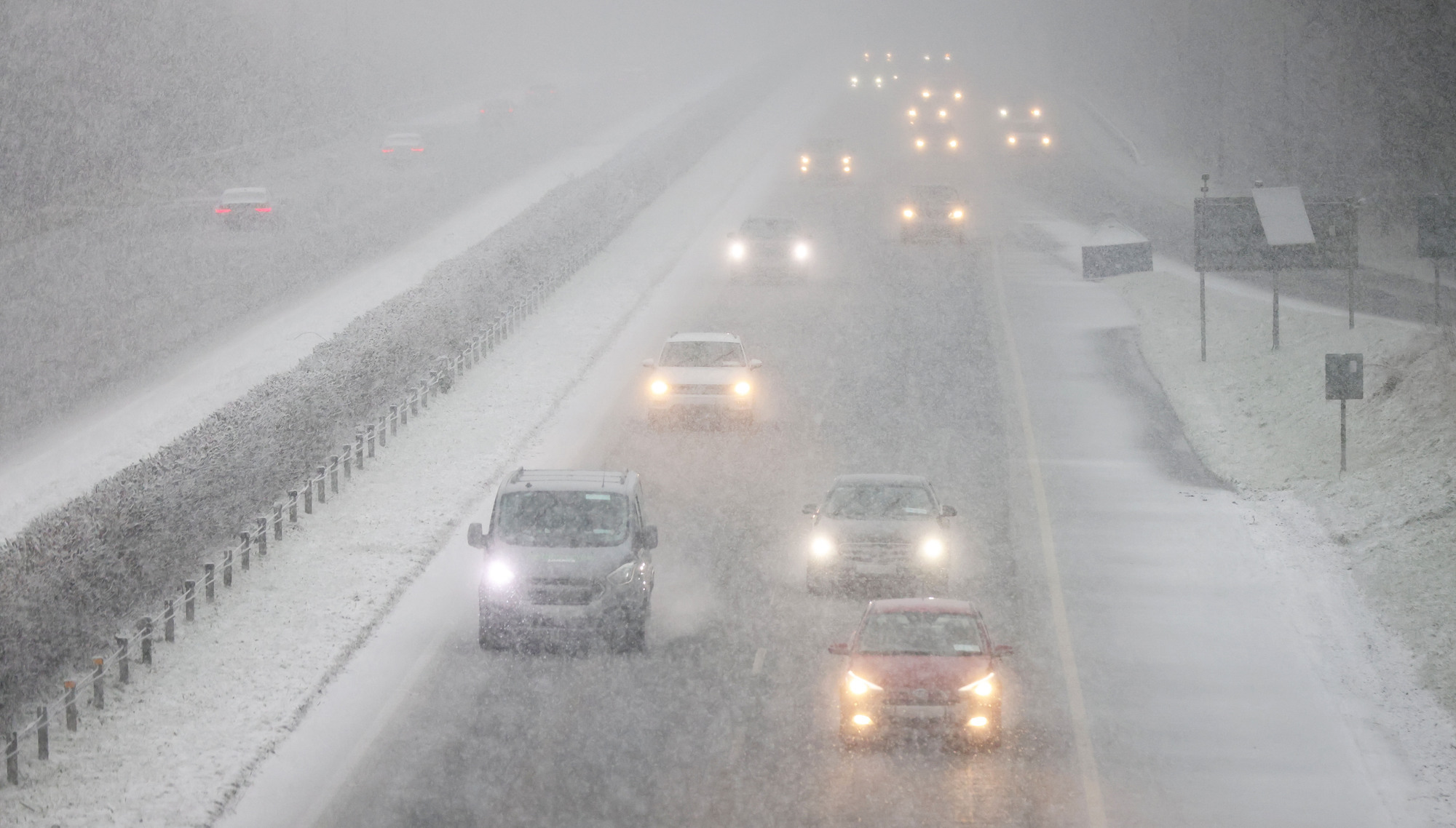
Difficult driving conditions for motorists heading south on Sunday, as heavy snow falls on the M7 motorway in Kildare. Picture: Eamonn Farrell / © RollingNews.ie
Caught in the middle of what we must learn to call a “multi-hazard weather event”, it is a nod to the future to learn that more than two thirds of all schools now either have solar panels installed or have gone to tender for the project.
Since the first phase of the solar for schools programme was launched in 2023, more than 1,000 have been installed across 11 counties. Since October, when the scheme was extended nationwide, more than 1,660 schools have successfully entered the tender stage of the €50m process.
While the nation has been shivering amidst a cluster of orange and yellow snow and ice warnings, with predictions that temperatures could fall as low as -10C by tomorrow night, it may be the moment to familiarise ourselves with a weather concept that will assume greater importance in years to come.
Linguists will recognise it as a description which is Germanic in origin. Welcome to the Dunkelflaute, which can be translated as the "dark doldrums", a meteorological pattern in which dense clouds settle over Northern Europe.
Here in Ireland, we are well used to the dark doldrums, but when solar power becomes increasingly central to our plans for net zero, it may have us glancing anxiously to the heavens and searching our wallets to pay increased charges.
While power from the sun and the wind does not rely on fossil fuels, a still and murky period means that a shortfall in renewables has to be compensated by purchases on the energy market which are usually drawn from backup, and traditional, plants.
At times of scarcity, as we witnessed after the Russian invasion of Ukraine nearly three years ago, competition among countries pushes prices up.
A German Dunkelflaute in mid-December caused electricity prices to jump temporarily to 14 times their seasonal average. One which lasts weeks “can have potential impact on security of supply”, said an official of Britain’s National Energy System Operator last month. Provision from Britain is of fundamental importance to us.
The volatility caused by the connected nature of international supply networks was demonstrated when Ukraine closed the last route allowing Russia to sell gas to Europe through its territory. On Thursday, the benchmark European gas price hovered at around €50 (£41) per megawatt hour, the highest level since October 2023.
That increase is a consequence of human intervention by warring political leaders. But the influence of mother nature is different. We are all used to it giving us a kick up the backside from time to time. A Dunkelflaute will enable it simultaneously to slip its icy fingers into our pockets.
The case for a complete overhaul of Ireland’s sclerotic planning processes called another witness this week with the ’s report that proposals for 1,300 apartments could face a decade-long delay.
Just before Christmas, An Bord Pleanála refused planning to Goulding Fertiliser for the construction of an agricultural fertiliser facility and additional use of the jetty at Marino Point near Belvelly, on Great Island, Cobh.
The inspector turned it down because of worries about the increase in heavy goods vehicles using Marino Point and subsequent adverse impacts on the local traffic network. A particular pinch point is the 222-year-old Belvelly Bridge.
The refusal blocks Goulding’s plans to relocate from Cork’s docklands, making its Centre Park Rd site available for an ambitious €600m project from O’Callaghan Properties which has already won approval from the city council. It is described as Ireland’s largest brownfield regeneration scheme.
Cork County Council, which granted conditional planning to Goulding’s Marino Point project, acknowledged the strategic national importance of moving port-related activities out of Cork City’s docklands.
But the inspector was unconvinced. Her appeal report states: “The proposed development is for a fertiliser facility that is entirely reliant on a road network for its distribution of outputs, yet entails the relocation of such freight activities from Cork docklands area — which has reasonable access to the national road network — to a location at Marino Point which has poor road connectivity, and the development of which is identified as being subject to significant road improvements in the Cork County Development Plan 2022-2028.”
The inspector’s report notes that despite the fact that a rail line crosses the Marino Point site, the Goulding proposal has no opportunities to make use of rail-based freight distribution.
Critics say rail is not tenable “given the logistical requirements to distribute to individual farms throughout the region”.
Whatever the truth of that, and whether it would be impossible to conceive of another distribution point, it is beyond argument that the road network is not adequate for major industry and, upon that fact, a hugely important national initiative runs the risk of foundering. It may feel counterintuitive, in an era where the drive is for net zero, to be undertaking road investment, but it may be necessary to bite the bullet. It is a failure of process that it is taking so long to reach this realisation and decide on appropriate action.
It used to be claimed that soccer was the “working man’s ballet”. If there was ever any truth in that, the mantle has long gone. Working men, and a lot of women, are much more likely to be drawn to darts these days.
Many of them, some wearing silly costumes, could be seen in the raucous environs of London’s Alexandra Palace as Luke Littler became the sport’s youngest world champion, aged 17, pocketing prize money worth about €600,000.
Millions watched on TV as he thrashed Michael van Gerwen. Some 40% of the audience travelled from Europe to attend, with 58 nationalities in the crowd.
Littler, a likeable and modest Manchester United fan, has 1.5m Instagram followers and was the third-most searched person on Google UK in 2024 (beaten by Donald Trump and Kate Middleton). He still lives at home, and hopes to learn to drive later this year.
Good luck to Luke the Nuke. Unspoilt by fame and unfazed by media critiques of his teenage body mass, we will see plenty of him for years to come.
CLIMATE & SUSTAINABILITY HUB
CONNECT WITH US TODAY



Be the first to know the latest news and updates