Irish Examiner View: Israel has rebranded as terror state

Lebanese soldiers and firefighters gather outside a mobile shop after what is believed to be the result of a walkie-talkie exploding inside it, in the southern port city of Sidon, Lebanon, on Wednesday, September 18. Picture: Mohammed Zaatari/AP

Lebanese soldiers and firefighters gather outside a mobile shop after what is believed to be the result of a walkie-talkie exploding inside it, in the southern port city of Sidon, Lebanon, on Wednesday, September 18. Picture: Mohammed Zaatari/AP

By now we are accustomed to saying that the level of savagery in Gaza has reached a new nadir, unfortunately.

That level differs for people. For some it may be the targeting of hospitals by the Israeli defence forces, or that organisation killing aid workers. For others it may be the deaths of dozens of children in Gaza from malnutrition, or the appearance of polio in the area.

Now a development in the Middle East poses a different question: Do the attacks on Hezbollah this week mean that that savagery will now spread beyond the borders of Gaza?

Home solar energy systems and walkie talkies were exploding across Lebanon yesterday, but that was preceded by electronic pagers used by Hezbollah detonating across Lebanon and Syria. The pager explosions left at least 3,000 people injured and 12 dead, including two children, at the time of writing. Sources cited by Reuters and US media stated that Israel had planted explosives inside the pagers months ago.

It would be difficult to conceive of a better example of terrorism, if by that term we mean activity designed to spread terror among a particular group of people. Living with the suspicion that a device carried in one’s pocket or bag could suddenly explode, maiming or killing those nearby, is the very definition of terror.

It also plays on an identifiably 21st-century anxiety: That personal devices are somehow betraying their users, listening surreptitiously, storing information. The concerns most of us harbour relate to targeted advertising and personalised marketing. However, this week showed that such devices can also be adapted for use as bombs.

If Israel is responsible for these attacks, then this may be a watershed moment. Not so much because the countries affected can be expected to retaliate, but because the attack surely changes Israel’s status. 

By seeking to spread fear in this indiscriminate way, Israel has behaved as a terrorist state. There is no other way to describe it.

Variety is vital for democracy

News that The Observer, the world’s oldest Sunday newspaper, may be sold to Tortoise Media has caught the eye in several different ways.

Maintaining variety in the media is necessary for any functioning democracy. The potshots against traditional media outlets from authoritarian regimes, far-right agitators, and tech tycoons are clear evidence which support that thesis: Why else would those elements find an independent media so threatening?

Another interesting part of this story is Tortoise Media, the company seeking to buy The Observer. Itself a media site, Tortoise was founded by James Harding, former editor of The Times and former BBC director of news at the BBC, with the former US ambassador to Britain, Matthew Barzun. This week, Harding said of The Observer: “We believe passionately in its future — both in print and digital. We will honour the values and standards set under The Guardian’s great stewardship and uphold The Observer’s uncompromising commitment to editorial independence, evidence-based reporting, and journalistic integrity.”

Perhaps more to the point for Observer employees, Harding also promised investment of £25m-plus over the next five years in the title.

In prioritising the traditional principles of journalism, Harding was emphasising ideas which are not as fashionable now as they once were. Today’s landscape can be one of hot takes, passing orthodoxies, and toxic groupthink. The irony here is in the fact that the term ‘groupthink’ itself was a coinage George Orwell invented. Orwell was, of course, one of The Observer’s most famous contributors, whose scrupulous factual reporting stands in stark contrast to much of what is offered by today’s opinion-media industrial complex.

It is reassuring that a newspaper founded in 1791 remains relevant today. It is even more encouraging that a newspaper known for independence, integrity, and reporting could be getting a new lease of life to grow into the future.

Salvatore ‘Totò’ Schillaci
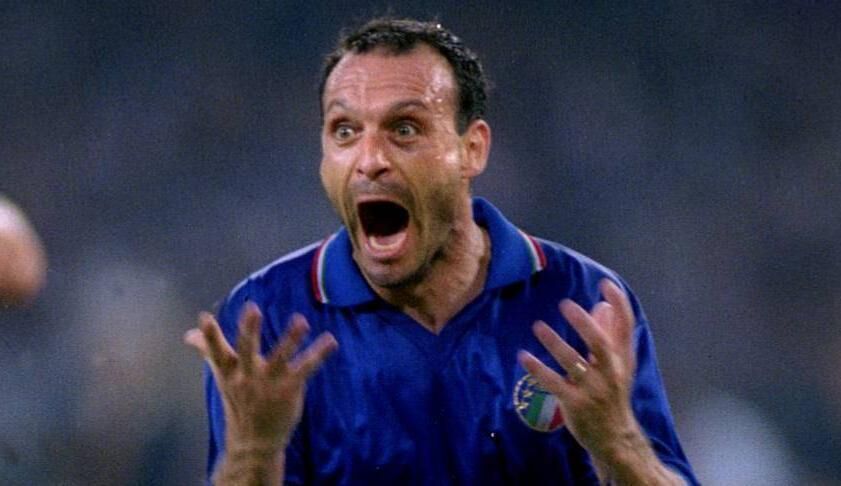
Salvatore Schillaci celebrates scoring against Argentina. Picture: INPHO/Billy Stickland

Sad news from Italy with the announcement of footballer Salvatore ‘Totò’ Schillaci’s death at the age of 59.

A native of Sicily, Schillaci played for Inter Milan and Juventus before ending his career in Japan. He lined out just 16 times for Italy over a couple of seasons.

His fame rests on his exploits at the 1990 World Cup. Schillaci only scored seven goals in total for his country, but he managed six of those in that tournament, ending up with the Golden Boot award as top scorer and the Golden Ball award as the top player of the World Cup.

The latter award was well earned — in a dour tournament with some very forgettable games, Schillaci’s expressions offered some memorable images. The diminutive forward played with personality — eyes wide, shouting in celebration, wheeling away after yet another goal. Exhibit A: That opportunist score to beat the Republic of Ireland at the quarter-final stage in Rome, when he stabbed home from close range.

It was striking, then, to see so many expressions of sympathy for Schillaci from Ireland yesterday. The fondness in those posts and messages was genuine, in contrast with the perception of pantomime villains such as Thierry Henry. Perhaps Schillaci’s association with an unforgettable summer for all of Ireland outweighed any villainy on his part in bringing that summer to an end.

Inter Milan marked his passing with a statement which began: “He made an entire nation dream during the magic nights of Italia 90.”

The nation whose dreams he ended? We never really held it against him.

More in this section

Revoiced

Newsletter

Had a busy week? Sign up for some of the best reads from the week gone by. Selected just for you.

Cookie Policy Privacy Policy Brand Safety FAQ Help Contact Us Terms and Conditions

© Examiner Echo Group Limited