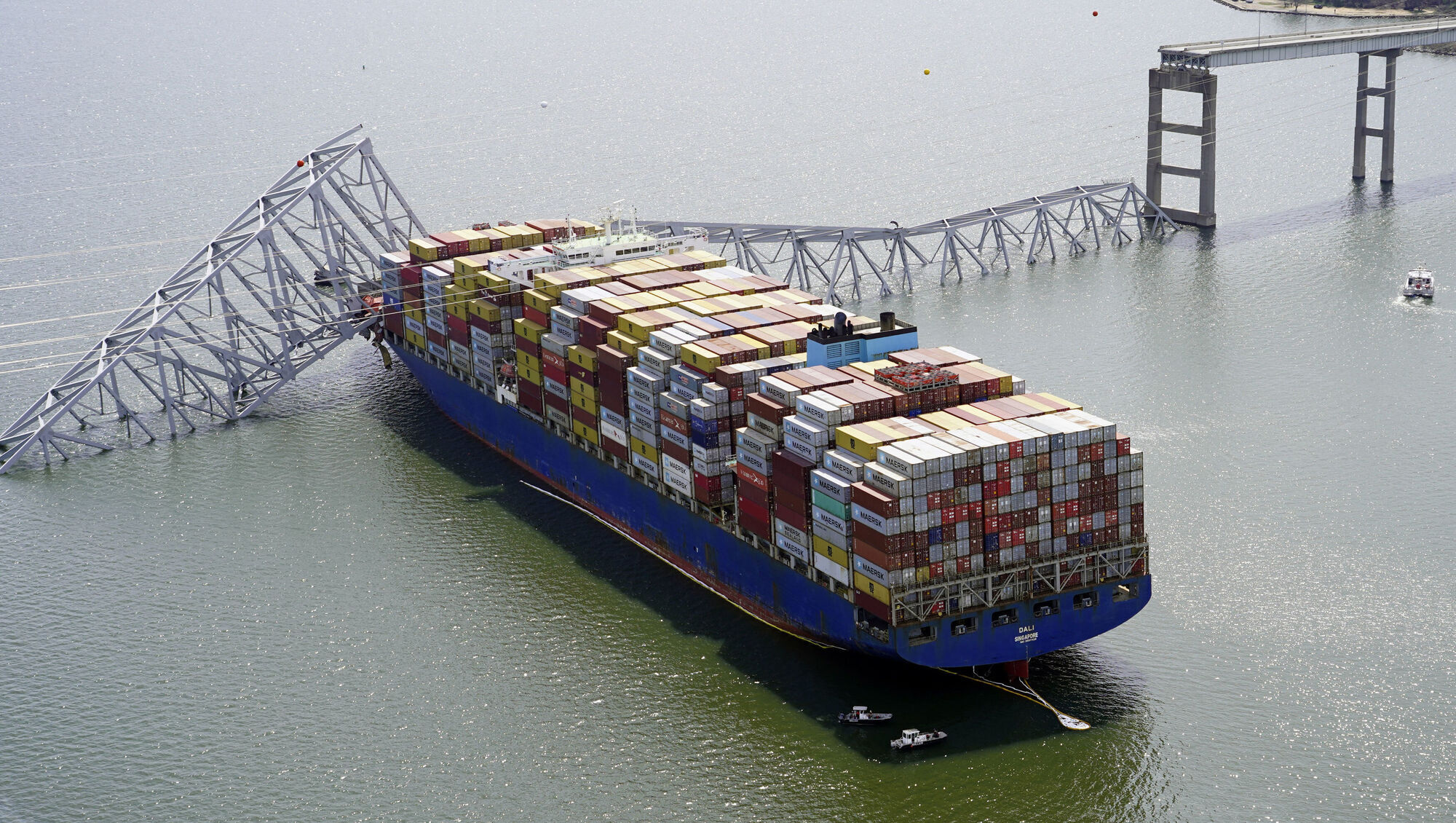
Though Baltimore is mourning the loss of six citizens in the Francis Scott Key Bridge disaster early on Wednesday morning, the city is certainly lucky many more lives were not lost.
When the giant container ship Dali lost power on the Patapsco River shortly after 1.30am and crashed into a support column, bringing the whole structure down, there might well have been hundreds of vehicles traversing the bridge and the emergency services might be looking for many more bodies than they are now.
The quick thinking of the ship’s crew in issuing a mayday signal, and the equally as rapid response of the police in closing the bridge off to road traffic, saved many lives.
While the accident was less calamitous than it might have been, nonetheless, questions are now being asked about the size of the ships being used to carry container cargo and the costs involved when things go wrong.
In 2021 when the massive container ship, the Ever Given, somehow twisted sideways in the Suez Canal and blocked one of the world’s biggest trade arteries, the cost was estimated at some €9.2bn a day in lost trade.
For Baltimore, the costs involved in the Dali’s destruction of the bridge are expected to be massive as well.
Last year, the port of Baltimore handled some $81bn of foreign trade. This year, that figure will be drastically reduced because access to the port is blocked. No figures have yet been suggested for the rebuilding of the bridge, but it can be expected to run to many hundreds of millions of dollars.
The two ships involved in both these catastrophes are both huge, but are of the kind that backbone modern global trade. And, when you consider the current geopolitical situation in places such as the Red Sea (which feeds the Suez Canal), the Strait of Hormuz, the Black Sea, the Malacca Strait, and the Taiwan Strait, these massive ships no longer seem to be the wisest choice of cargo carriers.
Keeping a lid on Russian strife
In the wake of the deadly terror attack at a Moscow concert venue one week ago, Russian president Vladimir Putin is now trying to keep the lid on potential ethnic violence across the country. With an estimated 25m Muslims living in Russia, authorities are now struggling to keep in check the excesses of those right-wing and far-right citizens only too willing to blame them for the Crocus City Hall massacre.
Some 140 people have been confirmed dead and reports suggest another 95 are missing, but the Russian authorities are fearful of inter-ethnic and interfaith conflicts within the broader population and especially so given the importance of those of the Muslim faith to the war effort in Ukraine.
It was noticeable that while the perpetrators of the concert hall attacks were all identified as being from Tajikistan, when arrested and charged in court with having committed the ghastly crime, Putin and his ministers were keen to suggest a Ukrainian involvement.
“Special attention” is being paid at a high level to preventing any ethnic violence sparked by this massacre and fear of this tragedy sparking such strife. But trying to keep a lid on anti-migrant rhetoric is a tough task in Russia right now.
Putin’s problems are complex but focus on the large numbers of Muslims fighting in the Russian army in Ukraine and the equally large numbers of Muslim immigrant workers from Central Asia who are coming to Russia to work, not alone in the armaments industry but also helping to keep the economy ticking over.
Many of Putin’s most fervent supporters, meanwhile, are Russian nationalists whose social media posts bristle with xenophobia and hatred. Keeping them happy and trying to keep tensions from flaring within society is a tricky one for the administration.
There are millions of migrant workers in Russia, mainly from the former Soviet republics of Central Asia, and they are a driving force within the economy. If they were they to become a target of the radical Russian right, then Putin and his cronies will have a lot more to worry about than their special military operation.
Hot seat beckons for John O'Shea
He may have only had two games — one draw and one loss — in charge of the Irish national men’s soccer team, but there are plenty of informed voices now suggesting John O’Shea should be handed the role permanently.
The Waterford native may not have vast experience in the managerial field, but the feeling is that there was enough on show in his two games in charge — the 0-0 draw against Belgium and the 0-1 reverse to Switzerland — to suggest he could succeed in the hot seat.
The sentiment may be in part due to fans’ exasperation at the stop-start nature of finding a permanent boss, given we failed to even score in his 180 minutes in charge.
However, being the corporate basket case it is, the FAI has said it will not announce the new manager until after the Irish women’s team face England on April 9.
That means there will have been a full six-month gap since the previous incumbent, Stephen Kenny, left the post.
The situation has been muddied — are the waters ever clear in FAI-land? — by the failed chase to sign Lee Carsley, the persistent pleadings of Gus Poyet to be given the job, and the revelation in today’s Irish Examiner that Roy Keane had been spoken to three times about the gig.
With CEO Jonathan Hill having only survived an attempted putsch earlier this week at an FAI board meeting, the overall situation with regard to the manager’s job is no clearer than the day Kenny’s contract ended. Player reaction to O’Shea’s brief tenure was positive, and so too that of the public. However, as appears to be the case with anything involving the FAI, nothing will be clear until it is vividly clear.
No obligation. Ts&Cs apply.
CONNECT WITH US TODAY
Be the first to know the latest news and updates