Irish Examiner view: Trump faces his biggest legal battles
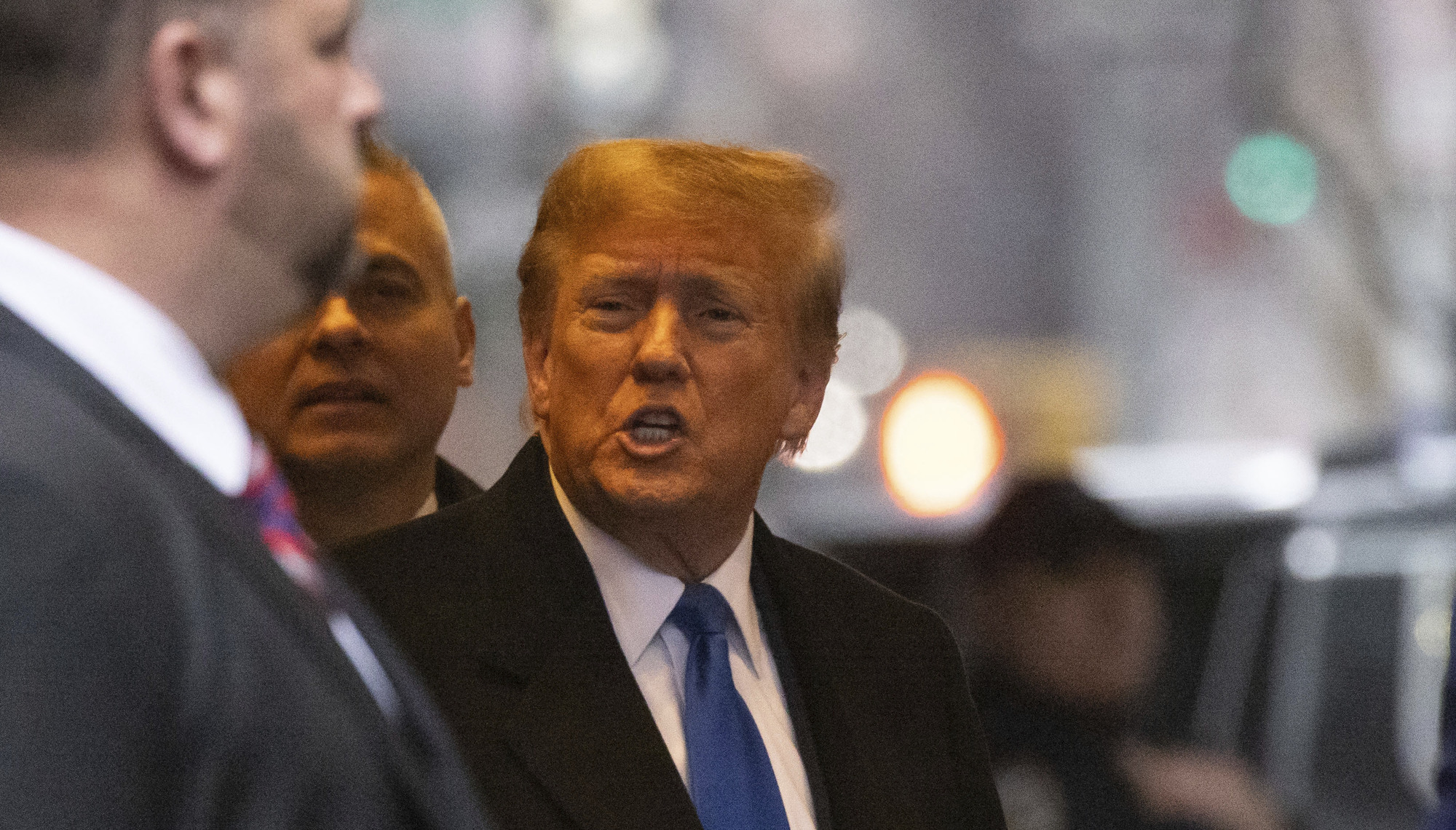
Trump has, for years, portrayed himself as a self-made mogul who can bend the justice system in his favour. While criminal cases (he faces four) might not bring down the House of Trump, the civil actions against him could well do. Picture:Â Yuki Iwamura/AP
Last week, Donald Trump fell into an $83.3m (€77m) hole. That was the amount a New York jury awarded journalist E Jean Carroll in her defamation action against the former US president and presumptive Republican nominee for this November’s election.
The hole was actually $88.3m if you include the $5m Ms Carroll was awarded in her first defamation action against Trump. And in the coming weeks on Trump’s seemingly endless legal carousel, he might find himself down to the tune of another couple of hundred million from a fraud case brought by New York attorney general Letitia James.
This should not — technically — pose a problem for a man who personally estimates his wealth in the billions (others disagree), so the prospect of bankruptcy should not arise, and nor is his freedom at issue, but it would seriously erode his financial cushion and could force him to sell assets.
Trump has, for years, portrayed himself as a self-made mogul who can bend the justice system in his favour. While criminal cases (he faces four) might not bring down the House of Trump, the civil actions against him could well do.
An infamously litigious man, Trump is used to courtroom battles, but nothing on the scale which he currently faces and nothing with such a high financial tally.
Heretofore, he has been using money raised through his political action committee to pay most of the costs incurred in the criminal cases against him and he may also be able to use some of it to pay off the Carroll judgement, but that will only cover a fraction of the sum set by the jury. That means digging into his own pockets and that is not something he will readily countenance.
While it appears he has enough cash and assets to cover the defamation judgement, paying the $370m that Letitia James is seeking might be another matter.
Who is policing social media?
Sexually explicit, deepfake images of pop megastar Taylor Swift have caused X, formerly Twitter, to prevent users from searching for her name on its platform after one single, fake picture of her was viewed some 47m times before the account that posted it was suspended.
In this case, it was good to see the platform acting with speed and impunity to protect the music star from such appalling treatment by scammers and fools for whom the creation of such images is nothing other than a laugh.
But this misapprehension of people’s identities and the sexualisation of their personalities is far from amusing and causes deep and long-standing damage psychologically, emotionally, and personally. The quick action of X in this matter is welcome, but alarming at the same time.
Undoubtedly Taylor Swift’s fame and cultural pre-eminence led X to take the action it did. But if she was not a famous pop icon, would the matter have been dealt with in the way it was? The answer, sadly, is no. Many people who have been subjected to abuse on social media have been met with silence or refused a satisfactory answer.
Vast numbers of women are treated to online degradation every minute of every hour of every day and nothing whatsoever is done to stop it. As most of these people have neither the money nor influence to prevent it happening to them, it goes on unabated.
Social media companies have shown themselves largely incapable of policing themselves or the content of their websites and that must stop. Since Elon Must bought Twitter, the social media giant has tried to modify content, largely unsuccessfully, it has to be said.
Taylor Swift and her legion of Swifties might have welcomed the intervention of X in her case, but it is one which cannot be acted upon in isolation.
Phones are deadly on the road
We are slaves to our mobile phones. That is a sad fact of modern life. These devices are obviously handy. They can also track where we go, what we say, and what we write — not to mention what we search for and purchase on the internet.
But as yet they will not help at all with a very modern public health threat.
The number of car crashes caused by drivers using their mobile phones or otherwise distracted by them is largely unquantified, but research carried out by the National Highway Traffic Safety Administration (NHTSA) in the US indicates that current estimations underestimate a worsening problem.
In 2021, nearly 43,000 Americans died in road accidents — a 16-year high — but, in that same 12-month period, only 377 fatal car crashes, which is just under 1%, were reported as having involved a driver distracted by a mobile phone. About 8% of the 2.5m non-fatal accidents in 2021 involved mobiles.
The NHTSA reckons those figures do not reflect all mobile phone distractions and US safety experts say the use of these devices goes unmentioned because it needs drivers to admit having been distracted, witnesses to identify it, or, in very rare instances, phone company records to prove it.
A 2022 survey by the US Insurance Institute for Highway Safety showed that 20% of drivers admitted scrolling social media, playing games, reading emails, watching videos, or
recording and posting them while driving.
We do not have figures for such behaviour in Ireland, but it can safely be concluded that the percentages do not differ much and that mobile phone distraction is increasingly becoming a factor in accidents here and, commensurately, the recent surge in road deaths.
The technologies exist to stamp out this problem and their use by law enforcement here should most certainly be encouraged.
CONNECT WITH US TODAY
Be the first to know the latest news and updates