Irish Examiner view: Swift action needed following Gaza findings
The International Court of Justice (ICJ), under its president, American judge Joan Donoghue, has stopped short of ordering a cessation of military action in the Gaza Strip, and of finding Israel guilty of genocide.
However, in all other ways, Palestine and its supporters, and that includes very many in Ireland, will take encouragement from the findings that a âplausibleâ case has been made, and that further consideration by the court will take place. Israel has been asked to report back within one month on certain requirements of the 29-page interim judgment.
The court found that the Palestinian people were protected by the Genocide Convention and that Israel must take measures to prevent killing of the members of that group, or causing them serious bodily or mental harm.
Actions which are calculated to bring about the groupâs physical destruction in whole or in part, or measures intended to prevent births must also cease and Israel must ensure that its military forces do not commit such acts, with immediate effect.
There are constraints on inflammatory language which might incite genocide. Israel must also enable basic services and assistance and the court gave weight to the comments of United Nations relief co-ordinator Martin Griffiths, who said: âGaza has become a place of death and despair.â
Israel must also ensure that all evidence related to allegations must be preserved.
Given the catastrophic situation since the attack by Hamas terrorists on October 7 and the large-scale military response, it was to be expected that a large majority of the 17 judges at the ICJ would give South Africa most of what it was asking for.
At the bar of world opinion, Israel must now quickly consider the scope of its response. Early signs are predictably unpromising, with Israelâs security minister, Itamar Ben-Gvir, describing the ruling as âHague Shmagueâ.
âThey were silent during the Holocaust,â he added.
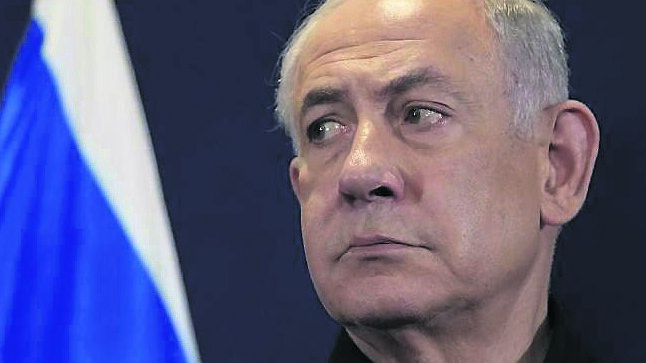
Prime minister Benjamin Netanyahu said Israel will continue the war until âabsolute victoryâ, its remaining hostages are returned, and Gaza is no longer a threat to Israel.
Attention must now turn to Israelâs strongest ally, the US, whose leader has been in daily contact with Jerusalem since the crisis erupted. Joe Biden has provided Israel with whatever military aid it has asked for. It has come at the cost of electoral support for the Democrats.
Last month the US delivered the sole veto on a UN security council resolution supporting a humanitarian ceasefire.
Israel has rejected proposals for a two-state solution and wonât contemplate any role for the Palestinian Authority in future government.
Small wonder that the Democrats are split, with one senator saying: âAt every juncture, Netanyahu has given Biden the finger.â
While the war of words continues it is impossible to see how aid can be provided consistently and safely until there is a pause in fighting. That will require more effective leverage from the White House than we have witnessed thus far, and a deal which liberates remaining hostages.
These are serious matters, beside which little local arguments over whether RTĂ should boycott Eurovision 2024 or whether Israel should be banned appear pale, trivial, and distractionary. If thatâs to be our contribution, we would do better to keep our counsel for now.
The centenary of the death of Vladimir Lenin, one of the most important figures of the 20th century, passed with barely a ripple this month. This is because he is persona non grata in Vladimir Putinâs Russia.

It is also partly because that the other continental giant influenced by his political impact, China, is in the process of airbrushing him from its foundation myths â unlike Marx, whose Highgate Cemetery grave is selfied daily by Chinese visitors.
We shouldnât let the moment pass, however, before recalling that the brutal dictator â as with his one-time ally Leon Trotsky â were great admirers of the Irish for the Easter Rising, and the challenge it brought to the forces of imperialism.
Lenin and the Bolsheviks were familiar with the writings of James Connolly, and the events of 1916 in Dublin formed a backdrop to their own revolution of 1917.Â
According to some academics, the 1916 Rising was later reinterpreted in the language of the times. The Irish Citizen Army became the Red Guards, while the British army became the White Terror.Â
Lenin commented that it was âthe misfortune of the Irish that they rose prematurely, before the European revolt of the proletariat had had time to matureâ.
Although he lived in London for a while and attended the British Museum reading rooms, there is no evidence that he made it across the Irish Sea. There are apocryphal stories that he spoke English with an Irish accent.
And there is a plot for an aspiring Netflix director. Please take it up, with the compliments of the Irish Examiner â just mention us in the credits.
News that the Liverpool manager JĂŒrgen Klopp has decided to leave at the end of the season after nine years will be a great disappointment for that clubâs supporters, of whom there are many in Ireland. And a great relief to other teams and fans who harbour aspirations of victory and success.

In Klopp, and his great rival Pep Guardiola â both in their mid-50s and at the acme of their careers â the Premier League can claim to provide a home to two of the best managers in world football.
Kloppâs announcement, made in a video message to supporters, recalls two other out-of-the-blue resignation statements at Anfield: The departure of Bill Shankly, the man who really started it all in L4, in 1974 and Kenny Dalglishâs exit in 1991.
The reason, Klopp said, is that he is ârunning out of energyâ. There are, he emphasised, no underlying health issues influencing his decision.
âI am healthy, as much as you can be at my age.â
He is 56.
When Klopp, a journeyman player but an inspirational coach, arrived from North-Rhine Westphalia, the Reds, while not actually in the doldrums following the Miracle of Istanbul in 2005, were struggling to make an impact in the league.
Their last title had been in 1989/90, a 25-year drought.
Klopp had transformed Borussia Dortmund, a side from Germanyâs Ruhr with a strong working-class identity, into Bundesliga champions. He rocked up in England proclaiming himself âThe Normal Oneâ, a self-effacing joke given his charismatic personality.
That wry humour has endeared him to many, and was ideal for Liverpool.
When recounting his youth, Klopp recalled that he had ambitions to be a doctor but lacked the intellectual weight to pursue the study of medicine.
His school principal told him: âI hope it works out with football, otherwise itâs not looking too good for you.â
Years later, when asked for his views on the pandemic, he rebuffed the questioner.
Covid was a serious thing in an area in which he had no expertise.
His opinion, therefore, was unimportant.
Klopp liked to talk about âheavy metal footballâ.
His phrase âgegenpressingâ â the high-intensity hounding of an opposition player â has entered the lexicon of soccer.
Crucially Klopp has demonstrated that he can deliver the gameâs equivalent of the music industryâs âdifficult second albumâ.
After a series of campaigns which have delivered that elusive 19th Premier League, the Champions League, the Club World Cup, the FA Cup, the League Cup, the Uefa Super Cup, and the Community Shield, Klopp has produced his second great team on Merseyside. As of this morning, Liverpool are top of the Premier League, face Norwich City today in the FA Cup, are in the last 16 of the Europa League, and have a date with arch contemporary rivals Chelsea in the Carabao Cup final net month.
The Germans have a compound word for it. Of course they do.Â
Vervierfachen. Quadruple. It would be a fitting send-off for the ScouserDeutsch.