Irish Examiner view: Goodbye to an Irish heroine
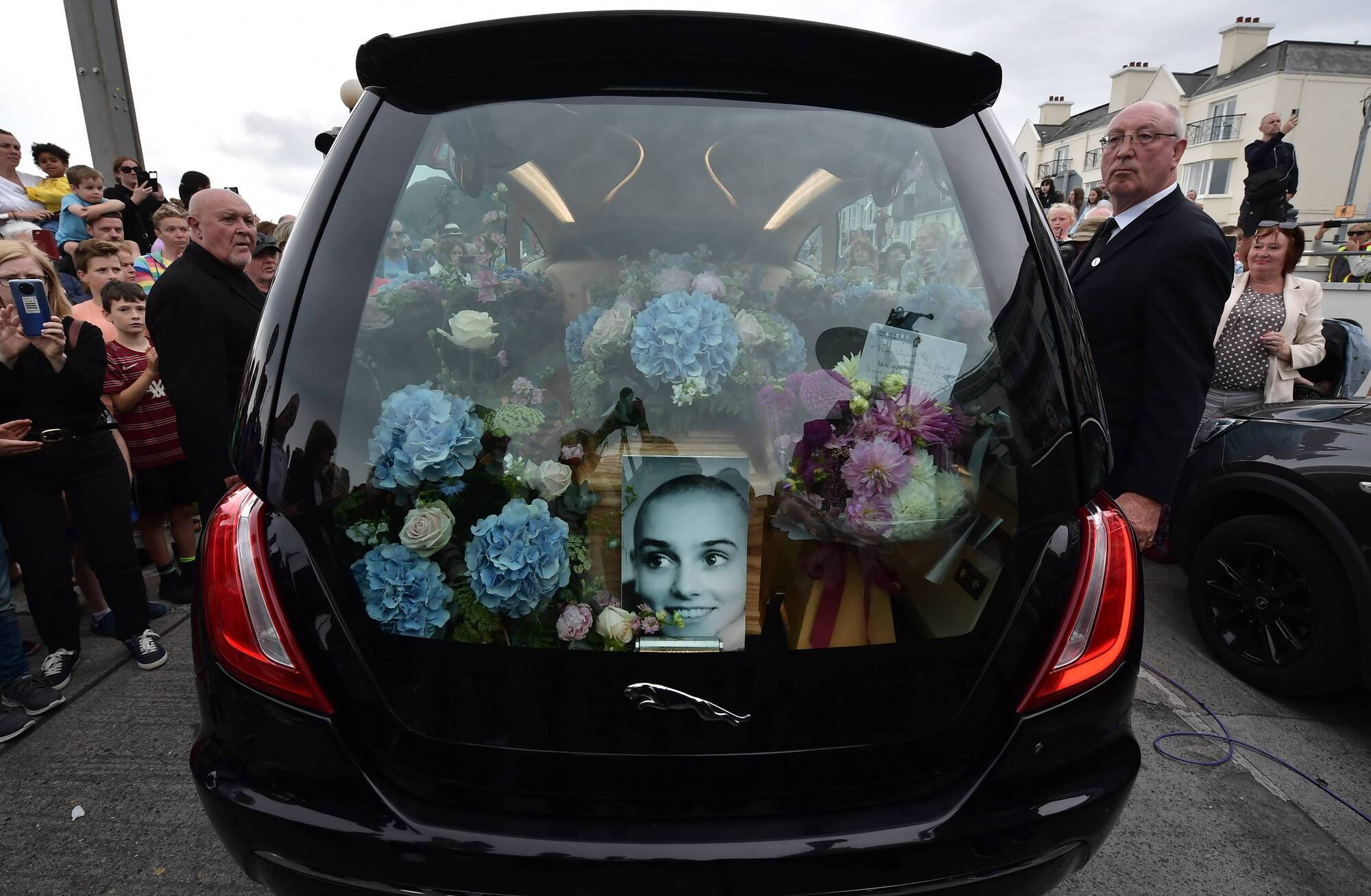
Some of those in attendance along the streets of Bray threw flowers on the hearse as it passed — a striking illustration of sympathy with a heroine gone too soon, of solidarity with her grieving family, and of the enormous loss which the nation has suffered. Picture: Charles McQuillan/Getty
People turned out in force yesterday along the streets of Bray to offer a final farewell to Sinéad O’Connor, who died last month. The singer-songwriter passed away in London, but her funeral cortege drove through the Wicklow town where she had lived for 15 years.
Her untimely death set off a whole cottage industry of opinion pieces and personal recollections across media platforms for the last couple of weeks, with many commentators striving to establish their own links to O’Connor. In that commentary, a long, successful career as a singer and musician was analysed and appraised at length — not always generously, it must be said — while her life was also held up as an emblem of the struggles of Irish women over recent decades.
The weight of meaning and significance being pressed upon O’Connor is understandable, as hers was a public
presence which blazed brightly for over 30 years. As has been outlined at length, her beliefs and advocacy were not subservient to her musical career, which goes some way towards explaining the depth of sadness many have expressed since she died. At a time when many performers shy away from controversy for fear of alienating potential customers, O’Connor remained true to herself and her convictions — and accepted the consequences of her authenticity.
All of the cultural debates and career evaluations were put to one side yesterday, however. Some of those in attendance along the streets of Bray threw flowers on the hearse as it passed — a striking illustration of sympathy with a heroine gone too soon, of solidarity with her grieving family, and of the enormous loss which the nation has suffered.
Ar dheis Dé go raibh sí.
Inaction allows problems to fester
The crisis in housing and accommodation continues and shows no signs of abating, despite politicians claiming that progress is being made.
Occasionally a combination of events or circumstances shows this crisis for what it truly is, a circular problem with interlocking challenges.
Yesterday, for instance, Tadgh McNally of this parish pointed out a shocking contrast when it comes to the basic availability of accommodation — there were a total of 18,086 Airbnb rentals available nationwide, compared to just 1,299 rental properties available on Daft.ie. That means there were 14 times more short-term lets on offer compared to long-term rentals.
That news alone crystallises the challenge facing those who need long-term accommodation. If it is more lucrative for property owners to use their premises for Airbnb then they will continue to do so, reducing the pool of long-term rents available.
In the same edition of this newspaper, Neil Michael reported on the extent of dereliction in north Cork, where large buildings such as the former Central Hotel in Mallow are left to fall into ruin. It was striking to realise that an area within commuting distance of Cork and Limerick, two of the largest cities in the country, has so much property on hand which is not being used for accommodation.
This reduction of housing stock obviously has an effect on accommodation as well, but these two issues are linked more clearly in another way.
As reported by this newspaper, there appears to be little will among State agencies to enforce the legal registration requirement for Airbnb properties, while municipal inertia when it comes to action on derelict properties has become all but proverbial.
If the authorities are not interested in fulfilling their legal duties in this regard, can we be surprised that the accommodation crisis continues to worsen?
Is this the end of working from home?
Are the end credits beginning to roll for the entire concept of working from home?
The pandemic drove countless people from their workplaces to the sofas and kitchen tables of home, and from those informal workstations they were able to engage with colleagues thanks to the advent of modern technology, which would have been unimaginable even 10 years ago. The likes of Microsoft Teams and Zoom have enabled people to work together to an unprecedented extent, with ‘jumping on a Zoom’ quickly becoming synonymous with the WFH phenomenon.
Now, however, a change is upon us, as even Zoom is looking for people to return to the office.
We learned this week that employees of the company who live near a Zoom location must be on-site for two days a week, with the company itself adding that a “hybrid approach” is one that will put Zoom in “a better position to use our own technologies, continue to innovate, and support our global customers”.
If Zoom is bringing people back to the office, what other workforce will be able to make the case for staying at home?
Whatever about the history of work, it is surely a watershed in the history of the pandemic, and appears at first to be the clearest sign of all that covid is in the rear view mirror. At the end of last month, the HSE retired both the covid tracker app and the EU digital covid certificate, but having people returning to the Zoom office seems somehow more symbolic of the new, post-pandemic era.
Whether that is premature remains to be seen. A new covid variant is spreading across UK known as EG.5.1 — descended from Omicron — and cases are beginning to rise again. Perhaps workers shouldn’t delete that Zoom app just yet.

Subscribe to access all of the Irish Examiner.
Try unlimited access from only €1.50 a week
Already a subscriber? Sign in
CONNECT WITH US TODAY
Be the first to know the latest news and updates