Irish Examiner view: Ambiguity can stymie progress
Von der Leyen's snub shows how how deep the cultural divide between the West and Turkey remains
Irish Examiner view: Ambiguity can stymie progress

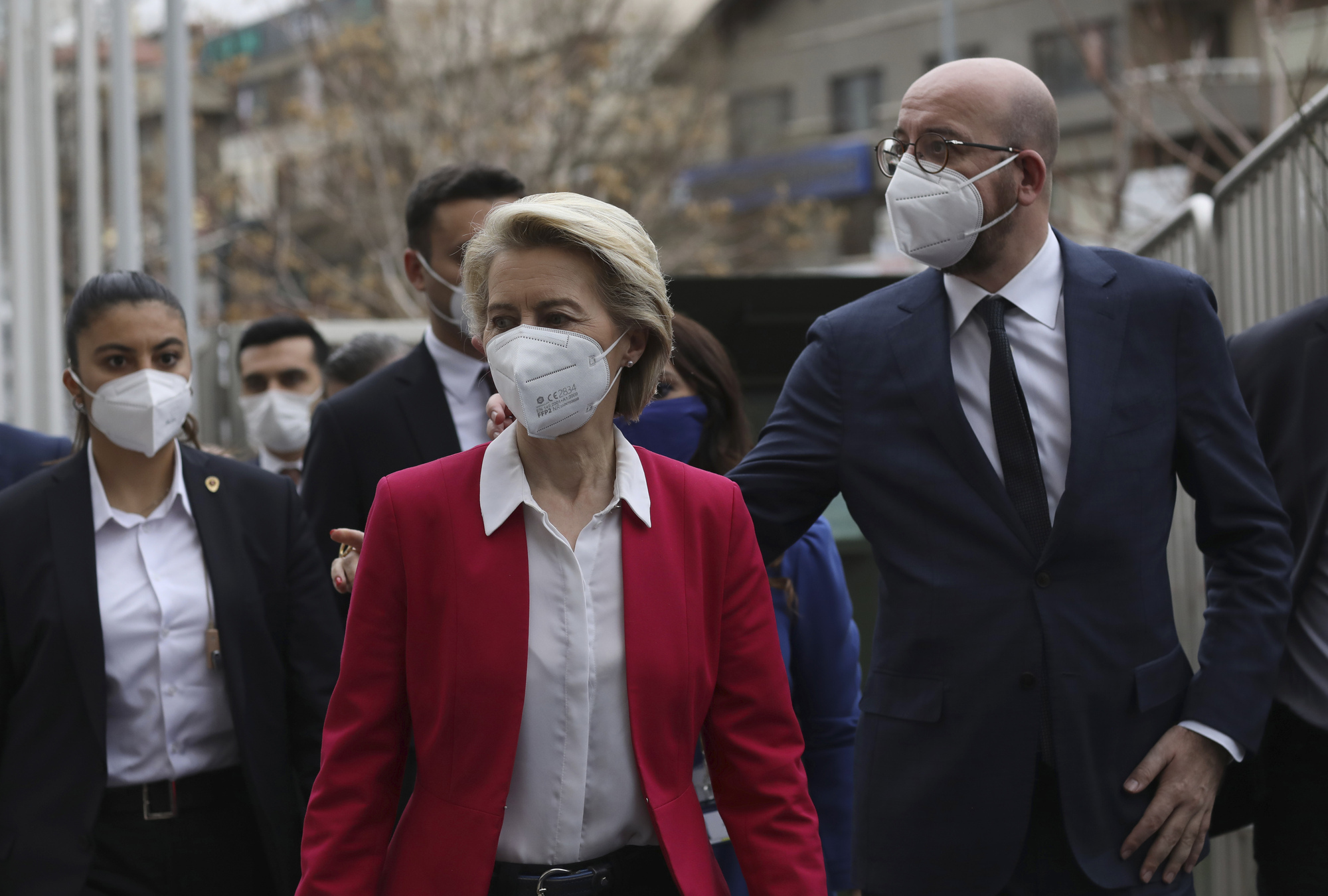
European Commission President Ursula von der Leyen, centre, and EU Council President Charles Michel arrive for a joint news conference after talks with Turkey's President Recep Tayyip Erdogan, in Ankara, Turkey, on Tuesday. AP Photo/Burhan Ozbilici

As the past is as incendiary a force in Turkey as it is in Ireland, then it is unsurprising that US president Joe Biden’s remarks last weekend — when he recognised the 1915/1916 massacres of Armenians in the Ottoman Empire as genocide — stretched the frayed relationship between the Nato allies. The gesture, more symbolic than concrete, recognised that around one million Armenians were killed by Turkish Ottoman troops during those years. 

One of the atrocities occurred less than two years after Cork was burned. The port of Smyrna — holidaymakers today know it as İzmir — was razed in September 1922. The death toll is disputed, but it may be as high as 100,000. One detail of the sack remains unforgettable. 

Military bands on Allied powers’ ships anchored in Smyrna’s harbour were ordered to play ever-louder to block out the screams of the townspeople drowning in the harbour, where they were driven by fire or Turkish troops. Behaving in a way complicit with the Turks, the Allied sailors prevented those drowning souls from boarding Allied ships. There was an exception, however: A Japanese freighter jettisoned cargo and took on as many refugees as was possible.

The standard invocation that such an atrocity could not happen today is, as ever, indulgent and wrong. So, too, is the suggestion that the US is unstained. Figures released by the International Organisation for Migration record that 4,159 migrants intercepted in the Mediterranean this year by the EU-supported Libyan coastguard were returned to Libya. Their fate is unknown, but it is unenviable.

If Mr Biden’s clarity has strained relationships with conservative Recep Erdoğan’s Turkey, then that country’s relationship with the EU must be strained by the president of the European Commission, Ursula von der Leyen’s necessary declaration that sexism was behind an incident in which she was snubbed during a visit to Ankara.

Violence against women and children is a crime. We must call it a crime and it must be punished as such

 “I have to conclude, it happened because I am a woman,” she told MEPs in the EU parliament. That sleight spoke volumes, but Turkey’s decision to withdraw from the Istanbul Convention, the first internationally binding instrument to take a broad approach to combat violence against women and children, shows how deep the cultural divide between the West and Turkey remains. It is disconcerting, too, and undermines the EU that several EU states have not yet ratified the convention.

 “This is not acceptable,” warned von der Leyen. “Violence against women and children is a crime. We must call it a crime and it must be punished as such.” The Istanbul treaty has been ratified in Ireland and came into force in 2019. However, the Czech Republic, Bulgaria, Hungary, Latvia, and Lithuania have not endorsed it, which means that the EU, as a whole, is not a party to it.

Though it took the US a century to call genocide a genocide, the wriggle room on these issues is not as abundant as it was. The EU, through von der Leyen, is right and must challenge behaviour fundamentally opposed to European values — not only because it is the right thing to do, but because of the support it offers to the millions who want to live in a society where gender is no longer a defining, chaining issue.

x

More in this section

Revoiced

Newsletter

Had a busy week? Sign up for some of the best reads from the week gone by. Selected just for you.

Cookie Policy Privacy Policy Brand Safety FAQ Help Contact Us Terms and Conditions

© Examiner Echo Group Limited