Irish Examiner view: Climate is more urgent than a united Ireland
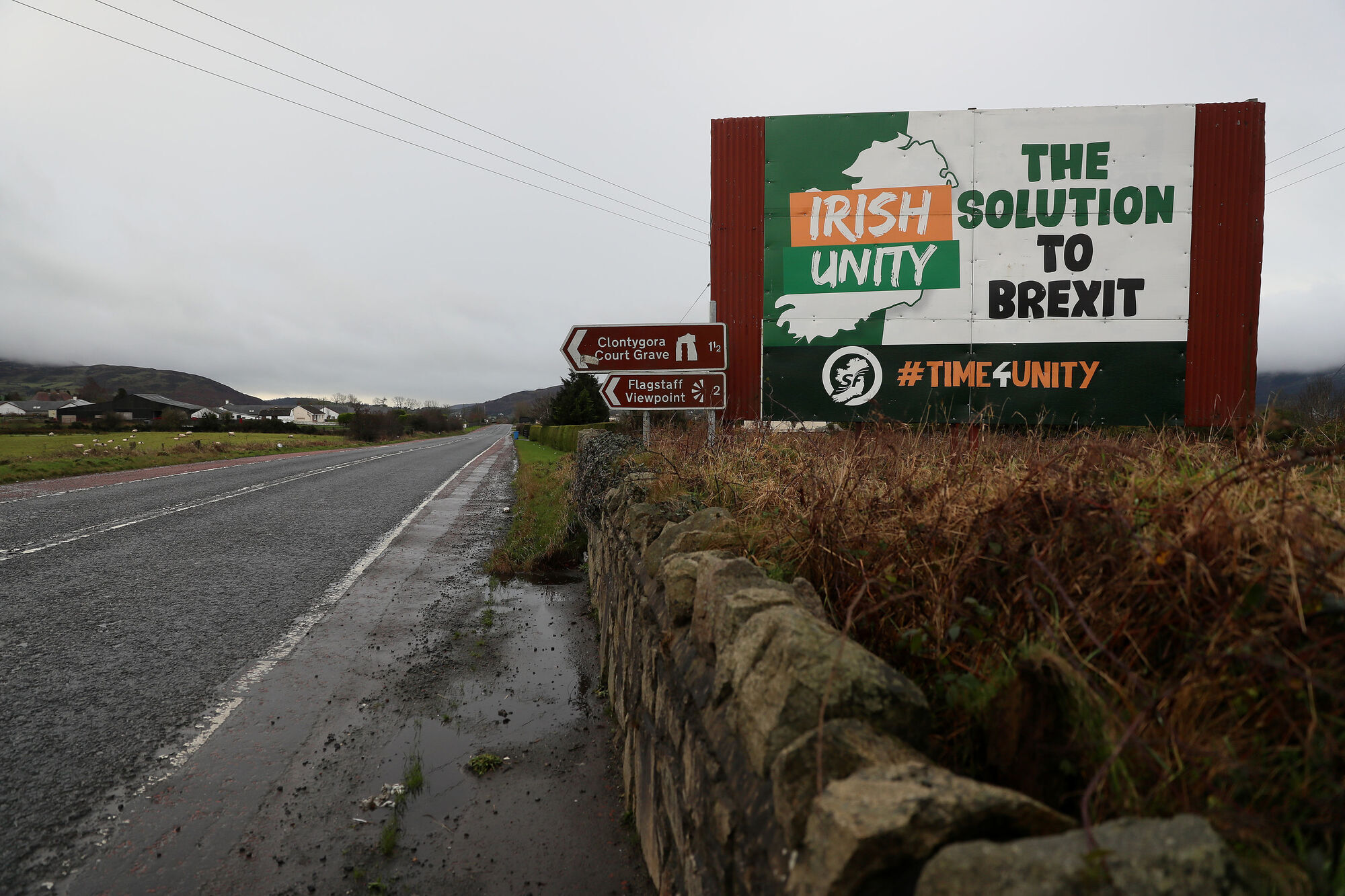
An anti-Brexit billboard proposing a united Ireland as a solution to Brexit at the border between the Republic of Ireland and Northern Ireland. Picture: Brian Lawless/PA
Though the pandemic complicates matters, premiership political handlers, business lobbyists too, understand that setting the public agenda is no more than minor hurling, first-round minor hurling at that.Â
The greats of that often invisible art — James Carville, Peter Mandelson, and, in the green corner PJ Mara — understood that setting an agenda was the easy part but that maintaining focus on a subject can be difficult — especially if the agenda-setting is, in part, designed to distract.Â
Carville, Mandelson, and Mara understood that highlighting a legitimate cause championed by passionate advocates was an ideal way to suck the oxygen away from other more prickly, more important discussions.Â
Sincerity and sleight of hand went, well, hand in hand.
The deep emotions expressed in the resumed debate around Irish reunification are such that a suggestion that it is, at this moment, a premature distraction would undoubtedly draw accusations of treason or, from the other side of that argument, just a recognition of the delusion involved.Â
Those accusations would be sincere even if a significant, globalised cohort is, in real terms, almost indifferent to the issue. This cohort, unhappy to be described as green or orange, has been described as the North's third minority.Â
Their southern counterparts — there are far more than might be imagined — might cheer reunification but recoil from paying the taxes to fund it. They would not, under any circumstances, countenance the prospect of renewed terrorism.
That 32-county third minority is far more concerned with social issues like housing or education, deepening inequity or climate change than it is about how long it might take North Antrim MP Ian Paisley to learn Amhrán na bhFiann or that Edward Carson's alma mater — Trinity College — might honour him with a new statue.Â
Their concerns are informed by global trends like how work is changing, how homeownership is becoming increasingly impossible, and how climate collapse will utterly change our children's prospects. Â
Just a month ago a meeting was called to discuss Agri-Food 2030, the Government strategy for the food sector. Karen Ciesielski, co-ordinator of the Environmental Pillar (EP) joined to discuss a plan 15 months in the making.Â
The EP withdrew from the process, saying it could not endorse what was being proposed. Indeed, the deck was so stacked it was surprising that the EP was involved at that stage.Â
Two years ago the state-funded EP, which represents 33 NGOs was offered one seat on the 30-strong committee. It had sought two more, one for Stop Climate Chaos and another for Sustainable Water Network, a conduit for 24 NGOs.Â
This request was denied and Ciesielski was a lone voice. The Department of Agriculture, which selected the committee — an unacceptable conflict of interest surely — welcomed members including five business lobbyists, five farm organisations, one fishing representative, one banker, Glanbia and Keeling's chief executives, various State agency chiefs, and scientists and academics.
Irish reunification is a noble cause but it does not have the same urgency as confronting climate change or the consequences that will have for so much of what we do.Â
Rising seas will not care if the post boxes are red or green.Â
Imagine how much better it might be if the snarling energy used in the reunification debate was redirected at a real and present, and growing danger.
Read More
  Â
CLIMATE & SUSTAINABILITY HUB