Irish Examiner view: More needs to be done with urgency about vaccine contracts
Announcement by the European Commission that it had reached an agreement with BioNTech-Pfizer for the supply of four million extra doses of vaccines is all the more welcome
Irish Examiner view: More needs to be done with urgency about vaccine contracts

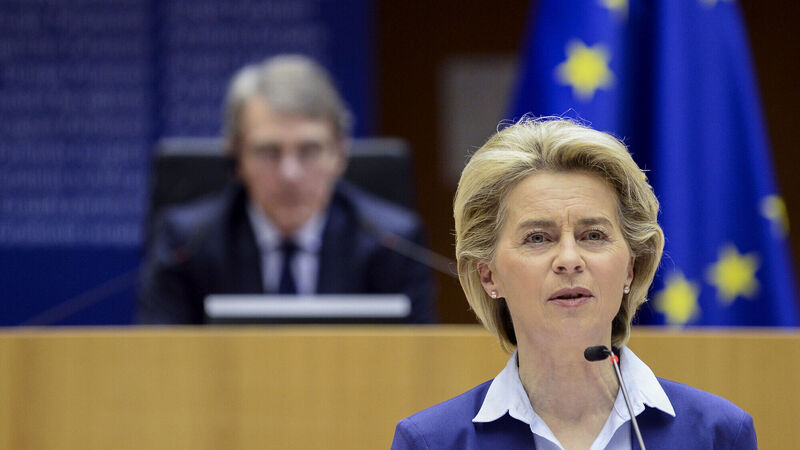
European Commission President Ursula von der Leyen offered a robust defence of the EU's policy of negotiating Covid-19 vaccine contracts as a single bloc. (Johanna Geron, Pool Photo via AP)

European Commission president Ursula von der Leyen yesterday offered a robust defence of the EU’s policy of negotiating Covid-19 vaccine contracts as a single bloc. “How would it look like in Europe if everyone would have gone on its own? We would have a few, four to five member states that would have access to vaccines — it’s the big member states — and all the rest would have no access to vaccines.”

That is a fair point, although a better argument would be that wealthier states would be likely to outpace poorer ones if it was left to all 27 members to negotiate their own deals
with manufacturers. The case she makes fails to recognise the fact that, when it comes to a swift vaccination programme, size doesn’t necessarily matter. Consider three nations that are way ahead of the EU — the US, population 331m; the UK, 67m; and Israel, population of less than 9m.

She also fails to address the danger to EU cohesion as more states lose faith with the EU programme. As early as last summer, the German government signed two preliminary deals with German biotech firms BioNTech and CureVac to secure 50m doses of their Covid-19 vaccines, even while the European Commission was also in negotiations with those firms. This was in spite of von der Leyen’s assertion that “no member state is allowed to negotiate in parallel” with vaccine companies.

Now that go-it-alone approach has been mirrored in six other member states. Austria and Denmark have announced they will partner with Israel for the production of new vaccines while Slovakia and Hungary have bought supplies of the Russian Sputnik jab. The Czechs and the Polish are in negotiations with China for its vaccine. That makes the announcement by the European Commission that it had reached an agreement with BioNTech-Pfizer for the supply of 4m extra doses of vaccines all the more welcome. These will be rolled out over the next two weeks in order to tackle coronavirus hotspots and to facilitate free border movement. Taoiseach Micheál Martin said Ireland is in line for an extra 46,500 vaccines before the end of March as a result of the deal.

Every little helps, but much more needs to be done, with greater urgency. Ursula von der Leyen hailed the agreement, declaring: “To tackle aggressive variants of the virus and to improve the situation in hotspots, quick and decisive action is necessary.” That needs now to take the form of holding suppliers to account and ensuring new vaccines are readily available, particularly the Johnson one-jab vaccine which could prove to be a game-changer.

Lest we despair, we are already seeing huge improvements in our hospitals, care homes and work places.

We also need to keep the main goal in mind, and that is saving lives. While the UK is speeding ahead with its vaccination programme, it is taking 12 weeks between doses to try and deliver jabs quicker. That experiment may pay off, but it wasn’t long ago its government’s failed flirtation with herd immunity led to a spike in deaths which now number 125,000.

Trust in science and continue to keep pressure on suppliers to fulfil their obligations.

More in this section

Revoiced

Newsletter

Sign up to the best reads of the week from irishexaminer.com selected just for you.

Cookie Policy Privacy Policy Brand Safety FAQ Help Contact Us Terms and Conditions

© Examiner Echo Group Limited