Paul Hosford: Life goes on in Kyiv as Russia's war on Ukraine grinds on
With drinks priced between 75c and €1.10, the small operation is doing a roaring trade. Across the street, breakfast business at an outlet of the French bakery chain Paul is picking up and people on their way to work mill around. A bus advertising an aquarium as a family day out rounds the corner.
Had it not been for the low drone of an air-raid siren just hours earlier, this could be any Eastern European city.
Read More
But this is Kyiv, four years into war with Russia.
While the city can appear normal, the signs that this is anything but business as usual are everywhere.
The biggest clue is in getting here. While Ryanair had a flight to the Ukrainian capital before the war and is among a cohort of European airlines planning to quickly re-enter when skies reopen, there are no official departures or arrivals at Boryspil International Airport.
For last week’s informal European Foreign Affairs Council meeting, the continent’s foreign ministers travelled by train from across the border in Poland, either from Przemysl or Chelm.
It is in the queue for the train, some 10 miles from the border, that the reality becomes apparent.
At Przseml station, in a snaking queue that makes a mockery of the 7.40am departure time, families tearfully say goodbye, split in all sorts of combinations: Men returning to Ukraine; men who are staying behind; children being left with grandparents. Children wrapped in blankets wait for passport control, loved-ones embrace, but the air that hangs over the place is enough for even the untrained eye to know that these are not just the goodbyes of the briefly apart.
On the train, there are warnings about what to do in an emergency, with that word ‘emergency’ taking on a much heavier meaning given that trains may stop in the event of an air attack and passengers have to be evacuated.
A video, like a pre-flight briefing, explains: If the threat is critical, the train is stopped and passengers are led out of the cars. This would only happen if, for example, a drone is moving directly toward the train or along the route.
If the situation is not critical, there will be no evacuation, but the train may be rerouted, slowed down, or stopped for a while. The video is played to prevent “unnecessary” passenger “stress”, but as a first-timer on the train, its mention has the opposite effect.
Once across the border, beyond the town of Medyka — where, at the war’s outbreak, 20,000 to 30,000 people flooded across the tracks — border guards with a a bomb dog check the train. The dog races along the carriage and is scolded for searching for scraps in a bakery bag, while a young woman examines passports and her colleague does bags.
They are looking for “medicines”, but the problem with drugs is growing on both sides of the war’s frontlines. According to a recent survey by the NGO 100% Life Rivne Network, 38% of Ukrainian troops had taken amphetamines in the past three months, while 66% had smoked cannabis.
As the train trundles through the Ukrainian countryside, in Pidbirtsi, outside Lviv, graffiti reads, ‘Fuck Ruzzia’, as a television in the carriage of the surprisingly modern and comfortable train plays ads for DIY drone kits and the Ukranian armed forces, in between clips of Korean animated show .
Arriving into Kyiv-Pasazhyrskyi station is remarkably normal, aside from the weariness of passengers who spent the guts of half a day getting here. Exiting requires no checks and the military presence is neglible.
Outside the imposing Soviet-era station, a McDonald’s restaurant is doing busy trade. The fast-food chain has become something of a totem for the normalcy of much of Ukranian life four years in to a full-scale invasion by Russia.
Last week, footage went viral of teens joyously reacting to the reopening of an outlet in Mykolaiv, a city just 70km from the front lines that has withstood a devastating water crisis in recent years.
It feels trite from an Irish perspective, but the restaurants’ reopenings across the country are a strong indicator of the deprivations of the invasion. In front-line cities like Sumy, Zaporizhzhia, and Kharkiv, McDonald’s remain closed.
As night falls, Kyiv is noticeably dark. The city doesn’t light up the way you might expect a modern capital would, with streetlights turned down to save electricity and to make it harder for Russian airstrikes. However, there are pockets of mundane life.
A restaurant is showing an old Uefa Youth League game between Dynamo Kyiv and Barcelona and serving food.
The bar across the road, at the foot of the city’s funicular — which links the old city with the commercial neighbourhood of Podil, through the steep Volodymyrska Hill — is playing loud music and full of young people. With conscription for those over the age of 25, the age profile is very young.
But more than the darkness, nightfall brings the threat of air raids.
As our taxi snakes back towards the hotel, the mobile phones of everyone in the car buzz. The air-raid app is warning of drones spotted around Kyiv. Within seconds, the haunting wail of the sirens begins. Nobody who is used to this bats an eye. A group walking up the street doesn’t break stride or speed up, hotel staff go about their business, and the taximan drops us off and goes in search of another fare.
Locals, and foreigners who have been here a while, tell those of us whose stomachs dropped at the first buzz of the phone that because of Ukrainian air defences, they have adopted a rule of thumb: If it’s drones (the app helpully distinguishes), you move away from the window; for missiles, you go to a shelter.
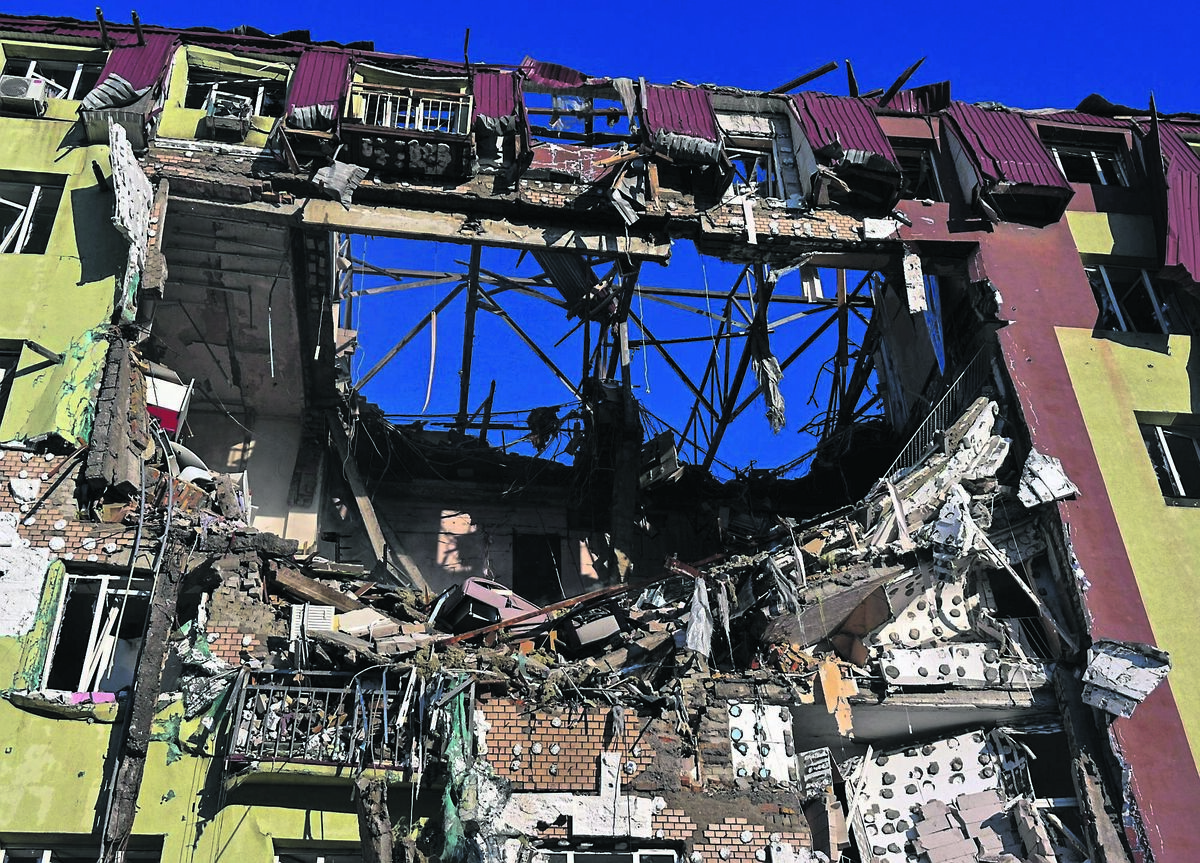
In the days before our arrival, Russia had launched a massive daytime drone attack on the city, catching locals unawares and killing several and wounding more. Russia repeated the tactic on Friday, having been largely inactive throughout the EU meeting, killing one and wounding eight, including a child.
But, routine or not, those strikes do require vigilance and being woken several times a night is draining, even for a foreigner in a hotel, let alone for parents bringing children up and down to bunkers. Kyiv’s residents live with that every day.
Locals say that lack of sleep is among the hardest parts of the war. It makes bringing children back to the country a difficult thing to rationalise. At a neonatal clinic — financed by Ireland through the UN Population Fund — doctors and midwives tell of rising rates of premature births and caesarean sections.
Some who give birth have not had a doctor’s check-up in 10 years. The war, like all wars, weighs heavily on women and children, with the Some who give birth have not had a doctor’s check-up in 10 years. The war, like all wars, weighs heavily on women and children, with the United Nations Fund for Population Activities, the agency aimed at improving reproductive and maternal health worldwide, warning of gender and sexual violence both at the front and across the country.
Some who give birth have not had a doctor’s check-up in 10 years. The war, like all wars, weighs heavily on women and children, with the United Nations Fund for Population Activities, the agency aimed at improving reproductive and maternal health worldwide, warning of gender and sexual violence both at the front and across the country.
While the focus has been on the last four years, a wall of remembrance that Helen McEntee, the foreign affairs minister, visited names the dead from 2014, when Russia invaded Crimea.
A kilometre away is the centre of what many Ukrainians thought would be the defining crisis of their lives: The Maidan Revolution.
The revolution was largely played out over five days in February 2014, because of then president Viktor Yanukovych’s sudden decision not to sign a political association and free-trade agreement with the European Union and instead grow closer to Russia. Approximately 120 people were killed and a new wave of reforms introduced, but a pro-Russian backlash also emerged.
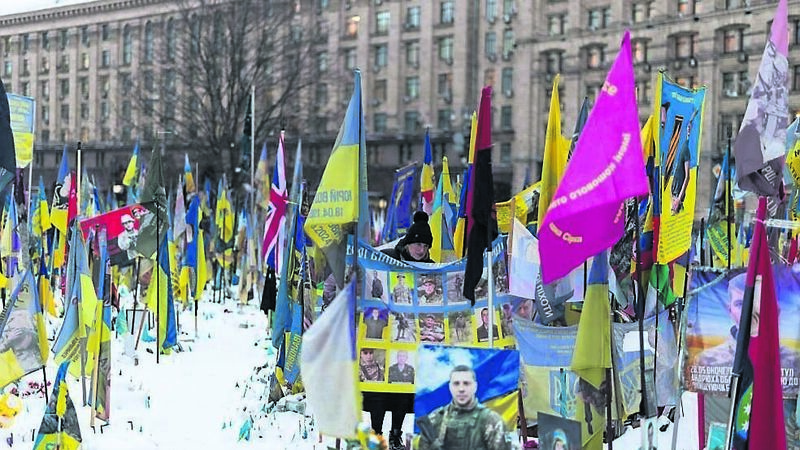
Where once the protesters had built a camp around the Independence Monument now stands a memorial made up of 18,000 flags from across the globe.
In the plot of grass tended by Oleg and his wife are Tricolours bearing the names of Alex Ryzhuk, Robert Deegan, Graham Dale, and Rory Mason, four Irishmen killed in the fighting.
Oleg’s colleague, Volodomyr, makes a point of handing journalists Irish/Ukranian patches as he sells t-shirts emblazoned with Russian president Vladimir Putin cast as the devil. They say there are similar memorials in nearly every town across the country.
The fog of war makes it hard to know just how many have died in the conflict, but figures suggest somewhere around 500,000, and with nearly 11m displaced, both within the country and fled abroad.
That has effects in the city, which at morning rush hour feels quieter than you would expect. There are just fewer people around.
Near a military arsenal converted in to a food market, Ireland and Ukraine mark 34 years to the day of diplomatic relations as a new permanent embassy opens with a reminder of air-raid protocol and a moment’s silence for the fallen. Amid the wine and canapes, it’s another jarring reminder of life in the city.
As with the way in, the way out is another train, this time an overnighter with a sleeper car of strangers to keep you company and a near two-hour wait at the border as men in fatigues check passports and ask if you are a military volunteer.
Once you reach Przseml, the queues for border checks are telling, the EU side marginal compared to the Ukrainians, who continue to seek refuge with their neighbour and beyond.
It’s not that Kyiv is not somewhat normal, but the risk is in thinking nothing is amiss, especially on days with minimal air-raid warnings.
But there is a weight to it all.
The people are pleasant and kind and resilient, but they have little option. Capitulation is not in their make-up, they argue, so forward they move.
Four years in, though, there is a weariness around the capital, one that comes without having the ability to process it all because it is still happening. It’s like knowing that you have PTSD before you can be post-anything.
But, for now, while the sun shines and there is coffee to be had, what else can you do?
- Paul Hosford, Acting Political Editor


CONNECT WITH US TODAY



Be the first to know the latest news and updates