Paul Hosford: Ukraine war merely another chapter in Russia's aggression against its neighbour
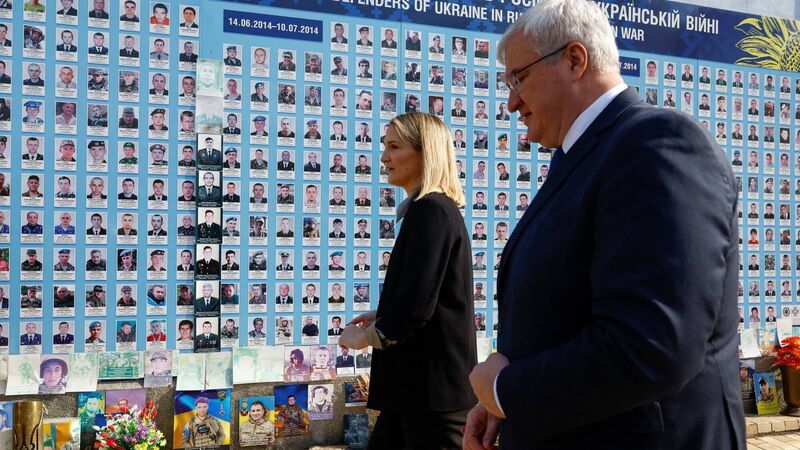
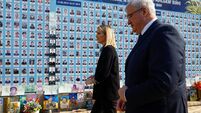
Ukrainian foreign minister Andrii Sybiha and minister for foreign affairs Helen McEntee visit the Wall of Remembrance of the Fallen Defenders of Ukraine outside St Michael's Cathedral in Kyiv, Ukraine. Picture: Valentyn Ogirenko/Reuters
One of the more striking, if logically obvious, things about Kyiv is how few children there are.
It's not that there are none, there are just noticeably fewer than you might imagine in a city this big.
In truth, there just aren't as many people, generally.
Russia's full-scale invasion of the country has meant that up to one third of Ukrainian children remain displaced, while many families have seen their plans for more children disrupted or ended.
In Kyiv, 940 of the children born last year were born at a facility co-funded by Ireland through the UN's Population Fund.
Due to the war, 20% of those were born prematurely. That is nearly three times the rate in Ireland.
Foreign minister Helen McEntee visited the facility on Wednesday as she finished a two-day visit to the Ukrainian capital, a day which began with an enhanced air raid siren.
Russian drones had been spotted some 30km from the centre of Kyiv, which on Tuesday hosted foreign ministers from across Europe.
On a gloriously sunny morning, Ms McEntee met with her Ukrainian counterpart Andrii Sybiha just yards from both her hotel and his ministry of foreign affairs.
The two walked along a memorial wall adorned with photos of the fallen in the country's war with Russia, but it was only when one looked up did one realise that these soldiers had died in 2014 during Russia's offensive to take Crimea.
It was a jarring reminder that what began four years ago was merely another chapter in Russian aggression against its neighbour.
Inside the imposing ministry building, next to where Ms McEntee and Mr Sybiha had their joint press conference, the ministry has a display of drones.
Land, air, and sea, defensive and offensive, Ukrainian drone technology is a large component of what has kept it fighting the war.
In the marble lobby of the ministry, all kinds of drones are on show, including land-based vehicles which can be used to transport injured troops away from the frontlines.
Later at the clinic, Ms McEntee is told that the midwives at the facility have one ambulance, which goes to rural and hard to reach places and at the outbreak of the war did not have mobile incubators and were forced to bring seriously sick children to a bunker which was ill equipped for their care.
They simply did not, the minister is told, foresee the scale of the damage and how it would affect children.
In response, Ireland is part funding a bunkered hospital facility in Kharkhiv, which still sees much on the ground fighting.
To round out the visit, Ms McEntee's final engagement is the opening of the permanent home of the Irish embassy in the city.
Ambassador Jonathan Conlan and his team have navigated an office move under trying circumstances and the reality of that is brought home by his opening remarks featuring both an air raid protocol and a moment's silence for the fallen, a common practice in Ukraine.
Outside the office there is an ad which is common across the city. It reads that Kyiv is "ready for you, after the victory".
As the people left on what were surely once bustling streets, mill around, it is hard to imagine when that might be and what effect it will have had on those children.
CONNECT WITH US TODAY



Be the first to know the latest news and updates