Limerick mayoral experiment will fail without legislative review
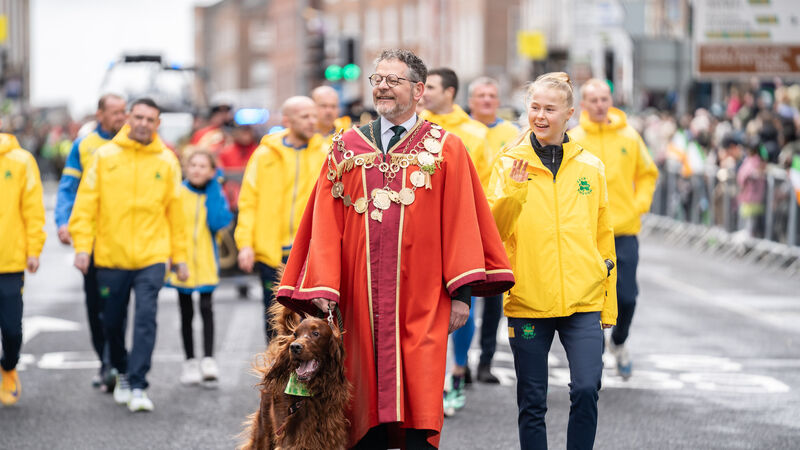
Limerick mayor John Moran at the city's St Patrick's Day parade with grand marshal, marathon champion Ava Crean. Picture: Karlis Dzjamko
At present, in 30 of our 31 local authorities, mayors are elected by their fellow councillors to serve for a 12-month period. Mayoral elections are usually pre-determined based on the political power in council chambers, and it is not uncommon for pacts and voting arrangements to be in place.
The alternative model of directly elected mayors is an appealing and popular one and is a traditional feature of local government in the US, Canada and Japan. In recent years, directly elected mayors have been introduced as a reform measure in England, Italy, Poland, Hungary and Germany. The core idea is that a mayor would be elected to lead their local authority, voted directly into power by citizens/residents, typically for a five-year term.
It is difficult to argue against directly elected mayors on democratic grounds, given we are talking about electing leaders directly by popular vote. Proponents of this model portray directly elected mayors as being more visible, more accountable, more legitimate and more powerful than any other sorts of local leader.
Legislation was passed in 2001 to introduce directly elected mayors, for a five-year term, with executive powers from 2004. The 2001 act lacked detail about the precise functions of the mayor and how the office would impinge on the traditional role of the city/county manager (now called chief executive).
These issues were never clarified, and, in a dramatic shifting of positions, the government repealed the directly elected mayor proposal two years later. The idea was put on hold until 2007 when a coalition government was formed with Fianna Fáil, the Green Party and the Progressive Democrats.
The parties produced a programme for government, which pledged to introduce a directly elected mayor for Dublin with executive powers by 2011. By the time the government left office nearly three years later, no legislation had been produced in this regard.
It was a further three years before the issue of directly elected mayors came forward again in legislation, this time under then local government minister Phil Hogan’s Local Government Reform Act, 2014. The legislation proposed the holding of a Dublin plebiscite on the issue on the same day as the 2014 local elections.
However, the minister controversially included a provision that each of the four local authorities which constitute the Dublin Metropolitan Area would firstly have to individually adopt a resolution in favour of holding the plebiscite. The insertion of this veto power for any one of the four Dublin local authorities was a curious move and always had the potential to open the proverbial can of worms.
And that's what happened. Three of the four Dublin local authorities comfortably adopted resolutions in favour of the plebiscite, but Fingal County Council did not and that was the end of it. That is, until 2019 when it was announced there would be local votes on the matter in Cork City, Limerick and Waterford, with Dublin to get a Citizens’ Assembly as an initial step. Limerick said yes by 52.4% to 47.6% while Cork and Waterford narrowly said no.
The Local Government (Mayor of Limerick) and Miscellaneous Provisions Act was only signed into law in March 2024, and it was announced the historic election in Limerick would take place on Friday June 7, coinciding with the local elections.
An impressive total of 15 candidates were on the ballot paper, seeking to become the first directly elected mayor in Limerick (and Ireland). Independent candidate and former Department of Finance secretary general John Moran topped the poll with 18,308 first-preference votes and was eventually elected after the 12th count.
It has not been smooth sailing for Moran since taking office. At the heart of the problems afflicting the Limerick mayoral experiment are three essential issues — the cautious nature of the legislation, the failure to build relationships, and the weakness of the Irish local government system itself.
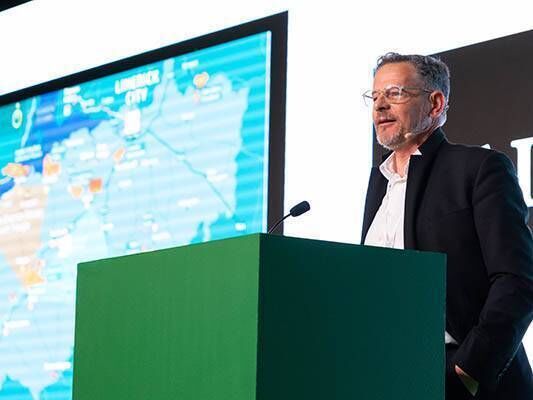
The Limerick legislation is centred on the establishment of a three-pillar structure comprising the mayor, the elected council and the director general (formerly the chief executive). The reserved functions of the council were not altered, meaning Moran is answerable to elected councillors. There has been a limited transfer of executive functions from the director general to the mayor.
Overall, the legislation is cautious, with the government taking the option of granting limited powers to the mayor that could be reviewed later. Moran has soft powers — for example, the Limerick Mayoral and Government Consultative Forum (established by the legislation) facilitates formal engagement between the mayor and central government by way of regular meetings.
The relationship with the council’s director general Pat Daly has been difficult — to the extent that Moran alleges he was "physically manhandled" by the former chief executive.
Equally, there is an obvious jostling for power between the mayor and the councillors. This was exemplified by the fractious council meeting in February when Moran left County Hall, saying he felt unwell.
In his absence, the elected members reconvened at 10.45pm and passed the local authority’s corporate plan. The ‘co-habitation’ between the mayor, councillors and the director general requires adaptability from all but, to date, this has not been apparent.
Many councillors oppose the concept of directly elected mayors; one obvious reason for this is that it denies five councillors (most likely drawn from the main political parties) having a go at the mayoralty under the traditional system.
If a directly elected mayor and the councillors cannot work together, everything falls apart. This happened in recent years in Bristol where councillors felt sidelined and triggered a referendum that saw the role of directly elected mayor scrapped in the city.
Limerick has been afforded a unique opportunity to lead the way and set an example for the rest of the country to follow. However, Limerick is also the guinea pig for a mayoral model that has taken a quarter of a century to implement. This brings pressure and intense scrutiny.
As Minette Walters wrote in , "I am only interested in beginnings, for there is so much hope at the beginning. The end has no merit but to demonstrate how badly that hope was misplaced."
We may be at the beginning of a new dawn for local government in Ireland or we may be guilty of grafting an unnecessary mayoral layer on top of a weak and dysfunctional system. In 2023, the Council of Europe’s Congress of Local and Regional Authorities produced a damning report on local democracy in Ireland, citing intense centralisation and tellingly noting: "There are no signs that central government supervision is about to be relaxed", and "the range of responsibilities handled under local self-government is clearly fewer that in most European countries".
In my view, an urgent review of the Limerick mayoral legislation is needed — we cannot wait until next year. By that point, the Limerick experiment will probably have failed. This will give the Government — already showing no enthusiasm or urgency on the issue — an excuse not to proceed with the mayoral model in Dublin or elsewhere.
- Aodh Quinlivan is a senior lecturer in the School of Society, Politics and Ethics at University College Cork
CONNECT WITH US TODAY



Be the first to know the latest news and updates