An Iranian woman’s war diary: 'The news called it carpet bombing'
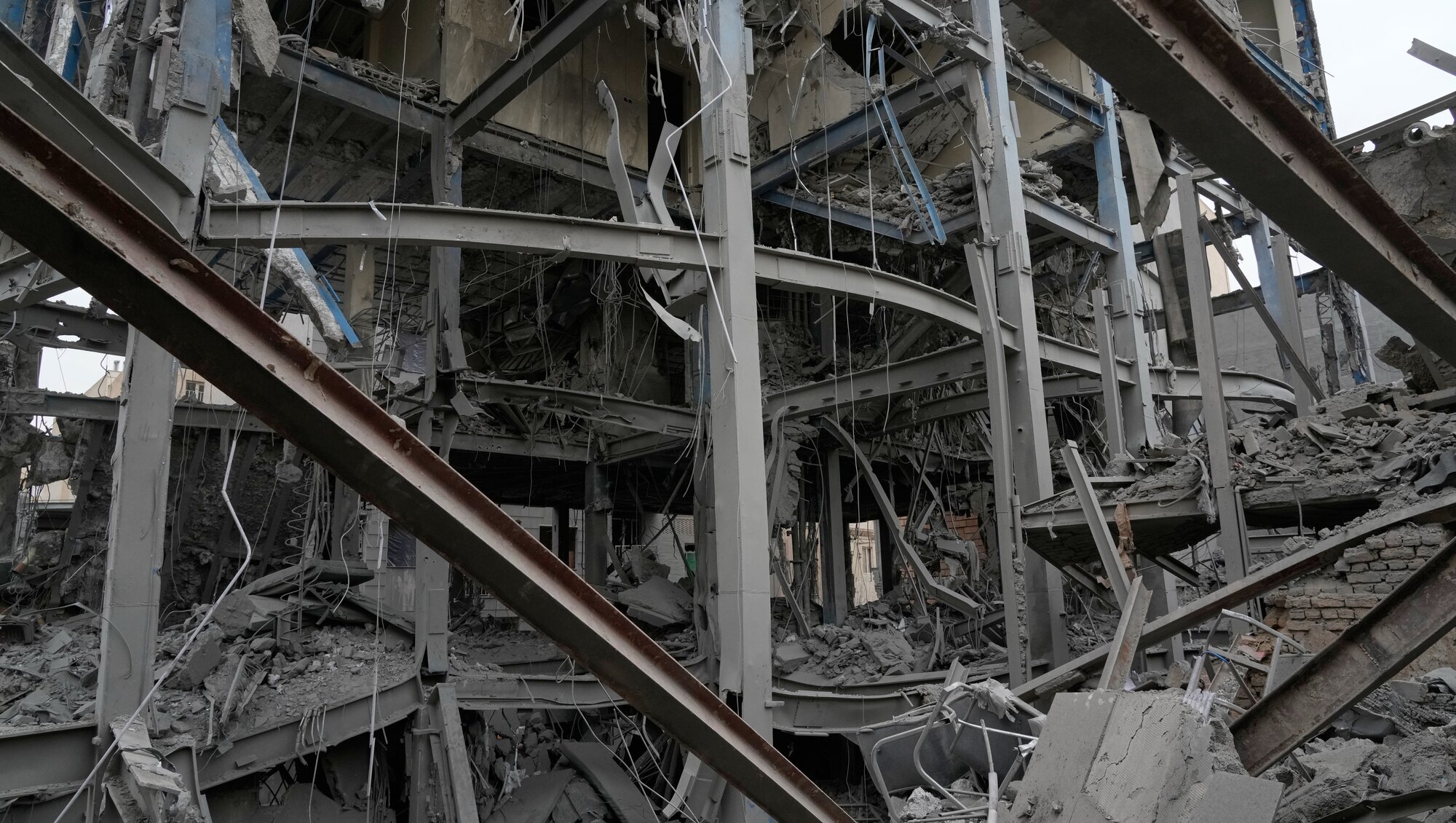
The shattered structure of a police station after it was hit in a US-Israeli strike in Tehran, Iran. Picture: Vahid Salemi/AP
No, not everyone can or wants to leave the cities; many have nowhere to go. Many still have to work in the cities for their own survival and that of others.
Many lack the psychological capacity for displacement for an unknown duration, as it would further damage their nerves.
Many prefer to die in their own homes, and many worry that if they leave, there will be no home left to return to.
No, not everyone leaves the city.
On the evening of the second day, large gatherings for mourning the ‘Martyr Leader’ (!) took place in main squares and large mosques.
When I stood on the sidewalk, I felt my whole body go cold; a shiver ran down my spine and my eyes grew wet with terror.
I saw people with flags, slogan-bearing headbands, and photos of Khamenei in their hands, screaming from the depths of their souls “Death to America” and “Death to Israel”.
Simultaneously, other images from another time came to life in my mind: people shouting “Death to the Dictator”, being shot, and their blood staining the streets; the crowds who raised their voices in protest nearly 50 days ago and were killed.
The two images merged, and I trembled.
Under my breath, I said, “People are killing each other; people are tearing each other apart,” as a lump formed in my throat.
I looked at the devoted followers of the leadership and thought about Reza Pahlavi’s [the son of Iran’s last Shah] so-called ‘call to action’, seeking refuge in God to prevent the war pictured in my mind from becoming a reality.
I saw the true image of a fractured society within that uniform march.
As an Iranian, seeing that image was the hardest thing I could witness.
Finally, out of millions of configurations, proxies, and VPNs, one worked, and I connected to the internet for a few minutes.
I had received dozens of messages from all over the globe; everyone was worried and frightened.
I sat down to reply to the “lights of my life”, and in the middle of some replies, I burst into tears.
It was not a calm night.
From 12:30am until 2:00am, they hit repeatedly, as if there were an imaginary line and bombs were lined up to explode in sequence.
The news called it ‘carpet bombing’.
Whatever the hell it was, it was massive and horrific.
You felt as if the whole city were falling apart. Karaj and Tehran endured the hardest night of the war that night.
The anxiety was so high that my friend Z said, “Let’s distract ourselves,” and we started gossiping, through a local chat group, about people we knew.
In the other group, the conversation turned to “I'm wearing this outfit; if I die and my photo is shared, don’t laugh,” which led to talk of breast sizes, university memories, and professors.
Occasionally, we would just say, “This one was very intense and close.”
That night passed bit by bit until nearly 3am with this avoidance, joking, and giggling.
If it weren’t for the Iranian sense of humor, we would probably all have been hospitalized in an asylum.
Eleven or twelve years ago, I saw Christopher Nolan’s Batman trilogy for the first time.
For some unknown reason, the scenes of explosions caused by the Joker remained vivid in my mind.
The night I watched the trilogy, I had a nightmare.
In my dream, I saw every building in the city being bombed by helicopters one by one, exploding just like in the Joker movie, with glass shattering everywhere.
The explosions were endless, and I was so terrified in my sleep that I woke up with a loud scream.
I found Mom hugging me, saying, “Don’t be afraid, don’t be afraid; it’s just thunder.”
The thunder was so powerful that all those wall-to-wall glass windows were shaking in the most terrifying way.
The sound of that shaking, combined with the thunder and the movie I had watched, had caused my nightmare.
As Mom held me, she asked what I had dreamed about, and with a voice that barely came out, I said, “War.”
Mom laughed and said, “My dear, war only exists in dreams; don’t be afraid.”
These days, when those damn windows shake, those horrific scenes repeat in my mind.
The explosion, the shattering glass, the fire entering — and then the scene ends, the camera turns off, and there is absolute darkness.
We had gone to my aunt’s villa so we could visit relatives who went there.
I also wanted to get some strength and energy from seeing my dear S and her even dearer child.
S is always witty and lively, and she has a strong sense of femininity and motherhood.
S, in her mocking tone, was saying, “The [large village] mosque is so big they might suspect the IRGC [Islamic revolutionary guards] or Basij [state-backed volunteer militia] are hiding people and ammunition here; if they hit the mosque, only a memory of us will remain,” and then she would burst out laughing.
Tonight, when they showed the fathers of the Minab children crying, I couldn’t take it anymore and cried with them.
[An attack on an Iranian primary school in Minab killed at least 170 people, most of them children]
What was the difference between those children and the children killed in the protests of last January? What was the difference between the life of Khamenei’s grandchild and dear Kian?
[Kian Pirfalak, 9, from Izeh, who was shot dead in November 2022, became one of the most poignant symbols of the 2022 protests sparked by the death of Mahsa Amini, 22, following her arrest for allegedly violating rules requiring women to wear the headscarf.]
Why do people draw lines when it comes to mourning the lives of innocent people? Why can't they just weep for a lost human life, regardless of this damn ideology?
I think about the fact that we didn’t come here to die; we didn’t come for war.
We deserved to live as much as any other human being.
We fought for life.
But the black and evil hands of the devil came out of the sleeves of religious dictatorial governments, out of the sleeves of cursed America and Israel, and took our lives.
These days, more than ever, I think about the media power of cursed Israel.

CONNECT WITH US TODAY



Be the first to know the latest news and updates