Every Gazan student in Ireland is haunted by what they cannot express
We are like children in the dark, feeling for another being made of flesh and not just a ghost. We tell each other without words: You are still here, writes Abdallah Aljazzar
Every Gazan student in Ireland is haunted by what they cannot express

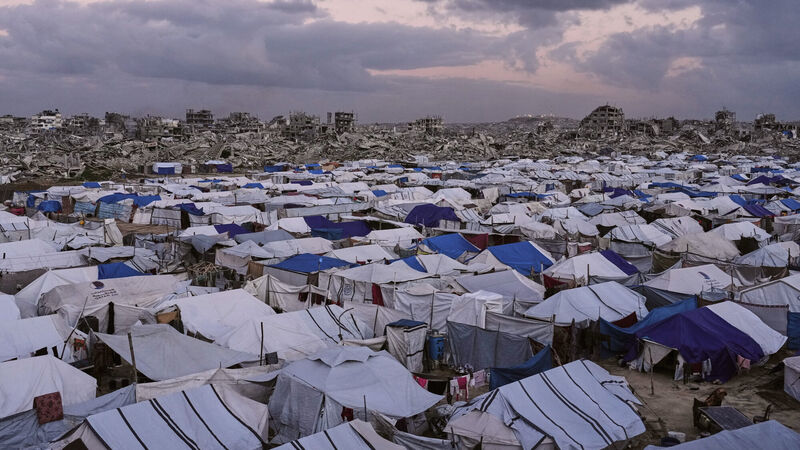
A tent camp for displaced Palestinians stretches across the Zeitoun neighborhood of Gaza City. Picture: Jehad Alshrafi/AP
O’Connell St in Dublin is a busy place on Saturday morning, especially in the rain. I had come from Maynooth by train to meet my friend Dima, and she had taken the Luas from UCD.

“Meet you by the spire,” I had said.

I saw her on the other side of the road — her long hair and that luminous smile — and I tried to signal “stay there, I will come to you”.

She was trying to tell me to stay, that she would come to my side. The light changed to green and we both ended up in the middle — no man’s land.

We laughed as we hugged on the wet day because, well, that was the story of us: Stuck in the middle between Gaza and the GPO.

“Let’s get coffee” she said.

We hurried to Butlers as a taxi hurtled past, hitting a puddle that splashed us.

Dima and I had a lot in common. We had been lifted out of Gaza in the dead of night last August and, whenever we meet, we don’t just hang out.

The first hug has a certain ritual to it. We are like children in the dark, feeling for another human being made of flesh and blood and not just a ghost. We tell each other without words: You are still here, and I am still here. It must not be a dream after all. We both have this suspicion that it’s all a fantasy. We wake up and the Irish mist dissolves us back into the tent cities of Rafah. But the coffee and the conversation, and being warm and out of the rain, make us feel real again. Yes, we are here. We made it.

“Did you hear about the new ceasefire? They are opening Rafah?” Dima asks me. “Tell that to my family,” I say.

“Yeah,” she says back.

 Gaza has ruined that word ‘ceasefire’. It means you can keep killing

(The United Nations estimates that more than 600 Palestinians have been killed and 1,500 injured since the October 2025 ceasefire was announced.)

Not exactly the lightest conversation to begin with. I was dying for a smoke, and I asked Dima if I could sneak out for a minute. She knows the bad habits of most Gazan men and says: “Sure. I’ll get something to eat. What do you want?”

We are both graduate students and, every day, we talk to our families. We know the situation on the ground and how different it is from what we read in the news headlines, which project the latest set of plans, predictions, and promises.

I come back and the rain has gotten even worse. I only got a few puffs because I couldn’t keep it alight. A smoker’s curse.

“Looks like we are going to be stuck in our tents today, Dima,” I say.

“That’s OK,” she says. I want to talk more than walk.

Benchmark for coping

Dima is always someone that I measure myself by to check if she is feeling the same as me or doing the same sort of things. She is a sort of benchmark for how well I am coping.

“What do you say to your friends, Dima, when they want to talk Gaza? Do you get into your story? Or do you change the subject?” I ask.

“That depends. I hate it when they think the ‘ceasefire’ is actually happening, or when they think ‘the war’s done, we can all get back to normal,” she says.

“Normal? What is that? My family still can’t get food and they were flooded a few weeks back,” I reply.

“As normal as a latte and a croissant,” Dima says, pointing to what is in front of us.

“I don’t know,” I say, “I feel guilty. We have more than enough while they still struggle. It is not fair.”

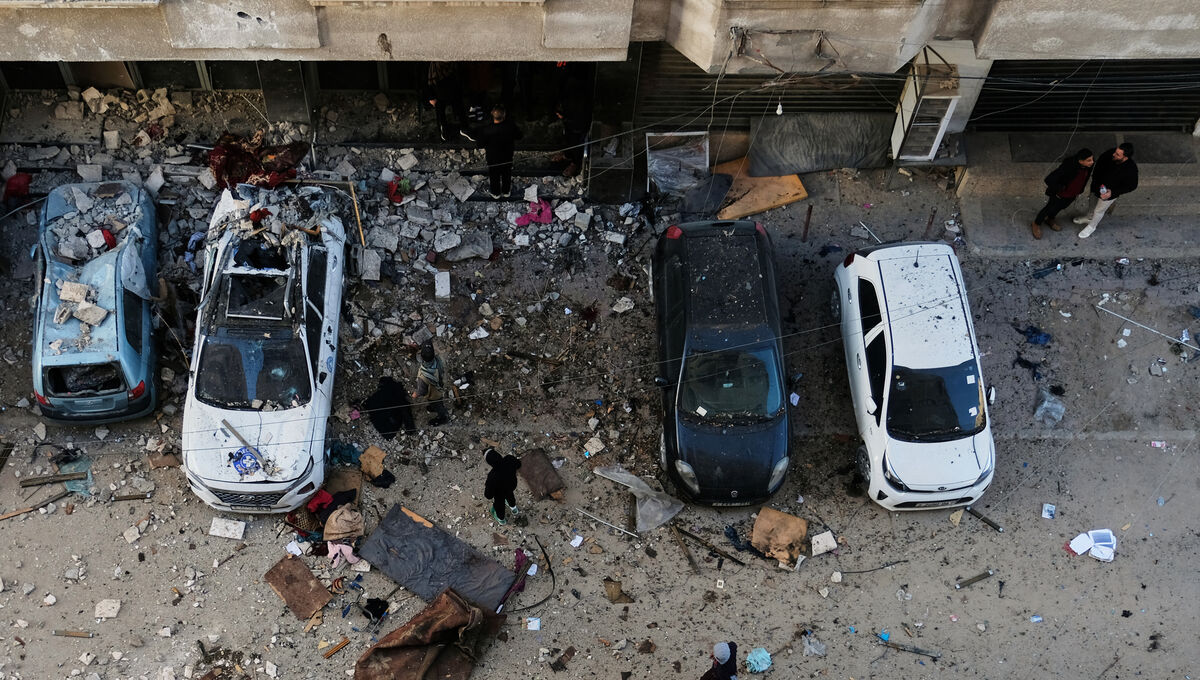
Palestinians survey the damage to an apartment building after an Israeli military strike killed several people in Gaza City in January. Picture: Jehad Alshrafi/AP

“Yeah,” says Dima, “but if we were still there, do you ever think we might be dead by now. I guess we got to take our chance, don’t you think?”

“I think that too, but some things just won’t go out of my head,” I say.

“Like what?”

“Waking up and thinking of where can I get flour for the family. Where can I get medicine for mum because she is sick?”

“What about you Dima?”

“I still hear my baby brother crying through the night because he is so cold,” she says.

“The body has a memory of its own, doesn’t it?”

Dima goes back to her theme.

“And then, they proclaim a ceasefire, and ‘peace in our time’, and we are supposed to let it all go — be friends again, and help build Trump casinos on Gaza beach,” she adds.

“Well it can never be the same — never. My brother Nour was kidnapped by the IDF and nobody knows if he is dead or alive. He is lost,” I say.

“I know you were so close to him, and you always tell me about him.”

“Yeah, it hurts just to think about where he is or what happened,” I add.

“What do you think: Is he dead or alive? I never know. But it’s not just my story,” she says.

“You must have lost a lot too?”

I catch myself. How dare I be so up front with a question like that. I don’t want to push any further. “Don’t answer if you don’t want to.”

Coded language

We are speaking in a code, the language of catastrophe, where the holes in the ground have also carved out larger holes in the language, silences that are louder than words.

Dima sips her coffee and stares away.

She says, as if to someone behind me: “Is ‘lost’ another word like ‘ceasefire’, you wonder? I lost my apartment keys the other night. I was carrying too many books and the laptop, and I knew I would find them. They were in front of me on the steps . But losing your home, your future, your family, your everything. Is that lost? Lost and found? Gaza lost and found,” she says.

“I hear you. I am supposed to be studying literature. I write my stories, but you always think is there anything left to say after genocide? The world says ‘yes there is’, and they love to use their words like ceasefire, and rebuilding, and technical councils, and the board of peace.”

Dima stares back from the door to me. I could see she was trying to catch the shadow of a memory, just like me.

“When I went back to find my home during the ceasefire in January 2025, I felt as if I had never been there before. It wasn’t until I came across the tall tower in front of my house with huge holes in it. I opened the door, and it was more like a small cow farm or worse,” she says.

“My room, my things, my toys, my little brother’s crib, all shattered in pieces. Everything was broken. It still is. 

Ceasefire just means you can go back, bury the dead, and see the damage. Ceasefire is the time you really get to see the war

“I’m so sorry, Dima,” I say.

“I have similar memories. Before the genocide, I used to stand on my balcony, pissing off my dad and begging him for money. The view from my balcony was so beautiful, Gaza was full of traffic, and people and kids going to school. Now, all I remember is silence, rubble, and that taste of dust in your mouth.”

“Abdallah, that day of the first ceasefire, we spent hours cleaning our house, and some neighbours were present, but most were missing,” she adds.

“Lost?”

“Lost.”

“So someone lost them, but oh, don’t worry, there is a ceasefire.”

“Yes, the war is over. Come find who is left. Mr Trump’s board of peace will set up a department of ‘Gaza lost and found’.”

“But we survived.” Dima said.

“Did we?” I said almost to myself.

Genocide destroys language

To look at us, you would think of typical student types having a Saturday together shopping.

You would have to listen closely to pick up the code words and the language of Gaza memories that haunts both of us.

Wars never end. They just change their shape.

As veterans from the fields of battle soon realise, the grenades and bombs they launched at their enemy can explode inside when they come home.

As for words like “lost” and “ceasefire”, we realised how the pain of genocide destroys language itself. It trivialises the tragedy.

How could Dima ever be able to convey to anyone what losing her home means?

How could I make someone realise the hole in my soul for losing my brother Nour?

Every Gazan student in Ireland is haunted by what they cannot express.

We make up a small army of survivors of the lost and found.

  • Abdallah Aljazzar is studying for a masters in literature of engagement at Maynooth University, where he is the
    programme co-ordinator for students coming from Gaza

x

More in this section

Revoiced

Newsletter

Sign up to the best reads of the week from irishexaminer.com selected just for you.

Cookie Policy Privacy Policy Brand Safety FAQ Help Contact Us Terms and Conditions

© Examiner Echo Group Limited