Ireland has deep ties to Lebanon and we cannot abandon its people
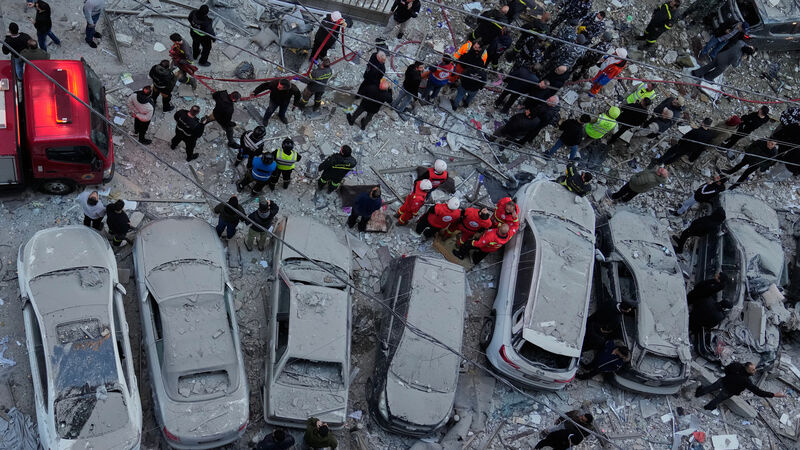
Rescue workers gather at the site where Israeli airstrikes hit apartments in Beirut, Lebanon, last week. Picture: Hussein Malla/ AP
The expansion of Israeli occupation and its bombing of Lebanon will devastate people there who had not yet recovered from the last wave of violence.
Once again, families have been forced from their beds and their homes as Israel rained bombs down on Lebanese communities.
What would typically have generated headlines around the world for its cruelty against civilians has now become only a moment’s thought — a fleeting piece of information in a firestorm of regional escalation.
How can we channel hopelessness into action when every single day brings new horror from our screens, live-streaming evidence in front of our eyes with no repercussions?
Read More
Today, civilians across Lebanon, Gaza, the West Bank, Syria, Iran, and beyond are paying the price for a world order that punishes some violations while excusing others.
The unlawful use of force by the United States and Israel has pushed the entire region into chaos.
Ordinary people bear the brunt of the consequences of this long-term failure to stop violations in the Occupied Palestinian Territory and Lebanon.
Lebanon is only one part of a widening crisis. Violence has already pushed 76,000 Syrian people to flee from Lebanon into Syria.
In the West Bank, widespread checkpoint closures are cutting people off from livelihoods, services, and humanitarian assistance.
Genocide in Gaza has not stopped and there remains a deliberate aid blockade. Every one of these outcomes was predictable and preventable.
Respect for international law amongst major powers has been in decline for decades, impacting the Middle East in particular; accelerated by the world’s failure to halt Israel’s illegal occupation and settlement expansion, its atrocities in Gaza, its international law violations, unlawful occupation, and invasion of Lebanon.
Ireland cannot break its hard-won trust with Lebanese communities. For decades, Ireland’s connection to Lebanon has been defined by service, solidarity, and a shared understanding of the shadow of different waves of aggression.
More than 30,000 members of the Defence Forces have served in Unifil since 1978, many forming deep ties with the communities of South Lebanon.
Their presence has given Ireland a unique window into the daily reality of a country living with cyclical trauma.
Hundreds of thousands of people have been forcibly displaced by Israel’s bombardments and ground invasion, as the conflict across the region reaches “a dramatically new and dangerous phase”.
Entire neighbourhoods have emptied overnight as families flee with little more than a bag of clothes.
Oxfam teams inside Lebanon are now supporting thousands across shelters in Mount Lebanon, the South, and the Bekaa with bedding kits, hygiene supplies, menstrual hygiene products, and clean water — the most basic ingredients of dignity.
These are communities that had already endured years of political paralysis, economic collapse, and previous waves of Israeli ground and air invasions on an already traumatised population.
For Irish readers, Lebanon is a place where loved ones have served, where Irish peacekeepers have lost their lives, and where families have welcomed our troops into their homes.
When forced displacement happens in South Lebanon, it happens in places Ireland knows intimately — Naqoura, Tibnin, At Tiri — and has built trust in.
According to the authorities, as of March 10, more than 667,000 people in Lebanon have now registered on the government’s online displacement platform — an increase of over 100,000 in just one day.
Almost 60m people across the wider region already rely on humanitarian aid to survive — a number that will rise dramatically if the violence continues.
Ignoring it is not an option — and pretending these crises are isolated is a dangerous illusion.
The international community must confront the root causes with urgency and consistency, and demand justice with action using any leverage at our disposal.
Oxfam teams across the country are coordinating with local partners, municipalities, and UN agencies to identify the most urgent needs.
This escalation is happening in a world where the foundations of international law have become negotiable.
The UN Charter’s rules on the use of force were designed not to constrain states arbitrarily, but to prevent exactly the kind of spiralling instability we are witnessing today.
- Independent investigations into all violations, regardless of perpetrator;
- Consistent diplomatic pressure on the US, Israel, and armed groups alike;
- International consequences (legal, political, and economic) for those who breach the norms protecting civilians;
- A clear rejection of the idea that some states are above the law.
We should continue to fund humanitarian response in Lebanon and across the region. Aid agencies cannot operate safely or effectively when violence spirals unchecked.
Three generations of Irish peacekeepers have maintained a presence on the hills of South Lebanon; the least we can do is ensure that the communities who welcomed them are not abandoned.
- Jim Clarken is CEO of Oxfam Ireland


CONNECT WITH US TODAY



Be the first to know the latest news and updates