Future Cork: 2026 must be year of infrastructure delivery for the city
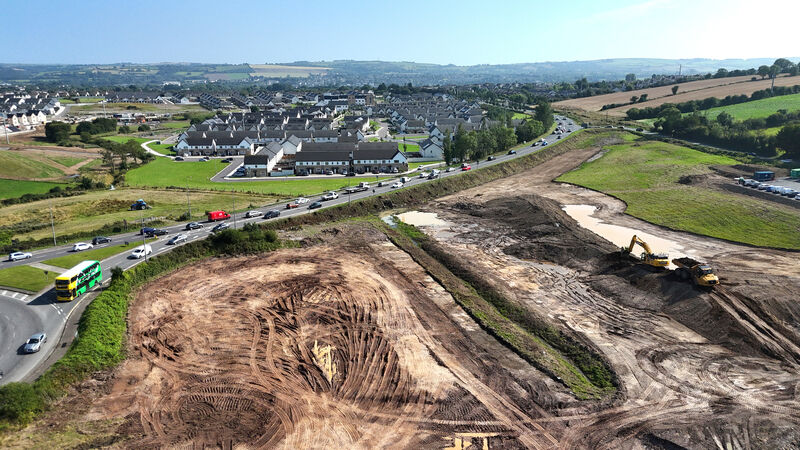
Earthworks in progress for the M28 motorway under construction at Shannon Park Roundabout, Carrigaline for the M28 Cork to Ringaskiddy motorway, linking Bloomfield interchange with Ringaskiddy port. Picture: Larry Cummins.
Over the last 18 months, we have witnessed intense policy activity and strategic positioning across construction and infrastructure.
The Government has revised the National Development Plan and the National Planning Framework and established the Infrastructure Delivery Task Force and the Housing Activation Office, which have the potential to improve how Government, agencies and local authorities coordinate.
Having introduced these policy changes, the focus must now shift to visible investment and delivery. While changes to policy, legislation and regulation are welcome, committed funding must now translate into tangible progress.
The time for discussion is ending because the industry is ready to deliver and eager to move. 2026 must be a year of infrastructure delivery and greater certainty.
Certainty is particularly important in the Southern Region, where ambition and growth continue at pace. More than 600,000 people live in Cork, two thirds of whom are within 25 kilometres of the city itself, making Cork a thriving second-city region.
Read More
Over the last number of months, authorities have granted planning permission for more than 1,500 apartments in Cork City, which is positive. Cork city and county delivered more than 3,720 homes in 2025, accounting for over 10% of the national total. These figures show progress, but we have the capacity and will to deliver more.
The year 2026 will test infrastructure delivery. Early milestones in the Accelerating Infrastructure Report and Action Plan, particularly those due in the first six months, will show whether new coordination and governance structures are delivering real change.
Cork is Ireland’s fastest-growing city and plays a key role in the economy of the south.
To support continued economic development and population growth, the region needs targeted, strategic infrastructure investment and clear delivery timelines. Critical projects such as the M20 Cork to Limerick motorway, the M28 motorway, the N25 Carrigtwohill to Midleton upgrade, the R624 Cobh Road, the Events Centre and Cork’s light rail system are essential to the region.
Delivering these strategic projects will strengthen Cork’s competitiveness and further establish it as a genuine economic counterweight.
One of Ireland's largest employers supports more than 6,000 jobs in Cork. However, the road network cannot adequately meet the commuting needs of these Cork-based employees, let alone local residents.
The Northern Distributor Road is essential to resolving transport issues in the area, but the project remains at pre-approval stage and has yet to secure funding.
The establishment of the Housing Activation Office (HAO) in 2025 marked a significant development, and its role this year will be central to boosting delivery.
The HAO must identify sites capable of delivering large-scale housing and coordinate agencies such as ESB, Uisce Éireann, Transport Infrastructure Ireland and the National Transport Authority to ensure infrastructure supports housing delivery. A site without connections to water, wastewater, transport or power cannot deliver homes.
Coordination must be swift, decisive and consistent because infrastructure delays create uncertainty and disrupt the entire development cycle. The HAO has begun engaging with local authorities, and we expect infrastructure projects across the Southern Region to progress in the coming months.
Cork’s role as a counterbalance to Dublin cannot rest on rhetoric alone. It depends on delivering the major transport and infrastructure projects that underpin population growth, employment and sustainable development.
The publication of the sectoral transport plan in the closing weeks of 2025 marked a positive milestone. The plan outlines committed investment and progressing projects; however, clearer delivery timelines and greater transparency are still required.
Recent policy changes are positive, but the industry has not yet reached the level required. In main contracting, Ireland continues to export significant expertise and services.
The stop-start nature of the project pipeline, particularly in public procurement, drives this trend. The absence of a predictable flow of tenders undermines stability. Tendering for major public works projects carries significant costs for large contractors.
Viability reforms also remain a priority. Improving project viability is essential to increasing delivery, particularly for apartments, housing and regional infrastructure. This links directly to the need for a reliable project pipeline.
Faster procurement processes, clearer timelines and a predictable flow of work are not abstract demands. They are fundamental to retaining skills, planning resources and sustaining a strong domestic construction sector.
Recent years have improved perceptions of construction, but more must be done to retain talent and encourage girls and young women to pursue careers in the sector.
Cork’s construction industry stands out for its innovation, experienced talent base and ambition.
However, delivery must remain the priority. We must remove barriers to funding and address infrastructure constraints. Clear pipelines, pace and practical solutions will drive progress. The frameworks are largely in place.
Quicker decision-making, clearer timelines and coordinated action are essential to achieving our objectives.

CONNECT WITH US TODAY



Be the first to know the latest news and updates