Shannon Airport and ICE deportation flights raise fresh questions over Irish neutrality
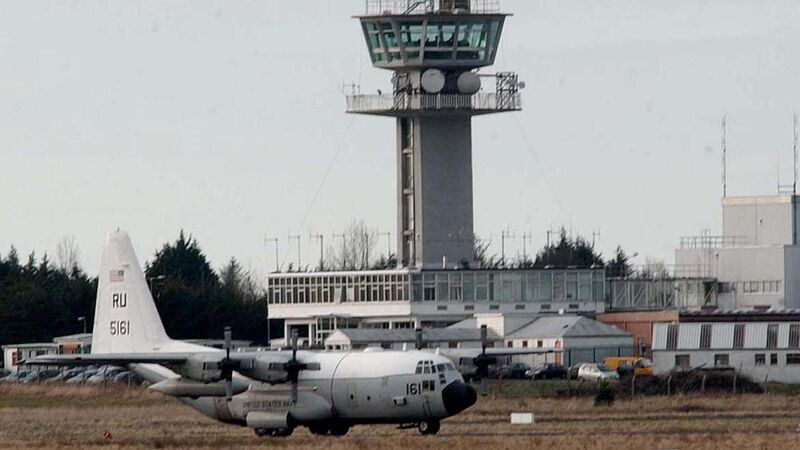
A US Hercules Transporter parked at the side of the Shannon Airport in 2003. File photo: AP/John Cogill
There is an image at the centre of the latest story regarding US state use of Shannon Airport that is difficult to shake.
Palestinian men, taken from their families in the United States, bound in shackles, sitting aboard an aircraft on Irish soil — before being abandoned at a checkpoint in the occupied West Bank with no support, no legal process, and no dignity. Even if they never stepped off the plane, even if the stop was “technical”, Ireland was part of the chain.
Chairperson of the Irish Palestine Solidarity Campaign, Zoë Lawlor, sees the ICE deportation flights as one more example of a state that is willing to ignore public sentiment in favour of geopolitical deference.
“The Government is always telling us how much they are doing for Palestine. It’s all talk,” she said. “No Occupied Territories Bill. No sanctions against Israel. Ongoing trade with Tel Aviv — and now, we are complicit in aiding ICE operations? It beggars belief.”
Read More
For Lawlor, the explanation is neither complicated nor accidental. “A deference to America. Complete submission. It’s craven,” she said. “We will go to Washington next month — and will anything be said or done?”
The revelations about ICE flights have sharpened that critique. These are not troop transports or formal military missions, but civilian aircraft operating under US government charter. Yet they slip through the same ecosystem that has allowed Shannon to become, in practice, a reliable stopover for American power.
“The reality is, we have thousands and thousands of Irish people consistently exercising their dissent regarding Palestine and Gaza,” Lawlor said. “And now we learn there is more going on than we even knew. If it wasn’t for the piece, we wouldn’t even know.”
None of what is now publicly known about ICE’s use of Shannon has come from any state-led intervention, but from journalists and independent flight trackers piecing together the truth from publicly available aviation data.
Former staff writer Gillian Brockell has been tracking the movements of ICE-contracted aircraft and documenting repeated stopovers in Shannon since last May.
Her reporting has also drawn attention to ICE’s wider “third-country removal” system, in which deportees can be routed through states such as Egypt and then transferred onwards to destinations where they may face imprisonment, disappearance, or state violence.
Brockell’s most recent update, published this week, showed another ICE flight travelling from Mesa, Arizona to Shannon and onward to Cairo — a route she notes has previously been used by ICE to transfer Russian dissidents and asylum seekers into the hands of Egyptian authorities before forced onward transfer to Moscow.
In other words, Shannon is not merely a stop on the way to Israel: it is increasingly appearing as a refueling node in a broader removal architecture that reaches far beyond Palestine.
That detail punctures the Government’s preferred framing: that these are isolated incidents, a handful of landings, a technicality. What emerges instead is a pattern — and one that the State appears content to ignore even as it becomes politically impossible.
The Irish Government’s first instinct, as ever, is to reach for procedure.
The central defence is that these flights fall under the category of “technical stops”: landings for refueling, maintenance or crew rest, where an aircraft is not picking up or setting down passengers or cargo.
Under international aviation norms and Ireland’s own approach, technical stops are generally permitted without the kind of advance political clearance that would be required for other categories of flight.
But a legal distinction is not a moral one. A technical stop is still a form of facilitation. It is the infrastructure of removal: fuel, time, a safe runway, and the quiet permission of a state that wants to pretend it is not involved.
Ireland is not a passive bystander here. Shannon is Irish infrastructure, protected by Irish policing, operating under Irish law.
A refueling stop may be routine to an airline, but for those on board it is part of a chain that begins with detention and ends with forced transfer — sometimes into the hands of occupation forces, sometimes into the custody of states with documented records of abuse.
For John Lannon of Shannonwatch, what is happening now has depressing parallels with the CIA rendition flights of the mid-2000s. The language has changed — “rendition” to “removal”, military transport to charter aviation — but the core pattern is familiar: credible evidence, public protest, and State refusal.
“Twenty years ago we were doing exactly what we are doing now,” he said. “Not just protesting on site, but making the authorities aware that rendition flights were being facilitated through Shannon Airport.
"This wasn’t conspiratorial — there was evidence then, as there is now with ICE. We implored the Gardaí to investigate, to board the flights. Nothing happened.”
The significance of that history is not simply that it happened. It is that the State learned the lesson that denial works. If you refuse to look, you can claim you did not see.
If you rely on diplomatic assurances, you can claim you were misled, and if you criminalise protest, you can shift the story from what is being facilitated to who is objecting.
The Shannon 3 — Áine Treanor, Aindriú de Buitléir and Eimear Walshe — walked onto the runway at Shannon in 2024 to protest US military use of the airport and Ireland’s complicity in war.
They were charged with offences related to trespass and interfering with airport operations.
Their case has become one of the most symbolic in the long history of Shannon activism — not because it was uniquely disruptive, but because of how determinedly the State has pursued it. The trial has been adjourned again, with the court seeking guidance from the Supreme Court.
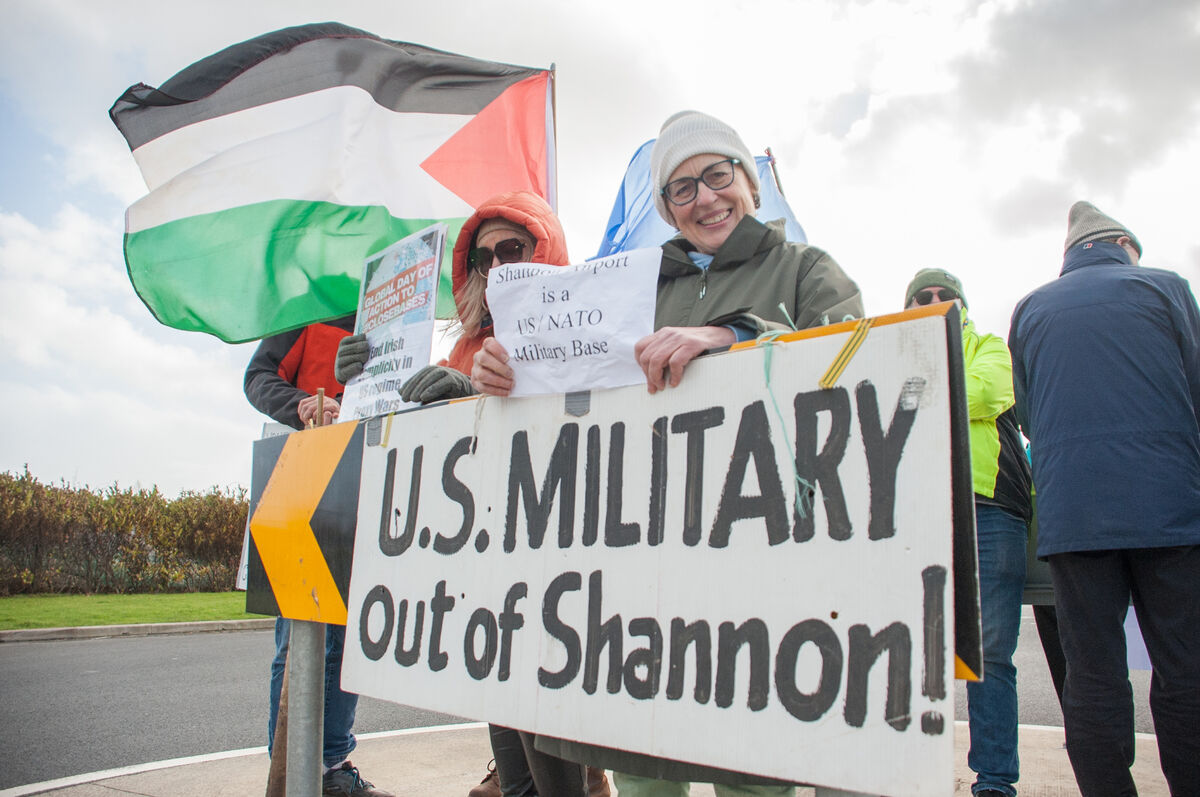
Supporters argue the repeated delays reveal what the case is really for. It is not simply about a runway incursion discouraging the kind of dissent that makes the State uncomfortable.
Prolong the proceedings long enough and the punishment becomes the process: legal fees, stress, uncertainty, and the slow message to others that direct action will be met with the full weight of the system.
As recently as Wednesday this week, Lannon said he received information that another ICE removal flight had landed at Shannon — a Gulfstream V operated by ICE charter Journey Aviation.
He called the Gardaí and asked them to inspect the aircraft, as Shannonwatch routinely does. The plane took off before any intervention was made.
“It’s not like the information is not out there,” Lannon said. “Surely there is enough evidence to warrant increased State scrutiny as to what is happening.”
Furthermore, both the Army and the Gardaí are on the ground to facilitate such an intervention. “Manpower isn’t the issue, Lannon argues, “willingness is.”
That line lands because it removes the usual excuses. The State cannot claim it lacks capacity. It has police, it has a military, it has an airport. It simply refuses to apply scrutiny to US-linked flights in the way it would to almost any other perceived security concern.
Ireland’s neutrality is often presented as a settled identity. Shannon exposes it as a performance: a set of words repeated in Dublin while the logistics of American power pass through Clare.
When the State allows US military-linked flights to refuel, the argument is framed as pragmatic: Ireland is not participating in war; it is merely providing transit.
When the State allows ICE removal flights to refuel, the argument becomes technical: it is not a traffic stop; no authorisation is required.
But in both cases, the same truth remains. A refueling stop is not morally neutral. It is how wars are sustained and removals are executed. You cannot claim distance from an operation while providing it with fuel.
Still, the Irish Government will continue to hide behind the language of aviation norms. It will continue to say it is complying with international obligations. It will continue to treat the issue as administrative rather than political.
But what the investigation has done — alongside months of work by the , and the meticulous flight tracking of Gillian Brockell — is collapse the space for plausible deniability.
These flights are happening. The routes are known. The aircraft are identified. The stopovers are documented and the pattern is visible.
For Lawlor, the continued public engagement matters as much as the exposure.
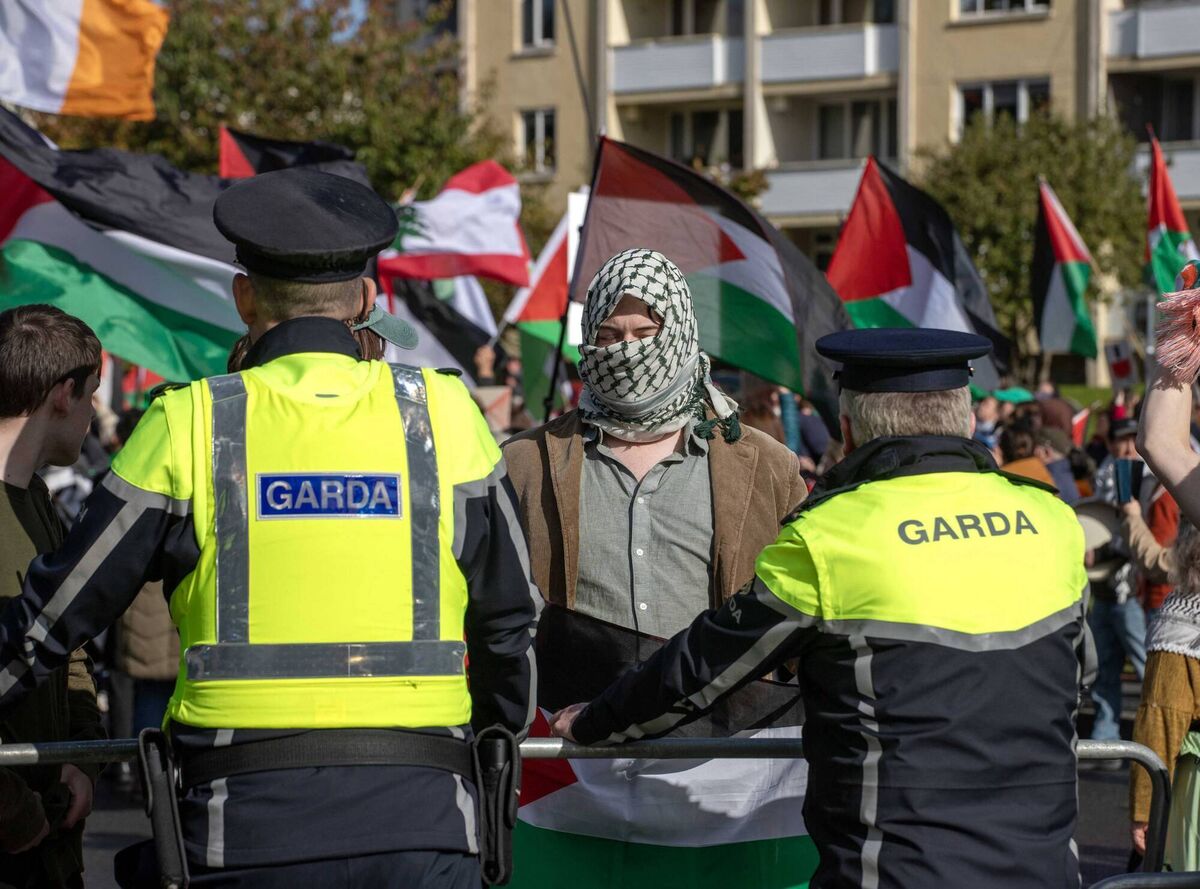
“For all the time that has passed, people are still engaged, still protesting and still horrified,” she said. “Time has not diminished the anger — if anything it has compounded it.”
The story of Shannon is often told as one of inevitability: a strategic airport, a small state, a powerful ally. But the ICE flights bring the question back to its simplest form.
If Ireland is willing to let shackled Palestinian men refuel on Irish soil on their way to the machinery of occupation, what exactly does the State believe neutrality means?
A technical stop may satisfy the law. It does not satisfy the conscience.
CONNECT WITH US TODAY



Be the first to know the latest news and updates