Colin Sheridan: Bad Bunny's show spoke the language of the colonised
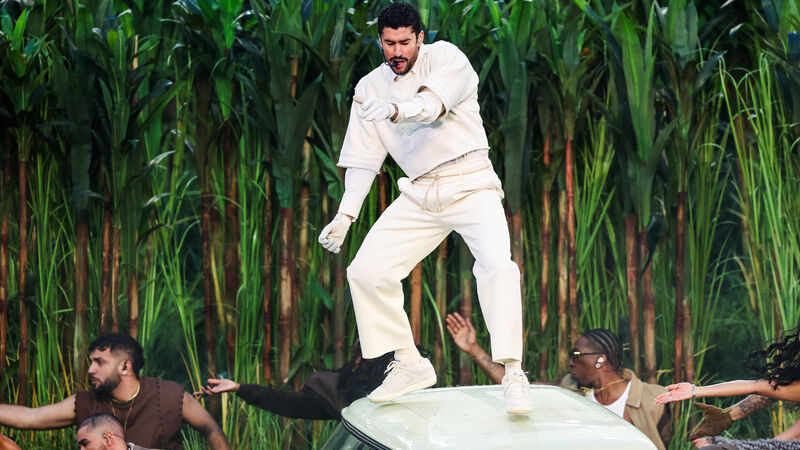
Bad Bunny’s Super Bowl half-time show, performed almost entirely in Spanish, was widely described as a triumph: a pop-cultural coronation for a global star.
For just a few minutes on Sunday night, on the biggest stage in American entertainment, the United States was forced to watch itself through someone else’s eyes.
Bad Bunny’s Super Bowl half-time show, performed almost entirely in Spanish, was widely described as a triumph: a pop-cultural coronation for a global star. But that framing, while not wrong, is also a kind of evasion. It suggests the show was a victory of progress. Something safe. It wasn't safe. It was deeply political. And in Trump’s America, that’s no small thing.
Within hours of the performance, the president had taken to social media to denounce it in the Trumpsiest possible terms, calling it “one of the worst ever”, and “a slap in the face to our country”. He also complained that “nobody understands a word this guy is saying”.
Trump wasn’t reacting to choreography, he was reacting to the idea that the Super Bowl could belong to someone who looks and sounds like Benito Antonio Martínez Ocasio. Ocasio did not simply bring Puerto Rico to the Super Bowl, he brought the nuance of its colonial status, its marginalisation, and its resistance.
He did it with a string of cultural codes that many viewers would’ve missed — because the point of codes is that they need to be hidden in plain view. This has long been a strategy for colonised people, especially when the coloniser is your majority audience.
They cannot vote for the US president unless they live on the mainland. They have no voting representation in Congress. Their relationship with the United States is framed as benevolent guardianship, but functions like a century-long limbo dressed up as modernity.
Bad Bunny’s music has always spoken from inside that contradiction. It’s reggaetón as celebration and reggaetón as record of a colonised culture forced to survive on its own terms.
That’s why the Super Bowl performance mattered so much, because it wasn’t merely representation, it was a Trojan Horse embedded in an institution that has historically preferred its politics invisible.
The NFL is not neutral terrain. It is, culturally, one of the most conservative spaces in American life — a corporate cathedral to patriotism, militarism, and the myth of national unity. It has spent years trying to scrub away controversy, and the league’s relationship with Trump-era culture war politics has never been subtle.
So when Ocasio took that stage, he was not simply performing, he was intruding, and he did so in a way that was cleverer than the predictable model of celebrity protest — the scolding speech. Instead, the show unfolded as a kind of encrypted broadcast.
Take the light blue dress worn by Lady Gaga. In Puerto Rican political symbolism, light blue has long been used as a visual reference to the island’s sovereignty movements — distinct from the darker blue associated with the officially sanctioned flag.
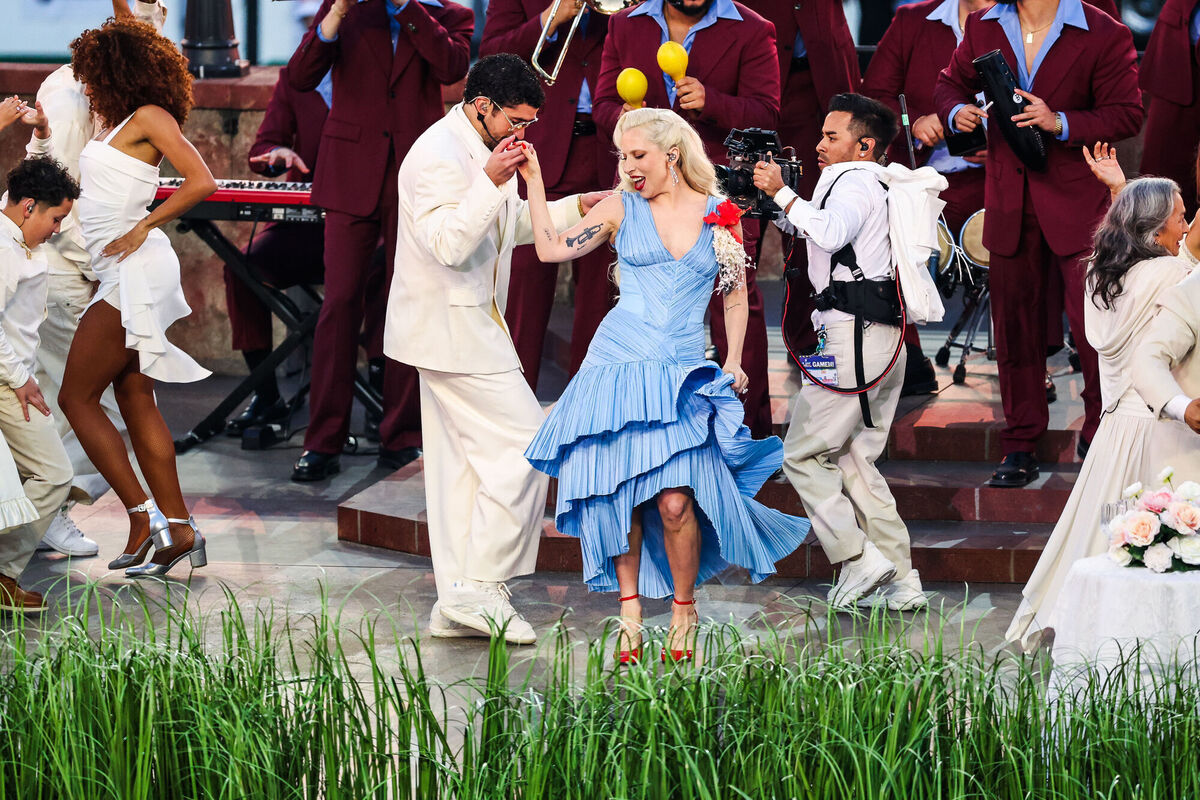
It’s a small detail, but that is the point: colonial resistance often survives through smallness, through signals that can pass under the gaze of the dominant culture.
Then there was the sequence in which Bad Bunny climbed electric poles. On first viewing, it played like a kinetic stunt.
But for Puerto Ricans, it was unmistakably a reference to the island’s power grid: its collapse after Hurricane Maria in 2017, the painfully slow federal response, and the ongoing crisis of outages and infrastructure decay. The poles were not props, they were a literal structure of neglect.
The interlude featuring Ricky Martin carried a similar charge, widening the lens beyond Puerto Rico to another place shaped by American colonial power: Hawaiʻi. Hawaiʻi’s annexation, the overthrow of its monarchy, and its later repackaging as a tourist paradise is one of the USA’s most successful acts of historical laundering.
And then there was the most obvious political act of all: the language. Bad Bunny performed in Spanish at a moment when Spanish itself has become politicised in the United States.
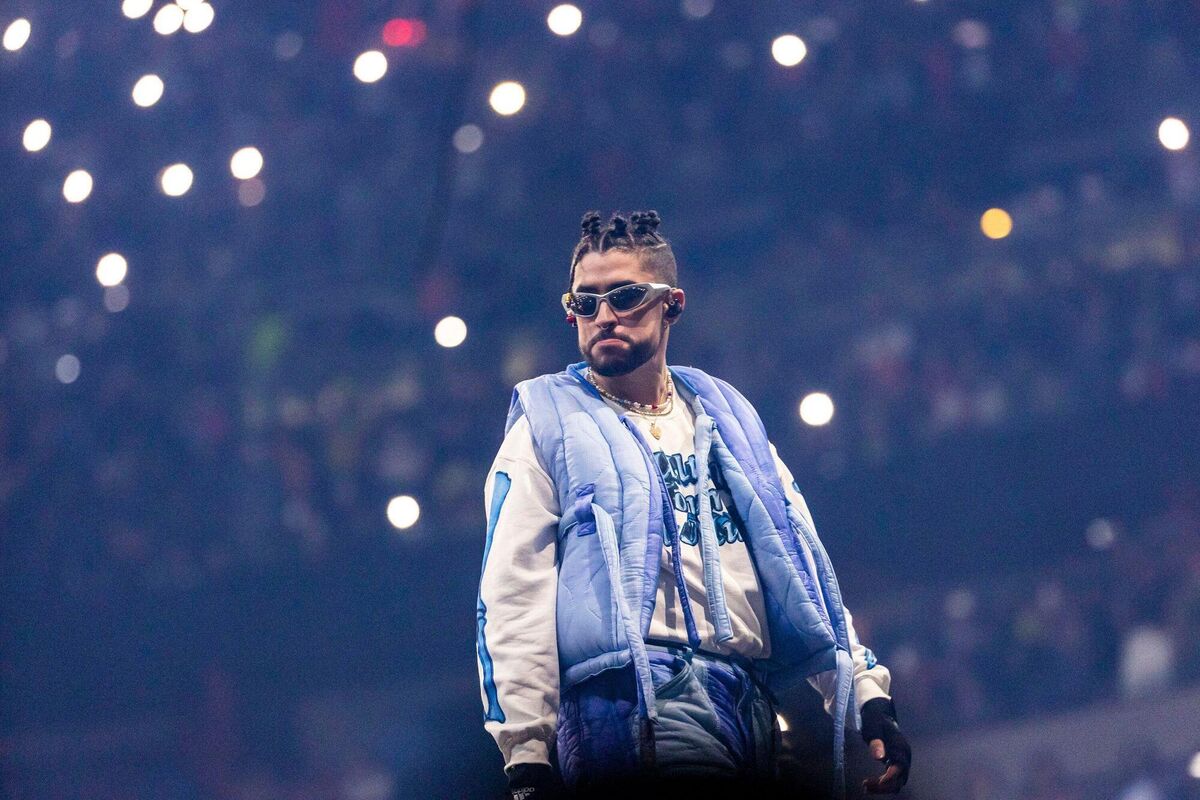
Language in America has always been a proxy for belonging, and in periods of heightened immigration enforcement and nationalist rhetoric, Spanish becomes a target. It is treated not as a language spoken by tens of millions of Americans, but as evidence of foreignness.
This is where the show’s political impact becomes clearest. Ocasio is not a new activist. His career has included open criticism of the US response to Hurricane Maria, solidarity with Puerto Rican protest movements, and outspoken opposition to ICE and anti-immigrant crackdowns.
That through-line didn’t vanish at the Super Bowl, it simply became more sophisticated — because the audience was larger, and the constraints tighter.
Trump’s reaction, in that sense, almost served as an accidental footnote — proof of concept. If the show had truly been meaningless, it would not have provoked such hostility. His outrage was not about musical preference but the boundaries of Americanness, and who gets to define them.
Bad Bunny’s show refused those boundaries. It did not ask for permission. It simply spoke — in the language of the colonised, on the stage of the coloniser, and with enough joy in its delivery to make the protest impossible to dismiss as bitterness.
CONNECT WITH US TODAY



Be the first to know the latest news and updates