Ireland is buying defence capability, without confronting what that actually requires
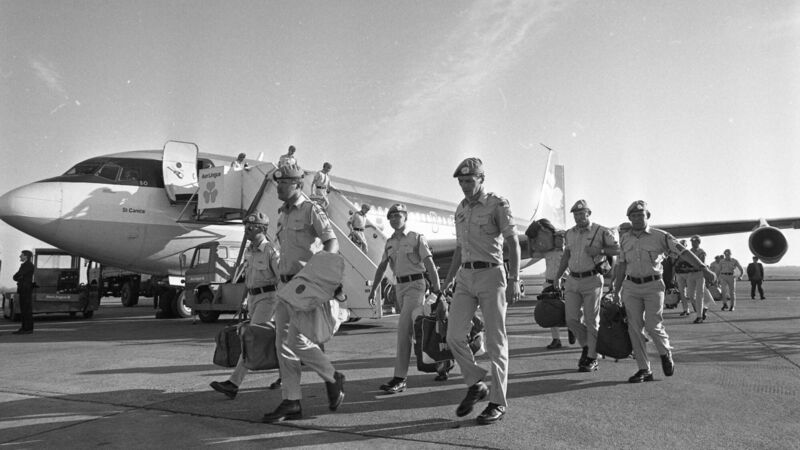
The 58th Unifil Battalion at Dublin Airport returning from a tour of duty in the Lebanon in May 1986. Picture: Independent News and Media/Getty Images
Ireland is now exporting its distinctive military culture into the European defence conversation. In a recent interview, General Seán Clancy spoke eloquently about preparedness, resilience, consensus, and urgency — themes that sit comfortably within Ireland’s long-standing approach to security.
What went largely unremarked, however, were the elements that distinguish defence from reassurance: coercive decision-making, unified command under pressure, lethality, and survivability.
This is not a personal criticism. It is a structural one. The Air Corps from which General Clancy emerged is, by design, largely non-combatant, focused on transport, surveillance, and humanitarian tasks. It produces professional officers — as does the Defence Forces more broadly — but not officers shaped by sustained exposure to combat arms, force-on-force decision-making, or the management of violence under uncertainty. His language reflects that experience.
The significance is not the individual, but the continuity. Ireland is now carrying into European defence forums the same cultural instincts that have shaped its own forces for decades: preference for consensus over command, reassurance over coercion, and process over decisive action.
That approach has functioned in peacetime. It is not the paradigm shift demanded by a security environment in which deterrence rests on credible willingness — and ability — to impose cost.
It operates an unarmed police service. Yet the State has never structured, trained, or legally prepared its Defence Forces to operate decisively in a fast-moving domestic kinetic environment in support of civil authority — let alone in a war-fighting role.
That omission is not accidental. It is cultural.
For decades, Ireland has designed a military optimised for presence, reassurance, and restraint. Peacekeeping and aid to the civil power are legitimate and often honourable missions, but both deliberately avoid coercion.
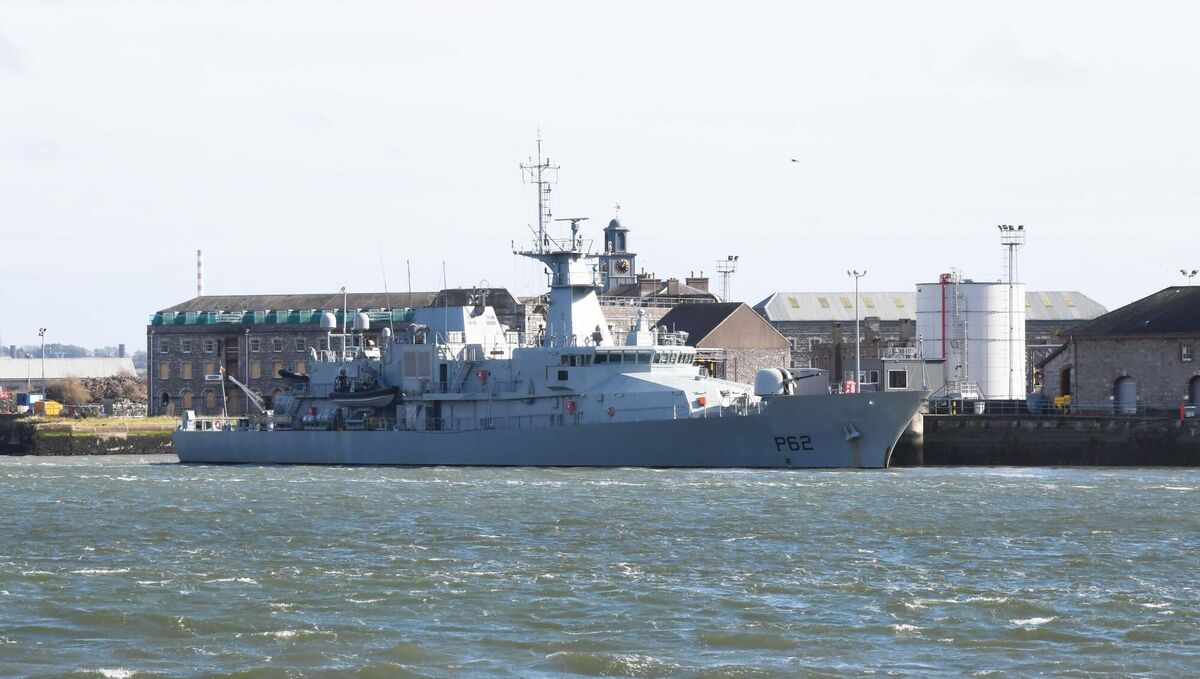
Peacekeeping prioritises visibility and stability; aid to the civil power confines the military to a tightly bounded, legally constrained supporting role. Together, they form a military analogue of community policing — visible, reassuring, and intentionally not designed to seize initiative or impose outcomes.
The consequence is predictable. A force that does not routinely practise coercion loses the institutional confidence, habits, and reflexes required to apply it at scale.
This matters because Ireland now speaks confidently about defence “transformation”, largely through procurement and policy language, while avoiding the harder question beneath it: what is the Defence Forces actually for when force becomes unavoidable?
The effects of this avoidance are clearest in logistics. Defence logistics remain anchored in processes that predate the modern State — paper-era ledgers with digital systems layered on top. Equipment accountability still relies on manual reconciliation. There is no comprehensive register of lost weapons or ammunition — an inconceivable gap in a combat force.
This is not a technical glitch. It is a cultural signal. Systems built for administration rather than combat never experience the pressure that forces reform.
When capability is not demanded, sustainment atrophies. New equipment has repeatedly sat in storage for years — in some cases over a decade — not because it was unsuitable, but because no operational requirement compelled its use. Capability did not develop because nothing required it to be exercised.
The same logic governs readiness. When stocks of small-arms ammunition ran low, the response was not emergency procurement to protect core competence, but instruction to reduce firing. Shooting was treated as discretionary. That logic fits a force shaped by non-kinetic missions. It does not fit a military that claims war-fighting as a core function.
This is not about blame. It is about incentives. Organisations become what they are repeatedly asked to do — and what they are never required to do.
Ireland largely missed the global war on terror. The Defence Forces have no sustained combat experience to draw upon and no institutional process for extracting and inculcating hard lessons from overseas engagements — including periods in Lebanon when Irish troops did face hostile action.
Fundamentals are taught. Reality is rarely stress-tested. Exercises are basic rather than immersive. Standards are set to be achieved, not reached.
Pride, over time, has detached identity from proof. Irish military self-confidence is often reinforced by humanitarian tasks, flood relief, and overseas deployments where contact is rare and English is the working language — valuable contributions, but not substitutes for combat learning.
These weaknesses have been formally identified. The Commission on the Defence Forces stated plainly that Ireland lacks a credible war-fighting capability. Earlier Nato assessments reached similar conclusions. The Independent Review Group and an ongoing tribunal point to deep governance failures. These are structural diagnoses of a system that is internally fragile, culturally cautious, and misaligned with contemporary demands.
Recent investment does not resolve that contradiction. Modern equipment has often been procured to meet external expectations, while operational reality lagged behind. Ireland ensured it did not appear behind peers during EU battlegroup rotations through emergency procurement.
Hybrid threats now dominate Irish security discourse because they sit comfortably within this inherited identity. They emphasise coordination, resilience, and observation. Nobody fires. Nobody bleeds. They allow Ireland to discuss security without confronting force.
But force is the foundation beneath law. Ireland invokes international law fluently while rejecting the coercive power that gives it meaning. It purchases defensive tools while avoiding the industrial, doctrinal, and cultural realities required to use them decisively.
None of this argues that Ireland must embrace militarism. A state may choose restraint. It may choose neutrality. It may choose not to exercise force.
What it cannot do — honestly — is claim to possess a military force while organising, training, and governing it as though it will never be used. Ireland is not struggling to buy defence equipment. It is struggling to absorb it.
The State now faces the task of introducing complex, unfamiliar military systems into an under-strength force, constrained facilities, and a logistics architecture still underpinned by centuries-old processes — within a culture shaped by restraint rather than decisive military action.
That challenge cannot be solved by spending alone. Cultural change is harder — and unavoidable.
And for those who would prefer that Ireland never develops a modern military instrument at all, the evidence suggests the cards remain firmly in their favour.
- Alan Kearney is a retired Irish army commandant with operational experience in Lebanon and Afghanistan. He has worked extensively in Nato-aligned counter-terrorism and marauding-attack training in Europe and the United States, and now works in the international defence sector on capability development and soldier survivability


CONNECT WITH US TODAY



Be the first to know the latest news and updates