Will Trump expose Europe's hypocrisy?
It seems unclear if Europe will put pressure on the rest of the world to ‘take a moral stand’ and cut off their trading ties with the US, asks Krishna Vadlamannati
Will Trump expose Europe's hypocrisy?

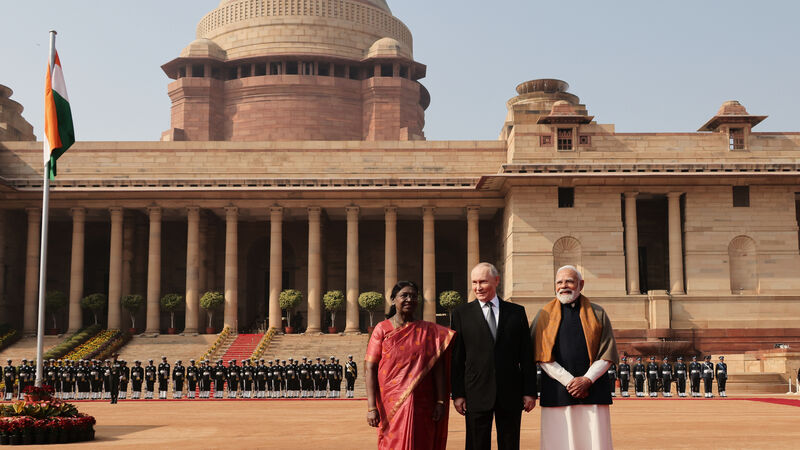
Vladimir Putin with Indian president Droupadi Murmu, left, and prime minister Narendra Modi at a ceremonial reception in New Delhi last year. India has made it clear that Europe does not get to decide the moral compass of the rest of the world. Picture: AP

A crisis is unfolding, not in some distant theatre of war, but right on Europe’s icy doorstep. Greenland - vast, strategic, sparsely populated, and politically tied to Denmark - has suddenly found itself at the centre of an alarming geopolitical threat.

Donald Trump, emboldened by the claimed success of a covert night raid in Venezuela, has made it abundantly clear he wants Greenland, and he wants it by hook or by crook. For now, it doesn’t look like an idle provocation. Trump has threatened massive tariffs on European countries should they resist his ambitions, and then somewhat rowed back these threats

His administration has already engaged Denmark and representatives from Greenland in what can only be described as coercive diplomacy. Strip away the bluster and the transactional language, and the implication is stark — the possible possession of sovereign territory against the will of those who live there.

What does this mean for Europe? And more importantly, will this moment finally expose Europe’s long-standing hypocrisy on the global stage?

To understand the bind Europe now faces, one must rewind to February 2022. When Russia invaded Ukraine, Europe reacted with unity and moral clarity. Sanctions followed swiftly, as did travel bans on Russian officials and high-net worth individuals, asset seizures targeting oligarchs, and financial restrictions on Russian officials. 

Vladimir Putin was branded an international pariah, capped by an International Criminal Court (ICC) arrest warrant that symbolically cast him as a global outlaw.

Europe said in unison that sovereignty was sacrosanct, borders could not be changed by war, and international law must prevail. Moral pressure was not just applied to Russia but exported outward. Countries such as India were lectured, sometimes repeatedly, urged to be on the “right side of history”.

Yet, even in that moment of supposed moral awakening, Europe’s principles were flexible. So long as it suited, Russian gas continued to flow into Europe. When the war dragged on and cutting Russian energy entirely became economically painful, a workaround magically emerged. 

India was allowed, albeit quietly, to buy Russian oil at discount, refine it, and re-export it to Europe. Moral absolutism, it turned out, could co-exist comfortably with economic pragmatism.

Fast forward to today, and Europe finds itself in a bind. If Trump follows through on his Greenland gambit, this will constitute a violation of sovereign territory against the will of the local population. Europe will face uncomfortable questions. 

Will Europe impose crippling economic sanctions on the US? Will it freeze American assets held in European banks? Will Ireland bar the 10 most prominent large American firms which contribute 56% of corporate tax revenues? Will Trump’s cabinet members find themselves banned from European capitals? Will the ICC be urged to issue an arrest warrant for an American president?

More awkward still, will Europe pressure the rest of the world to “take a moral stand” and cut off their trading ties with the US? Will European envoys lecture countries in Asia, Africa, and Latin America for maintaining strong political and economic ties with the US, just as they have done with India over Russia? This is not a hypothetical question. 

Only recently (in December 2025), diplomats from the UK, France, and Germany sparked a diplomatic row by publishing a joint op-ed in India condemning Vladimir Putin during his state visit to New Delhi. This provoked a sharp response from India — Europe does not get to decide the moral compass of the rest of the world.

So, will Europe now apply the same standard to America? If it does, then one could say Europe has truly arrived on the global stage.

But if it does not, the European hypocrisy will be exposed. After all, you cannot have two sets of rules — one for Russia occupying parts of Ukraine, and another for America taking Greenland — when both these acts defy the will of the local population.

Europe is about to discover a hard truth of geopolitics: what goes around, comes around. For years, Europe has operated under the comforting delusion that Europe’s problems are the world’s problems, but the world’s problems are not necessarily Europe’s problem. 

Greenland may shatter that illusion. And when it does, history, and the rest of the world will be watching keenly as to what Europe will do.

  • Krishna Vadlamannati is associate professor and director of the PhD programme in global human development at the School of Politics & International Relations at University College Dublin 

More in this section

Revoiced

Newsletter

Sign up to the best reads of the week from irishexaminer.com selected just for you.

Cookie Policy Privacy Policy Brand Safety FAQ Help Contact Us Terms and Conditions

© Examiner Echo Group Limited