‘In Myanmar, I could feed my children. I can’t do the same here’
From 2026, funding for humanitarian aid to support Rohingya refugees in Bangladesh will be halved, writes Eilis Staunton
‘In Myanmar, I could feed my children. I can’t do the same here’

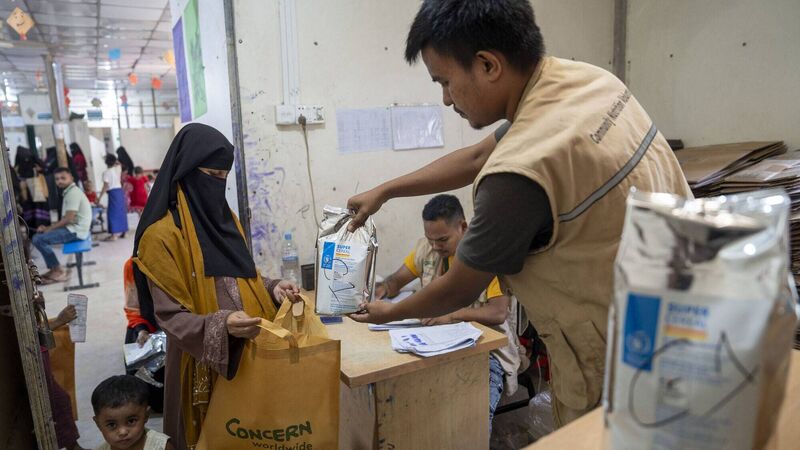
Concern runs several nutrition clinics across Cox’s Bazar, preventing and treating malnutrition in children under five and pregnant and breastfeeding women. Picture: Saikat Mojumder/Concern Worldwide

"Ronaldo, Ronaldo — we love Ronaldo,” the chants continue around me, as I fail miserably to brag about Ireland’s recent victory over Portugal to the large group of teenage boys and girls eager to get an opportunity to practice their English in Cox’s Bazar in Bangladesh, the world’s largest refugee camp.

Almost 1.3m people live in refugee camps in the hills outside Cox’s Bazar, a beach holiday destination for many Bangladeshis.


They are Rohingya people forced from their homes in neighbouring Myanmar due to violence and persecution.

The majority have been here for over nine years, when this area was just hills with tropical vegetation, where Bangladesh’s small elephant population once roamed.

The hills have been dug out. Small makeshift shelters —made from bamboo, mud, and tarpaulin — have taken their place. The hills’ geography means that heavy rains can lead to landslides and flooding, destroying these fragile homes despite the recent construction of cobble stone roads, paths, and steps.

When cyclones hit the camps, which is becoming increasingly regular, there is little protection. Fires are common within the crowded spaces, with people losing everything they have in moments.

The camps are densely populated with 45,000 people per square kilometre, compared to 73 people per square kilometre in Ireland.

My next conversation on the street is much more sombre in tone.

A young Rohingya man asks me in fantastic English why I am here in the refugee camps. I explain I’m here to see some of the Concern Worldwide-run nutrition clinics and speak to the mothers and children they support.

I ask him where he learnt English, he tells me in the schools in the camp.

He says that, in Myanmar, he did not go to school, as education for the Rohingya population was not a priority for the authorities there

However, as he’s in his early 20s, he has finished and aged out of education system in the camps. He tells me his dream is to go to university, but he doesn’t know how, and that he would love to apply for a scholarship. He ends our conversation by telling me life is difficult in Cox’s Bazar.

“People do not have any opportunity to work and earn money, so they are fully dependent on humanitarian aid, which means everything from food, water, shelter, health, education — everything. And with recent funding cuts, providing these services is getting much more difficult,” explains Manish Kumar Agrawal, the Concern Country director in Bangladesh.

“Most recently, there are the US funding cuts — but the cuts already started a few years ago. There’s fatigue amongst donors of how long they are going to support this crisis.”

From 2026, funding for humanitarian aid to support Rohingya refugees in Bangladesh will be halved.

Almost 50% of the funding for the Rohingya response came from the US.

The majority have been here for over nine years, when this area was just hills with tropical vegetation, where Bangladesh’s small elephant population once roamed. File Picture: Sonali Chakma/Save the Children/PA

$800m was the budget to support 1.3m people in 2025, it’ll most likely only be funded to the value of USD$400m in 2026.

Recent flare ups in violence in Myanmar has seen 150,000 people enter the camp in the last few months.

Concern runs several nutrition clinics across Cox’s Bazar refugee camp, focused on preventing and treating malnutrition in children under five and pregnant and breastfeeding women.

Three quarters of the population in Cox’s are women and children. Nine in 10 children are at risk of malnutrition.

When a child is malnourished, it can affect their growth, physical health, mood, behaviour, and many of the functions of the body.

Acute malnutrition weakens the immune system, leaving children at high risk of dying from common childhood illnesses as well as from malnutrition itself. In 2024, malnutrition rates were at 15.1%. They continued to climb in 2025.

Concern staff report that children are presenting at clinics and being diagnosed as malnourished, although they are on food rations provided by the United Nations.

These food rations have been reduced year on year, given the funding cuts, have been drastically reduced further since January 1

The clinic I visited was incredibly lively, lots of toddlers and young children running around, crying, not listening to their parents, curious to know who these strangers are, as they wait to be seen by nutrition staff.

For parents in Ireland who have brought their child to the public health nurse for their check-ups, the process is remarkably similar except for the use of the MUAC band — a small band that goes around the upper arm which using a traffic light red, yellow, and green system, indicates whether a child is healthy, malnourished, or acutely malnourished.

There are plenty of healthy-looking children in the clinics, thanks in large part to the treatment they have been receiving such as super cereal. It is a porridge-like dish that provides essential nutrients and can be made at home.

But there are children that are obviously severely underweight and malnourished, the weighing scales just confirming it. The clinic sees approximately 350 children a day. Of those, on average, 20 are identified as severely malnourished, while 50 are moderately malnourished.

Rihana* and her two children are among those supported by a Concern nutrition clinic.

“In Myanmar, I could feed my children properly, but I can’t do the same here. The food we receive for one month only lasts about 15 days. We struggle a lot for the remaining 15,” she says.

Funding was provided to help Rhiana start a vegetable garden around her home.

She’s able to help feed her children with the produce, while selling the surplus.

“From the money we get selling vegetables, we can buy different kinds of foods, medicines, and clothes for our children,” she says.

With the cut in funding, the money will not be there to support the additional activities such as home gardens and livelihood training which allows people to supplement the reduced rations they receive.

Organisations such as Concern will be forced to prioritise. As clinic supervisor Anamal Haque stressed: “We will have to switch from preventing malnutrition to treating the most severe cases.”

“If the proper nutrition and care is not provided in the first 1,000 days of life, these children might suffer from medical complications, their intellectual development will be disturbed, and their long-term development will be affected.”

A year from now, I dread to think what I will see if I were to visit this clinic again.

The small bit of hope and support that it gives to babies, toddlers, small children, and their parents in incredibly difficult circumstance, I fear will be gone.

It will be less full of the sound of happy and active children, and be replaced by the silence and cries of sick and hungry patients.

  • * Name changed.
  • Eilis Staunton works for Concern Worldwide. To learn more about Concern’s work visit Concern.net


More in this section

Revoiced

Newsletter

Sign up to the best reads of the week from irishexaminer.com selected just for you.

Cookie Policy Privacy Policy Brand Safety FAQ Help Contact Us Terms and Conditions

© Examiner Echo Group Limited