High-profile meetings put Ireland in world of our own on China visit thanks to ‘diplomatic traditions’
The EU and China are currently without a formal agreement, and trade is done through piecemeal agreements or, in recent cases, disagreements, writes Paul Hosford
High-profile meetings put Ireland in world of our own on China visit thanks to ‘diplomatic traditions’

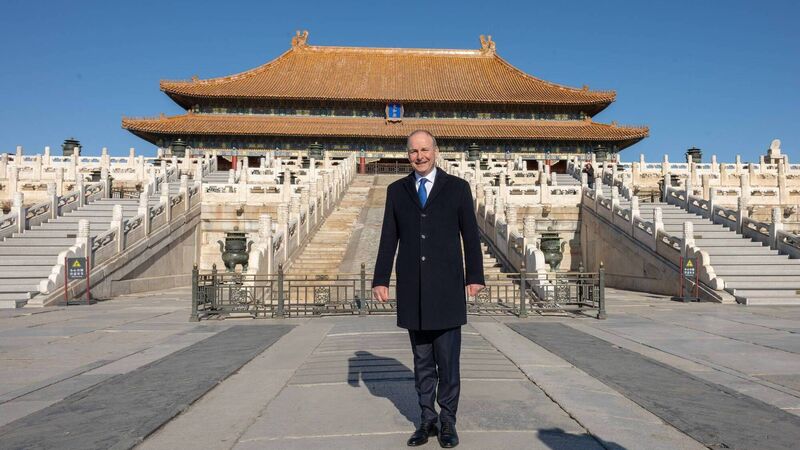
Taoiseach Micheál Martin visits the Forbidden City in Beijing as part of his state visit to China.


On day two of the Taoiseach’s visit to China, there was major news for one of Ireland’s biggest exports.

Yes, Westlife are coming.

The boy band will play a number of cities in China at the end of the month.

However, their performances will come too late for Micheál Martin. He will be back among matters domestic by then.

Depending on the mood of Fianna Fáil backbenchers throughout January, he may wish to fly to Shanghai or Guangzhou.

As Westlife, who are massive in China, announced their gigs, Mr Martin was on his way back to the Great Hall of the People to meet with chairman Zhao Leji.

General Zhao’s position as chair of the National People’s Congress makes him the third-ranking member of China’s ruling party.

As with Mr Martin’s meeting on Monday with president Xi Jinping, the opening statements focused on the warmth of the relationship between Ireland and China along with how strong the trade links are.

However, while those comments often require parsing or reading between the lines, it was the local media which gave a better insight into how the hosts are feeling about this week.

In the ruling party’s own newspaper, The Global Times wrote that Ireland could play a “bridging role” in China’s attempts to formalise a trade deal with the EU.

Wang Hanyi, a research fellow at the Shanghai International Studies University, told the newspaper that Ireland’s “pragmatic diplomatic tradition, and its economic needs, will enable Dublin to play a unique bridging role in mitigating extremist tendencies within the EU, focusing on practical co-operation with China”.

Data, AI, and pharamceuticals

She added that the two countries are expected to accelerate co-operation in a number of areas.

In the long term, “if breakthroughs can be achieved on key issues such as cross-border data flows, AI standards, and mutual recognition of pharmaceutical regulations, China-Ireland co-operation has the potential to become a pioneering demonstration zone for China-EU co-operation”, she added.

The EU and China are currently without a formal agreement, and trade is done through piecemeal agreements or, in recent cases, disagreements.

China recently hit the EU with 42.7% of provisional tariffs on dairy products, including milk and cheese imported from the bloc.

That move was based on preliminary results from an investigation opened by China’s commerce ministry in August 2024, which reviewed subsidies provided by EU countries for their dairy and other farm products.

It was launched as part of tit-for-tat measures as the EU investigated Chinese subsidies on electric vehicles (EVs), later imposing tariffs as high as 45.3% on Chinese-made EVs. But that wasn’t always the case.

Taoiseach Micheál Martin, centre, arrives at the Great Hall of the People to meet with Chinese president Xi Jinping on Monday. Picture: Andy Wong/AP

Previously, it took seven years for the EU and China to agree a deal which has never been implemented.

On December 30, 2020, the EU and China reached an agreement in principle on a comprehensive agreement on investment.

The text agreed upon was set to be translated into all official EU languages prior to being submitted formally to the Council of the EU for approval and to the European Parliament for consent.

However, in May 2021, the European Parliament adopted a resolution on Chinese counter-sanctions to EU human rights sanctions against selected Chinese officials in connection with reported human rights abuses in Xinjiang.

The resolution states that the European Parliament will not consider the agreement until Chinese counter-sanctions are lifted.

The agreement is on hold, but Mr Xi indicated he would like a “more comprehensive framework” to Mr Martin during Monday’s meeting.

This was further underlined by the level of the meetings Mr Martin has had in Beijing. Not only did he meet Mr Xi and General Zhao, yesterday he was received with a military reception ahead of a state banquet by premier Li Qiang.

This means the Taoiseach has met the first-, second-, and third-ranking members of the ruling party of China in short order.

Mr Li was quick to point out that his country was seeking strengthened relations with Ireland and the EU, making it hard to ignore the overtures that China is making towards the bloc.

Asked afterwards if he was in any way suspicious of the Chinese motives, Mr Martin accepted that countries “all have our interests”.

European member states all visit China to varying degrees, and all have strong partnerships with China on a trading basis, on an economic basis

“It is logical at some stage that the European Union and China will have to resolve trading issues. Just like we have with the United States ... where there were very significant issues at the beginning of last year,” he said.

While the flags which flew outside the tomb of chairman Mao were Irish, there is growing belief that Mr Xi is seeking an agreement with the EU which would be — in the words of one Irish export soon to hit China — unbreakable.

More in this section

Revoiced

Newsletter

Sign up to the best reads of the week from irishexaminer.com selected just for you.

Cookie Policy Privacy Policy Brand Safety FAQ Help Contact Us Terms and Conditions

© Examiner Echo Group Limited