Shona Murray: Europe at risk if it does not become a 'genuine federation'
Now that reality of Donald Trumps second administration has set in, Shona Murray asks what should Europe do?
Shona Murray: Europe at risk if it does not become a 'genuine federation'

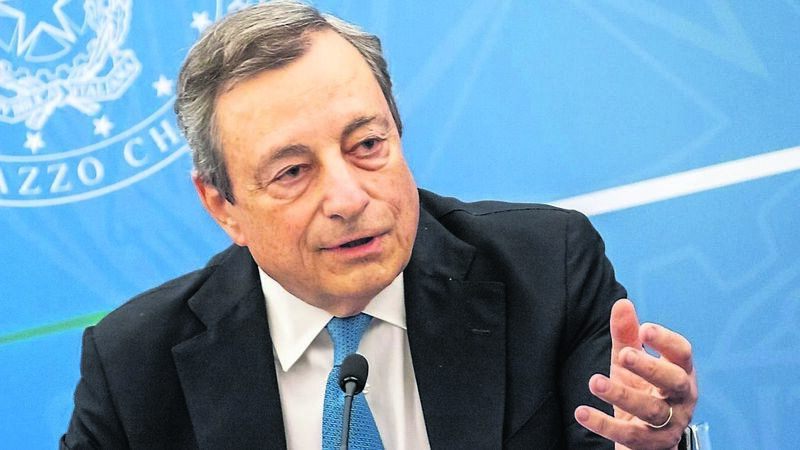
Former head of the European Central Bank, Mario Draghi, in his much-vaunted report of 2024 urged the EU to finally overcome burdensome obstacles existing among 27 member states delaying the completion of the single market. File picture: AP

ON THE eve of the US election in 2024, EU Commission officials said they were doing necessary preparations in case Trump was returned to the White House. Given his well-worn predilection for tariffs, it was foreseeable he’d threaten to deploy this “very powerful weapon” — like he did in the last administration.

A year on from the second term of Trump and across the EU, member states are accepting that he is not just the irascible, unpredictable — yet manageable — egotist they once knew from 2017-2020. 

His presidency is beyond anything they had imagined. There is now an acknowledgement in the EU that US relations are at a structural turning point, and Europe must act.

It doesn’t mean the EU and the US must be sworn enemies — certainly Europe has no interest in engaging in the type of coercion threatening US territory such as we saw from Trump over Greenland. Nor does it intend imposing economic hardship on allies through harmful trade measures.

And the US is still an important trade partner and is likely to remain so given how interdependent the two continents are. But the years of “shared values” and defending the post world-war rules-based system — albeit selectively — is dead.

The US administration is actively supporting far right movements across Europe to overthrow any centrist, democratic parties in government that might object to the imperialist, authoritarian policies of the US. It’s as simple as that. 

The EU is regularly demonised by Trump officials, with EU Commissioners referred to as commissars, and Brussels depicted as a repressive Soviet-like set-up dictating to voiceless member states.

Looking back at the threat analysis of European officials in late 2024 they were deluded, at best naive. The “worst case scenario” Brussels expected was whether Trump might reduce support for Ukraine and perhaps take aim at Nato and European allies for not doing enough on European security.

On the upside, Trump was deemed “the only one likely to pressure Putin to end the war in Ukraine, and Netanyahu to do a hostage deal to end the war in Gaza”, as another official said.

“We should be happy Europe will finally take its security seriously now that Trump is back,” an EU official messaged me just before dawn broke on the morning after the election.

Trump swept the board in the US Electoral College in contrast to expectations it would at least be a tight race. 

America had well and truly re-elected Trump, and all he stands for — cruel, lawless ICE gangs, an attempted coup, using the office of president to enrich himself and his family, and endless crude divisive racist diatribes on social media.

This is precisely why German chancellor Friedrich Merz — a committed Atlanticist with impeccable English rightly said “Pax-Americana” is dead. In the words of French president Emmanuel Macron, “we’ve had a big acceleration of history” in the last year.

Europe's choices

The key question for Europe is — now that reality has set in, what should we do?

Former head of the European Central Bank, Mario Draghi, in his much-vaunted report of 2024 urged the EU to finally overcome burdensome obstacles existing among 27 member states delaying the completion of the single market. Otherwise, he said Europe was in danger of dying a “slow and agonising death”.

This week he said Europe risks becoming “subordinated, divided, and deindustrialised”, if it does not transform into a “genuine federation”. He said it needed to happen because the global order is “now defunct”. 

For his part, Macron says the EU needs to act on several fronts to shore up industry and European innovation. He says Europe needs to fix the fragmentation of the single market, and provide low carbon energy with a common energy market now that the folly of cheap Russian gas and oil is no more.

Macron has suggested a Europe-first policy with a “made in Europe first” preference for public procurement particularly in the areas of defence. 

Earlier in the week he wanted the EU to cross the Rubicon towards a fully-fledged union and launch a policy of common borrowing or Eurobonds to stimulate growth and development.

“In order to stop with the fragmentation, weakening, and probably the humiliation of Europe ... is to make Europe an independent power," he said in his speech in Antwerp on the margins of the EU’s summit in Belgium on Wednesday.

Another option is to “try to compromise with those who are trying to kill our economy. What I call the happy vassalisation. I’m not even sure it would be happy,” he added.

EU division

But the age-old problem for Europe is that there is rarely a moment — apart from during covid — where the EU stood up as one and met the occasion with the necessary action.

The leaders of Germany and Italy have roundly dismissed the path of Eurobonds — even though Italy is by a long shot the greatest benefactor of grants within the EU’s €750bn covid recovery fund.

And there are concerns that Europe-first is too protectorate and impractical. Instead, they’d like to see an array of regulatory cuts and a greater focus on migration.

The governments of Hungary and Slovakia roundly object to most pro-integration polices, which is why member states are now seriously considering ending the veto to block important measures such as financial initiatives or enlargement.

Trade deals

In her letter to leaders this week, European Commission president Ursula von der Leyen said member states had an obligation to cut internal barriers to trade. 

She also said they had an obligation to help Europe pass trade deals around the globe.

“A competitive economy is a prerequisite for our freedom to choose our own destiny,” she said.

Meanwhile, Ireland is yet to outline what it’s vision for saving Europe is. 

Voting against Mercosur, as well as the State’s notoriously scant spending on security is not a sign Dublin is ready to make hard decisions in the face of defending the future of Europe, which directly effects the fate of the nation as a small, trading economy.

More in this section

Revoiced

Newsletter

Sign up to the best reads of the week from irishexaminer.com selected just for you.

Cookie Policy Privacy Policy Brand Safety FAQ Help Contact Us Terms and Conditions

© Examiner Echo Group Limited