Infrastructure is the battleground this Government cannot afford to lose
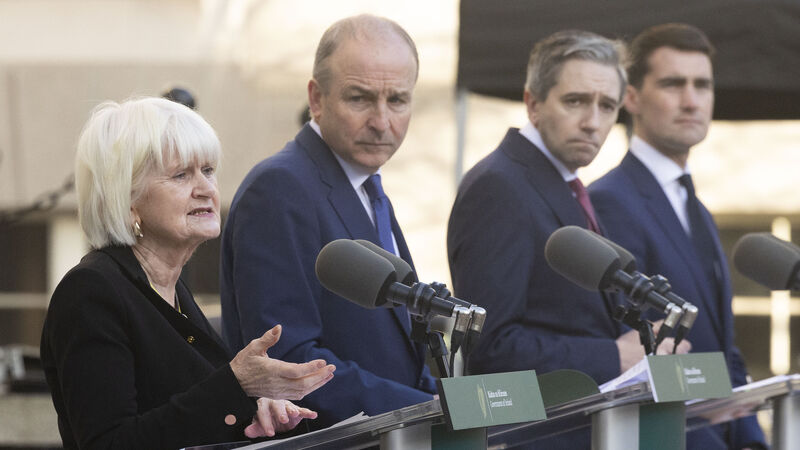
Minister of State Marian Harkin, Taoiseach Micheál Martin, Tánaiste Simon Harris, and minister for public expenditure Jack Chambers launching the 'Accelerating Infrastructure – Report and Action Plan' at Government Buildings. Picture: Sam Boal/Collins
This Government is going to live and die over its delivery on infrastructure.
Getting major projects like Metrolink off the ground and more houses built across the country are the big tests for Fianna Fáil and Fine Gael.
The publication of its report and action plan is a step on the road, but the key driver will be the implementation of its myriad of recommendations over the next two years.
We have been hearing about it for quite some time.
Most of the report’s 30 recommendations have been briefed out over the last month or so.
Last month, one senior Government minister touted its importance, saying it was likely to be more significant than the recently published housing plan:.
“It will be much more radical than people expect,” they said.
Actions being taken are significant, particularly the moves on a critical infrastructure bill.
It is similar to recently enacted Canadian legislation that allow for projects of national interest, like oil pipelines and mines, to be fast-tracked.
The report states that when a project is designated as critical infrastructure, processes like planning, regulation, funding decisions and any processes involving State agencies will need to be prioritised.
With the main priorities set to be water, energy, and transport projects, the Cork Luas project is likely to be one of the candidates for prioritisation once the route has been selected.
Judicial reviews also come in for significant changes within the plan.
Reforms will change fees, introduce tests, and simplify them to prevent multi-stage challenges.
Projects like the Greater Dublin Drainage Project, various BusConnects routes, and now MetroLink have all been hit with judicial review challenges, delaying their progression.
But the reforms in this area will not be in place until mid-2027 at the earliest, meaning more projects could end up delayed in the courts.
The timelines are in place, but questions arose at Wednesday’s press conference about the prospect of legal challenges against the new laws.
Public expenditure minister Jack Chambers acknowledged there is a risk of legal challenges against the Government’s reforms to things like judicial reviews.
However, he said this does not mean the Government would not move on the matter.
“We can’t shirk from doing the right thing because of risk of litigation. We need to confront this,” Mr Chambers said.
But if legal action is taken, it could lead to slippage in the key reforms being promised, which would again hold up the delivery of the key infrastructure the Coalition wants to accelerate.
Some proposed changes will be outside Ireland’s direct control, with a need to engage with the EU and member states to seek to change directives.
This includes proposals to advocate for a new approach to EU laws on critical infrastructure, which was to be expected.
While there is a major drive on simplification within the EU at present, processes move slower in Brussels so Ireland could be left waiting for changes to come into effect.
The proof will be in the delivery of this new plan over the next four years, with the Coalition set to be on the hook at the next election in 2029.


CONNECT WITH US TODAY



Be the first to know the latest news and updates