‘Misguided and foolish’ Knitting Map has stood the test of time
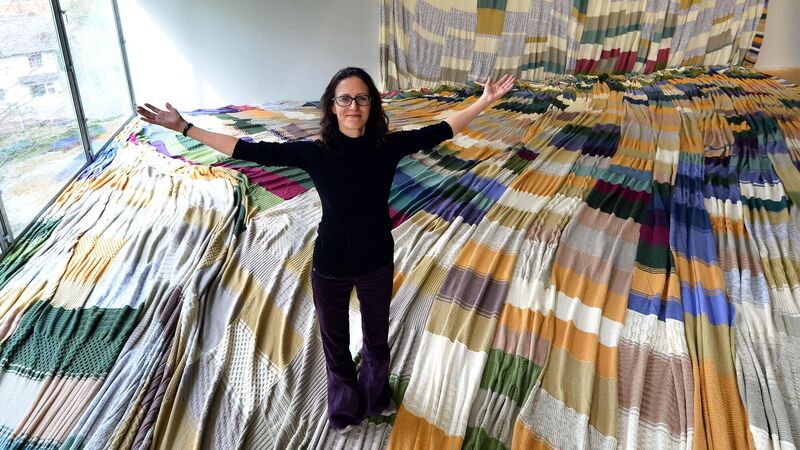
An artwork and community project 'The Knitting Map' made a space for older working-class Irish women to make meaning, writes Jools Gilson, Professor of Creative Practice at UCC
‘Misguided and foolish’ Knitting Map has stood the test of time

Artist Jools Gilson on 'The Knitting Map', a textile installation which combined hand-knitting with motion-sensing technologies, involving more than 2,000 people. Picture: Denis Scannell

It happens to me every time. The first time in Lancaster Pennsylvania in 2007, then at the Glucksman in Cork in 2015 and after a long gap again in Pennsylvania in 2021, Wisconsin in 2023, West Virginia in 2024 and a few weeks ago in Horgan’s Quay. 

When I first see it, it again overwhelms me. Often, I just stand there taking it in, and often I am close to tears. This afternoon I saw the same thing happen to Susan Sands, one of the managers of The Knitting Map from 2005, visiting for the first time.

She crouches down at the end of the map and looks at all its pleated movement, at its five metre drop from the rafters and she doesn’t speak and I see her eyes are full of tears. 

Marion O’Sullivan from Togher and mighty knitter of the entire edge of The Knitting Map is retired now and invigilates the exhibition on Wednesdays and Saturdays. She’s been getting rave reviews from visitors delighted to hear about the making of the map and what it meant to her and the other knitters. 

You can hear this in archive footage from RTÉ: “I just love it, I enjoy the company, there’s a great community spirit” says Marion 20 years ago. “When you see the way it’s growing, I think we’re really doing something very special here.” 

A visitor at the opening of 'Mapping Climate Change: The Knitting Map and Tempestry Project', now on view at 1 Horgan’s Quay in Cork City, until December 6, 2025. Picture: Marcin Lewandowski

But this isn’t how it was received in 2005 or in the years that followed. Instead, it was lampooned repeatedly in the local and national press as ridiculous, as a woolly joke, as a misguided and foolish commission from the people at Cork 2005. 

The Knitting Map was a flagship project for Cork’s year as European Capital of Culture. Ambitious in scale and imagination — data from city centre CCTV cameras mapped movement onto the complexity of knitting stitches, and local weather station data was mapped onto yarn colour. 

A wooden amphitheatre for 20 knitters was built in the crypt of St Luke’s Church, with monitors displaying what colour and what stitch to knit for that day. And then it was knitted every day of 2005. 

We spent 2004 raising awareness about the project, running workshops, knit-ins and mad knitted performances to develop a community of knitters who might contribute to the project. We had no agenda about who that might be, but in the end the vast majority of the 2500 knitters were older working-class women from Cork’s Northside, and Marion from Togher.

The vision of The Knitting Map — the women of a city rising up and knitting the weather for a year, has a revolutionary gesture at its core. It sought to find a quiet but profound way to give space to the astonishing in the everyday of so much feminine activity. 

In 2005, our administrator Elizabeth O’Dea told RTÉ: “It’s more like an open community arts centre and I think the actual product, the map, will only become important in time, the most important thing at the moment is that it’s a welcoming and warm place to be.” 

The project gave space to a profound politics of care, to ask if skills normally used for gift giving and solace could be used for something of vast collaborative gorgeousness, something whose use-value was both poetic and political. Using hand-knitting as its method meant re-working the relationship between femininity and power in an Irish context. 

It gave cartographic authority to working-class older women for a year. As we would learn, that wasn’t an acceptable proposition in 2005. Whilst dozens of women (and some men) came back again and again, had tea and scones, washed up, wondered about how to do that stitch, taught beginners, the press began to snarl. 

The project cost €285,000, out of a total City of Culture budget of €21 million - "hardly an outlandish sum", as Irish Examiner culture editor Des O'Driscoll put it, when he included it in his Cork in 50 Artworks series. 

Reaction

Donal Lynch quoted an anonymous businessman in the Sunday Independent saying “we want the All-Ireland in Cork, not a pack of oul’ biddies knitting”, and the work shifted somehow and became Cork’s “controversial Knitting Map”. But that was 20 years ago. 

The labour of creating The Knitting Map was a web that made the prevailing assumptions within Ireland about value, art, women and feminine labour visible and palpable. Or to put it another way — a major engine of the criticism was good old-fashioned misogyny. 

The Knitting Map made a space for older working-class Irish women to make meaning, as can be heard in some RTÉ archive footage: “This is a nice way of being involved in Cork 2005, and it’s a way that I can contribute.”

The bad press in some sense tried to put them back in their place, unable to acknowledge that the lowly craft of knitting could be exceptional, or that ordinary women’s collaborative contribution mattered. But The Knitting Map, like the women who made it, has exceptional resilience, and an enormous and unsteadying presence.

Twenty years after Cork's Year as European Capital of Culture and there isn't much that has endured, except a singular work made by more than 2,500 older working-class women from Cork's Northside. 

An artwork and community project The Knitting Map is wrapped around the rafters in a stunning renovated warehouse on Horgan's Quay, and spreads out in rivulets across its vast floor. Feminist, powerful, beautiful and from Cork. What's not to love?

Part of the Mapping Climate Change exhibition; come and visit before the work closes on December 6.

"An epic piece, that's surprisingly tender" — visitor comment, Horgan's Quay, Nov 2025 

Mapping Climate Change: The Knitting Map & The Tempestry Project Horgan's Quay 1, Waterfront Square, Cork City. T23 PPT8 

Opening Times: Tuesday, Wednesday, Friday 12–4pm, Thursday 4–7pm, Saturday 10am–4pm, Closed Sunday and Monday 

  • Jools Gilson is Professor of Creative Practice at UCC

Your home for the latest news, views, sports and business reporting from Cork.

More in this section

Revoiced

Newsletter

Sign up to the best reads of the week from irishexaminer.com selected just for you.

Cookie Policy Privacy Policy Brand Safety FAQ Help Contact Us Terms and Conditions

© Examiner Echo Group Limited