Why are there so many conspiracy theories around wind farms?
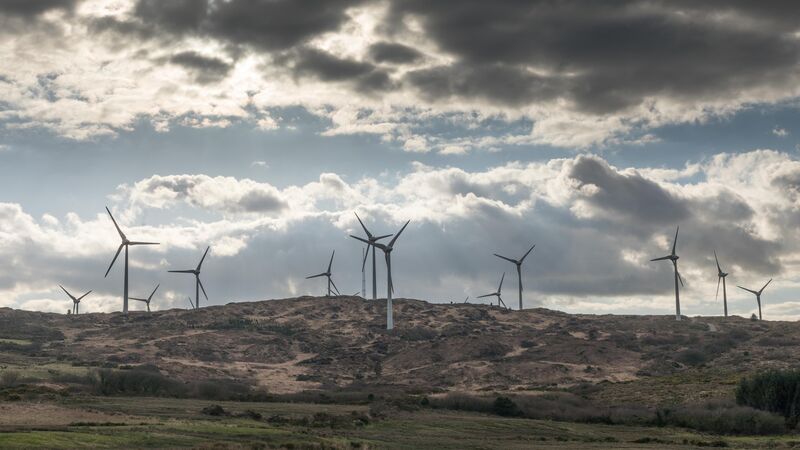
A row of wind turbines can become a target for fears about modernity, energy security, or government control. Picture: David Creedon
When Donald Trump recently claimed, during what was supposed to be a press conference about an EU trade deal, that wind turbines were a “con job” that “drive whales loco”, kill birds and even people, he wasn’t just repeating old myths.
He was tapping into a global pattern of conspiracy theories around renewable energy — particularly wind farms. (Trump calls them “windmills” — a climate denier trope.)

Like 19th-century fears telephones would spread diseases, wind farm conspiracy theories reflect deeper anxieties about change. They combine distrust of government, nostalgia for the fossil fuel era, and a resistance to confronting the complexities of the modern world.
And research shows that, once these fears are embedded in someone’s worldview, no amount of fact checking is likely to shift them.
Although we’ve known about climate change from carbon dioxide as probable and relatively imminent since at least the 1950s, early arguments for renewables tended to be seen more as a way of breaking the stranglehold of large fossil-fuel companies.
The idea fossil companies would delay access to renewable energy was nicely illustrated in a classic episode of , when Mr Burns builds a tower to blot out the sun over Springfield, forcing people to buy his nuclear power.
Back in the real world, similar dynamics were at play. In 2004, Australian prime minister John Howard gathered fossil fuel CEOs help him slow the growth of renewables, under the auspices of a Low Emissions Technology Advisory Group.
Meanwhile, advocates of renewables — especially wind — often found it difficult to build public support, in part because the existing power providers (mines, oil fields, nuclear) tend to be out of sight and out of mind.
Public opposition has also been fed by health scares, such as “wind turbine syndrome”. Labelled a “non-disease” and non-existent by medical experts, it continued to circulate for years.
In Germany, the academic Kevin Winter and colleagues found belief in conspiracies had many times more influence on wind opposition than any demographic factor. Worryingly, presenting opponents with facts was not particularly successful.

In a more recent article, based on surveys in the US, UK and Australia which looked at people’s propensity to give credence to conspiracy theories, Winter and colleagues argued opposition was “rooted in people’s worldviews”.
If you think climate change is a hoax or a beat-up by hysterical eco-doomers, you’re going to be easily persuaded that wind turbines are poisoning groundwater, causing blackouts or, in Trump’s words, “driving the whales loco”.
Wind farms are fertile ground for such theories. They are highly visible symbols of climate policy, and complex enough to be mysterious to non-specialists. A row of wind turbines can become a target for fears about modernity, energy security, or government control.
This, say Winter and colleagues, “poses a challenge for communicators and institutions committed to accelerating the energy transition”. It’s harder to take on an entire worldview than to correct a few made-up talking points.
Beneath the misinformation, often driven by money or political power, there’s a deeper issue. Some people — perhaps Trump among them — do not want to deal with the fact fossil technologies, which brought prosperity and a sense of control, are also causing environmental crises. And these are problems which are not solved with the addition of more technology. It offends their sense of invulnerability, of dominance. This “anti-reflexivity”, as some academics call it, is a refusal to reflect on the costs of past successes.
It is also bound up with identity. In some corners of the online “manosphere”, concerns over climate change are being painted as effeminate.
Many boomers, especially white heterosexual men like Trump, have felt disorientated as their world has shifted and changed around them. The clean energy transition symbolises part of this change. Perhaps this is a good way to understand why Trump is lashing out at “windmills”.
- Marc Hudson is a visiting fellow at the University of Sussex Business School, University of Sussex


CLIMATE & SUSTAINABILITY HUB
CONNECT WITH US TODAY



Be the first to know the latest news and updates