New ‘culture’ needed to fight radicalisation
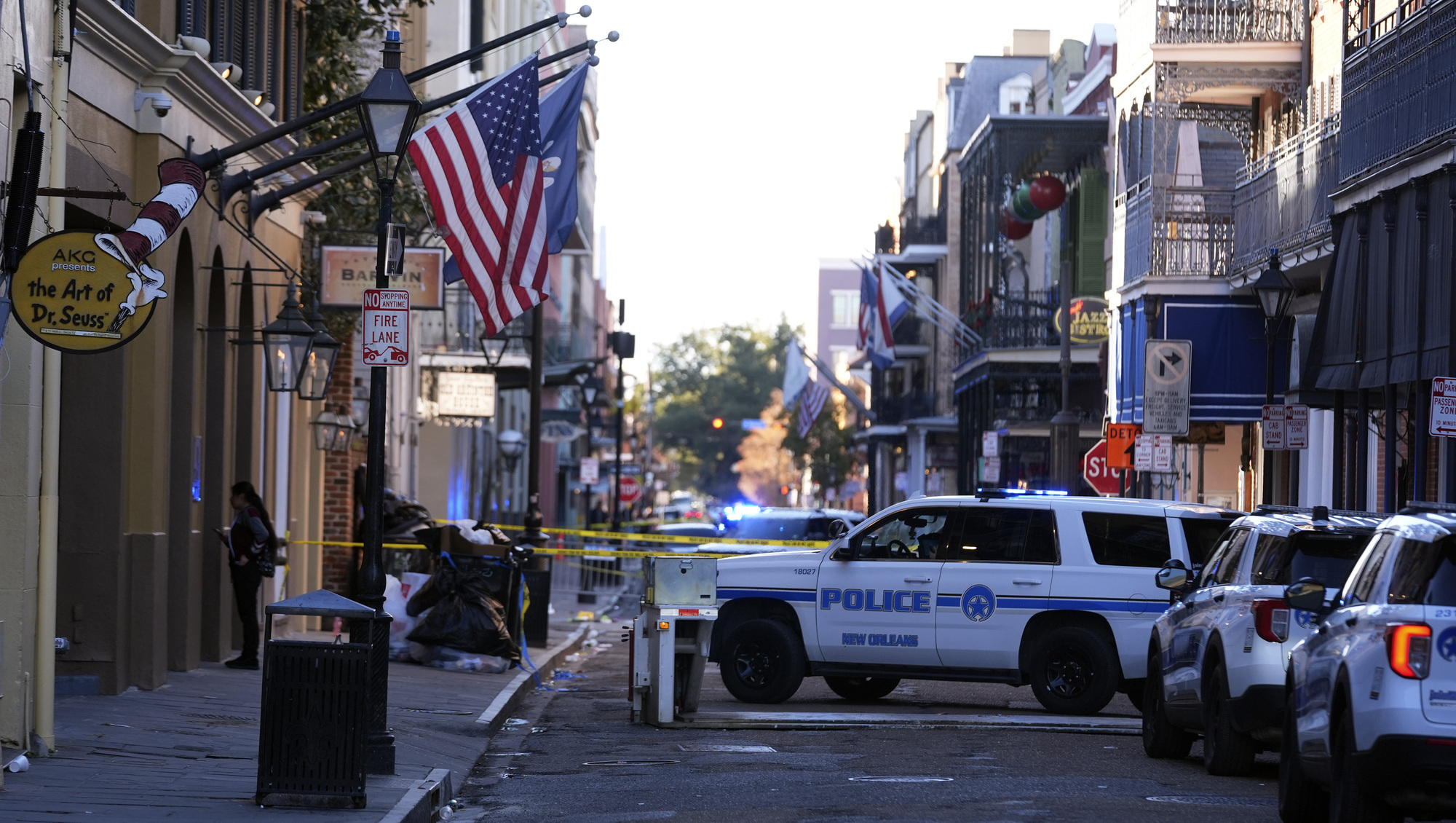
Shamsud-Din Jabbar’s actions left 14 people dead, many of them young, and at least 35 injured in New Orleans on January 1, 2025. Picture: Gerald Herbert/AP
Self-radicalisation and a “life crisis” makes for a potentially dangerous mix.
This is the assessment of various security experts as to why some individuals descend to committing shocking acts of public violence.
Life crisis can cover a wide range of personal factors, from relationship breakdowns, financial problems, mental health crises, or an “unmet need” of some kind.
While this is a threat that has plagued many European countries, the US, and beyond for many years, it can affect any country.
This includes Ireland, which is believed to have had two alleged jihadist-inspired terror attacks in recent years by individuals — both radicalised online.
One of these alleged incidents, the has learned, led to a fatality. This was not known publicly previously and, as court proceedings are underway, no further details can be provided.
While the details of the New Year’s Day terror attack in New Orleans continue to unfold, it appears that Shamsud-Din Jabbar acted alone — or as a “lone wolf”, as sometimes described.
Details have emerged of the dangerous cocktail of personal problems — relationship and financial — Jabbar had been experiencing.
Jabbar was a born and bred American, and he served in the US army. He qualified in computer science and information technology.
His father and brother have told media in the US they could not reconcile his terrible acts with the “kind, soft-spoken” person they knew.
The brothers were raised Muslim and regularly attended a mosque while growing up.
His brother Abdur said he spoke to his older brother nearly every day over the last year and a half, adding that he saw no sign of radicalism or any talk of Islamic State.
Information also emerged of relationship issues and financial problems Jabbar was having.
Recent reports show the extent to which Jabbar planned his attack, visiting New Orleans twice in the months beforehand. He even wore Meta smart glasses, capable of recording or livestreaming, during his reconnaissance.
Jabbar’s actions left 14 people dead, many of them young, and at least 35 injured. It could have been a lot more if his attempts to detonate explosives he planted had gone to plan.
Paul Gill, a professor of security and crime science at University College London, is one of the leading experts on terrorism — including on lone actors.
While stressing details were still emerging, he said Jabbar’s attack was “most likely triggered by some destabilising influences” in his life.
“Typically, what we see with lone actors — especially those in his age bracket — are a crystallisation of ideological influences propelled by a series of personal life crises,” he said.
Mr Gill, from Dublin, said many ideological influences come from online, which is the biggest source of narratives that promote violence as the only available solution.
However, he said many people exposed to these violent narratives don’t act on them and there are “other forces at play”.
He said: “What we typically find is that these narratives speak most strongly to those who have some sort of unmet need — be it a need for identity, a need for revenge, a need for brotherhood, or whatever might be the case — and there are pre-existing deficits in their life that mean that those needs aren’t being met in other ways.”
Mr Gill added that the scale of the attack and the ease with which it was perpetrated “will be a worry for security globally”.
He added: “There is a copycat effect where other lone actors take inspiration from the ‘success’ of others, and these sorts of events do tend to cluster in time.”
A source in the Irish security structure also used the term “life crises” to describe the combination of elements, along with radicalisation, that can push certain people to violence.
“The bigger risk is self-radicalisation and life crises — be they relationships, mental health issues, etc — where the person is struggling to cope,” the source said.
This source cites the need for good relationship with the Muslim community in Ireland and refers to the clinics local community gardaí often hold in local mosques, allowing figures in those mosques to contact gardaí if they are ever concerned about someone.
In one serious case, a member of a mosque “withdrew” from the community into his own world — where he consumed and propagated more and more intense anti-Western views. This person is suspected of self-radicalising himself to such an extent that it fuelled a violent attack in Ireland.
The security source said there is a need to widen groups and agencies that can contact gardaí or other security bodies if they have concerns about a person, including juveniles who may not be experiencing any “life crises” as such.
This applies to both jihadist radicalisation and growing far-right radicalisation and fake news, the source said.
The need to seek allies beyond the world of security is something former army officer Declan Power, now working as a security analyst, strongly believes is necessary.
“Personal radicalisation is much harder for law enforcement or national intelligence agencies to detect or monitor,” he said. “The early warners or detectors are the community — teachers, family, friends, and coaches — who may note a change in temperament or disposition of a subject.”
He said a strategic approach at national level could guide this, adding that Ireland could learn from radicalisation programmes abroad.
“National security is not always about the gardaí or the military,” he said. “We need to broaden this out and include people working in education and health.”
He sees promise in proposals in the Fianna Fáil election manifesto of setting up a new department of domestic affairs and the establishment of a new national intelligence agency.
“It has potential,” he said. “We need a more rounded vision, beyond the ‘green’ [military] and ‘blue’ [gardaí], with the right department and a different culture.”
Looking at the wider security environment, UCC professor Andrew Cottey said that, while the attacks in the US were shocking, they were not surprising.
“Since Israel began its war in Gaza in late 2023, experts have warned of a possible increase in terrorism against those countries supporting Israel,” he said.
He said that while some details of attacks in the US have yet to emerge, they highlighted two phenomena which Europe has experienced over the last 10 to 15 years: Home-grown terrorism [terrorism by one own’s citizens rather than foreign national] and lone wolf terrorism [terrorism by individuals inspired by, but not directly linked to, extremist groups].
Mr Cottey said that given Ireland’s relatively pro-Palestinian stance, it is “probably a less likely target” for Islamist jihadi terrorism. However, he added that this “doesn’t mean that Ireland is invulnerable”.
It is thought that security services in Ireland don’t see any organised structure threatening the State from a jihadist point of view, with most counter-terrorism investigations taken up with tackling the financing of terrorism abroad.
As reported in the last month, there were nine terrorism arrests in Ireland related to jihadist Islamic extremism in 2023 — twice the number of the previous two years — the bulk related to financing.
It is understood security services have not seen any increase in fundraising efforts since the October 7 atrocity by Hamas and the subsequent military campaign in Gaza, resulting in over 45,000 deaths, according to Gaza authorities. Nor have security services seen the emergence of a threat to national security more generally, with attention placed particularly on any threats to US or Israeli interests here.
Security services continue to monitor a small number of militant republicans who have latched onto pro-Palestinian protests.
National security services in Ireland must be “measured against their capacity”, the security source quoted above said, citing the relatively low level of investment and political priority attached to this area — at least compared to other comparable European countries.
Whether changes in the current climate, and if Fianna Fáil’s election promises make it into the next programme for Government, remains to be seen.

CONNECT WITH US TODAY



Be the first to know the latest news and updates