View from Israel: One year on from October 7 attack and omens are dark
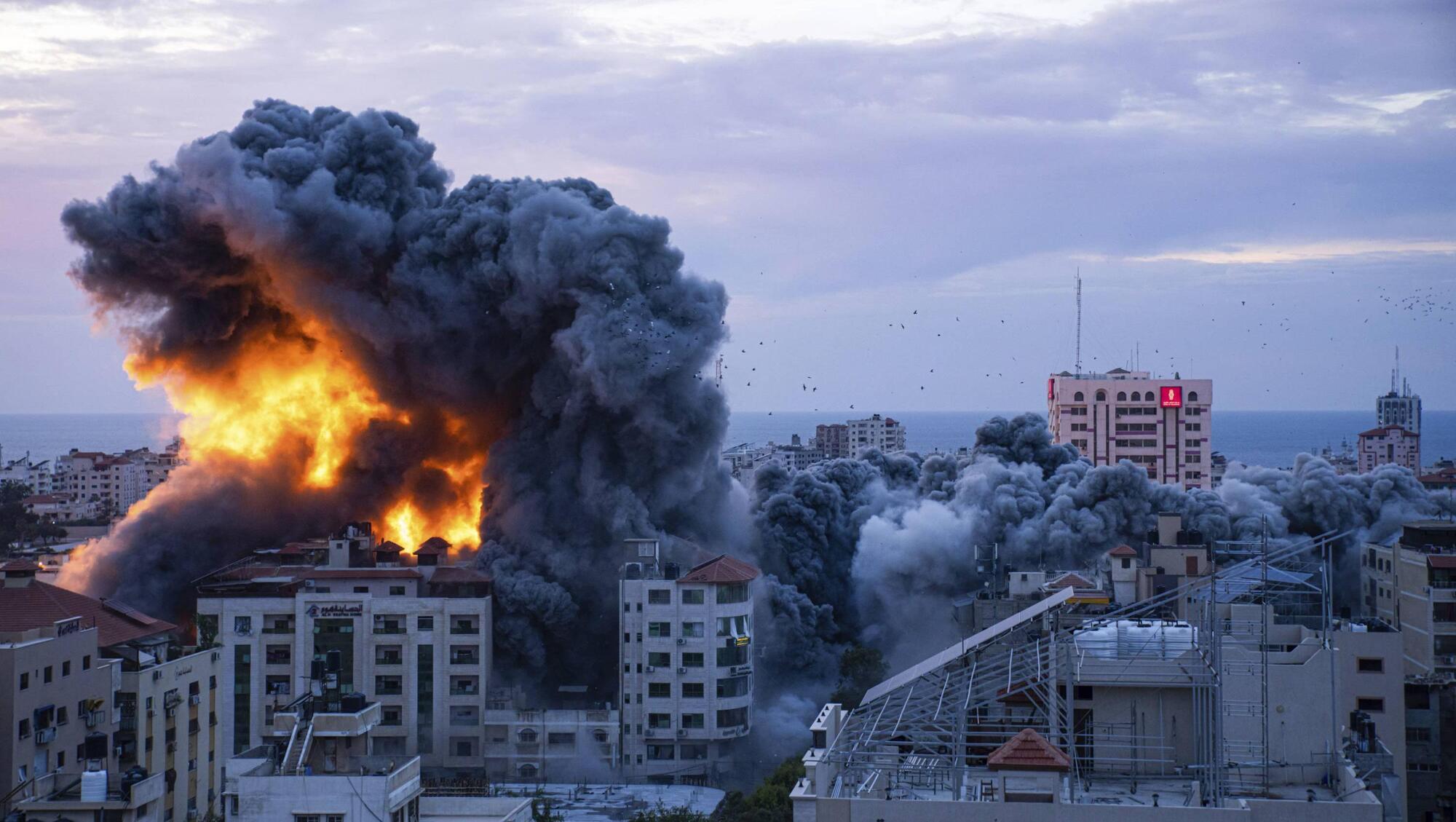
Fire and smoke rise following an Israeli airstrike, in Gaza City, on this day in 2023, following the Hamas multi-front attack on Israel at daybreak. Hamas fighters infiltrated the heavily fortified border in several locations by air, land, and sea, killing dozens and stunning the country. Palestinian health officials reported scores of deaths from Israeli airstrikes in Gaza. File picture: Fatima Shbair/AP
One year year on from the horror of the October 7 Hamas terror attack on Israel, when 1,200 Israelis were murdered, and a further 250 were taken hostage, the mood and outlook for Israelis and Palestinians and the wider region is bleaker than ever.
Some 100 or so of those hostages continue to be held by Hamas, and less than half are believed to remain alive after one year in captivity in the network of built tunnels under the streets and towns of Gaza.
As Israel wakes up to the sombre first anniversary of the attack, the mood in the country is dismal; for many Israelis, the rest of the world has simply moved on.
Since that fateful day, of course, more than 42,000 Palestinians, mostly women and children, have been killed by Israeli air strikes and ongoing military ground invasion.
In the last two weeks alone more than 2,000 Lebanese civilians and Hezbollah militants have died in Israeli-related air strikes and military operations.
As an Irish citizen living in Israel, I am constantly asked by Irish family and friends some variation of ‘how is the war sold?’ to Israelis, or ‘how do Israelis justify the bombing and killing in Gaza?’, and now of course the airstrikes on Beirut and across Lebanon.
There is no easy answer to those questions. But any fair attempt to do so should probably address two stark realities.
The first reality is Israelis simply do not see what the rest of the world sees on their television screens night after night for the past 12 months.
For those outside of Israel, it seems inexplicable and inconceivable that Israelis would have not seen the impact of Israeli airstrikes on Gaza.
But it remains a fact that the indescribable horrors of the carnage in Gaza — the screams of blood-soaked children, limp toddlers in tiny white body bags draped across the arms of an inconsolable father, mothers huddled over the lifeless faces of their dead children, bodies and body parts strewn across a street — are not, rarely if ever, shown on the mainstream Israeli news channels.
The second stark reality is for many Israelis, certainly most of those I speak to, do not feel they need the war to be sold to them. They simply bear witness to a different picture.
This includes the harrowing account of the morning of October 7 which is retold almost every day for the past 365 days on Israeli television — the anger and anguish over the fate of the remaining 100 hostages held captive, the daily news reports of Israeli houses and towns being bombed by Hezbollah along the Lebanese border for 12 straight months resulting in the deaths of dozens of Israelis and the displacement 60,000 residents from their homes.
Add in the constant fear of existential annihilation from every direction, and there is a profound sense that someone, somewhere is trying to kill you or your children because you are Israeli or Jewish.
Last week 180 ballistic missiles fired from Iran, rained down over Tel Aviv and central Israel.
Less than hour before that attack, seven commuters were killed and 11 wounded in a shooting terror attack at a light rail stop in the Jaffa coastal suburb of Tel Aviv.
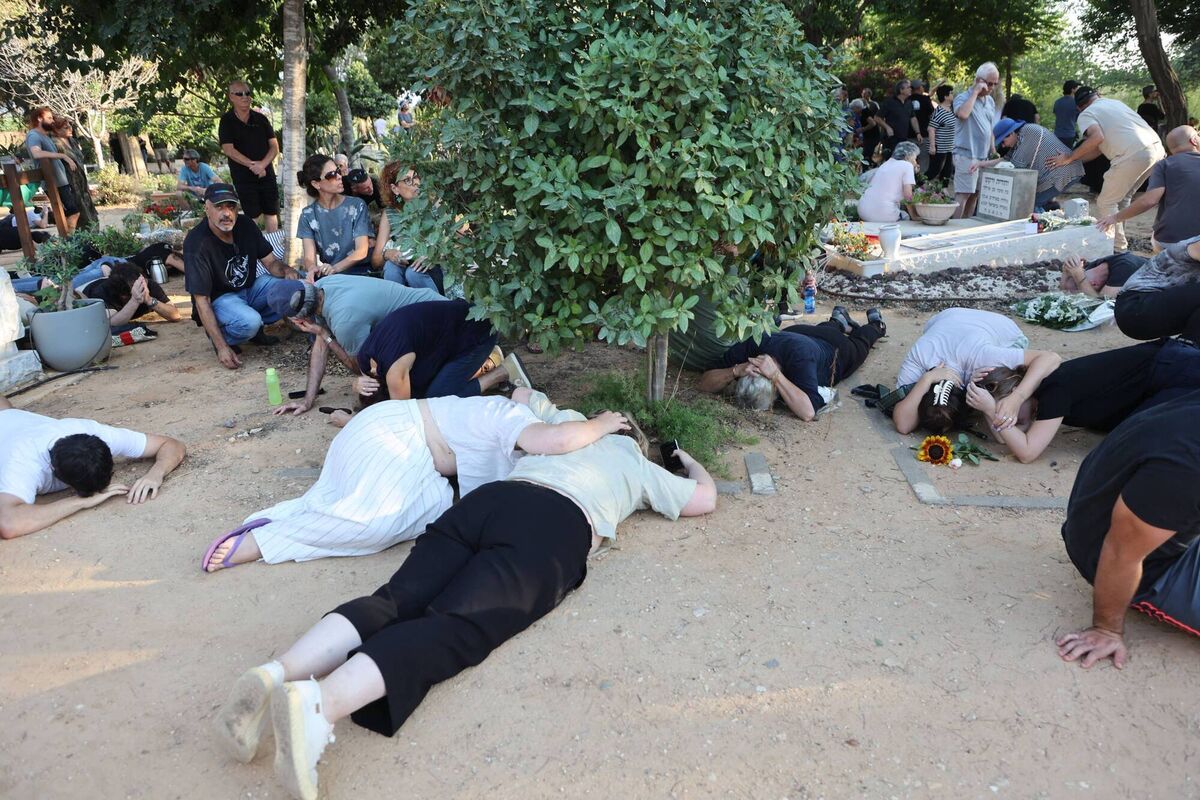
A couple of days later three Israelis soldiers were killed when a drone strike, apparently from Iraq, bypassed Israeli air defenses.
Much of the north of Israel this week, including Israel’s third city Haifa, is suffering from a barrage of rockets fired from Hezbollah.
On Friday, Iranian Supreme Leader Ali Khamenei in a morning prayer sermon in Tehran justified the Hamas October 7 attack as both “a logical and legal” action.
But contradictions abound. If there is an overwhelming sense of victimhood and widespread support for the actions of the Israel Defense Forces, opinion polls show most Israelis are deeply cynical and distrustful of the political motivations of prime minister Benjamin Netanyahu.
The government remains deeply unpopular. The mainstream media which refuses to show the truth of what is happening in Gaza is fiercely critical of Netanyahu.
The two most infamous far right ministers in Netanyahu’s coalition, finance minister Bezalel Smotrich and minister of national security Itamar Ben-Gvir, are widely despised and are lampooned, each vilified almost nightly on the mainstream television news.
But just as hundreds of thousands of angry Israelis continue to take to the streets every Saturday evening calling for the resignation of the far-right government, few of those same demonstrators voice an explicitly anti-war message.
This I imagine may astound many readers in Ireland, who see the harrowing images of Israeli airstrikes on Lebanon.
The common view in Israel is those strikes are justified in the light of 12 months of incessant rocket attacks on northern Israeli towns and villages.
Within hours of the Hamas October 7 attack a year ago, Hezbollah started firing guided rockets and artillery shells at Israel.
In more recent weeks following the audacious exploding pager and walkie-talkie attack and the assassination of Hamas leader Hassan Nasrallah, a disquieting kind of hubris has emerged in Israel.
This can be heard on news programmes, read in newspaper articles, and casually pops up in daily conservations.
This is the view, summed up by Amos Harel, the senior military correspondent for the Israeli left-leaning newspaper, Haaretz, that “the regional balance of power has changed, and Israel — still reeling from the horrific disaster and failure of the October 7 attack — is restoring some of its confidence”.
With Hamas’ and Hezbollah’s military capability degraded, the argument goes, Israel can focus its military might on Iran and that a window of opportunity now exists for Israel to fashion the politics of the Middle East in its favour.
Just last week Netanyahu made a television address directly to the people of Iran somewhat brazenly arguing:
“The people of Iran should know — Israel stands with you” against “a regime that subjugate[s] you” before accusing “the regime of bringing the noble people of Persia closer to the abyss”.
In that short rather perfunctory quote, Harel reveals much insight into the Israeli psyche.
Despite the deaths of 42,000 Palestinians in Gaza and the death of 2,000 people in Lebanon, this is an Israel that is “still reeling” from October 7.
Those attacks including the assassination of Nasrallah and Hamas leader Ismail Haniyeh are essentially seen through the prism of military campaigns and seen as “restoring some of [Israel’s] confidence”.
By implication military “success” is the way forward.
With such a bellicose mood widespread in Israel on this dark anniversary, the omens on what may lie ahead for Israelis, Palestinians, Lebanese, and Iranians alike, in the months ahead are arguably darker still.
- Paul Kearns is a freelance journalist living in Tel Aviv
CONNECT WITH US TODAY



Be the first to know the latest news and updates