Fragile Middle East peace demands resources
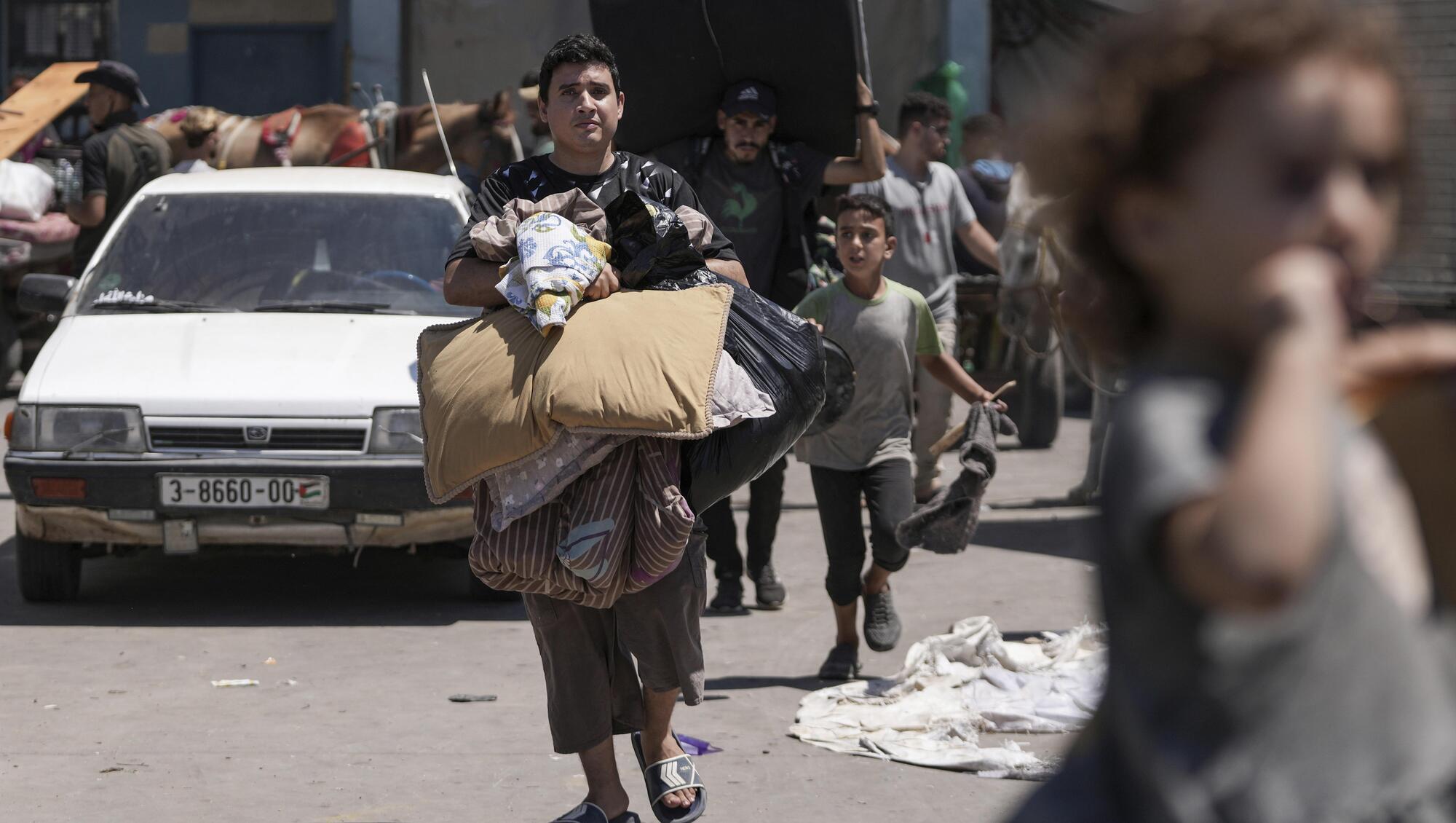
Palestinians evacuate a school that had been their shelter, in eastern Deir al-Balah, Gaza. Picture: Abdel Kareem Hana
As the death toll in Gaza exceeds 40,000 and an Irish Unifil convoy in southern Lebanon has a narrow escape, diplomatic efforts are being made to prevent the war in Gaza spreading in the region. A low intensity regional conflict of sorts is already underway. Since October 8, Hezbollah has been firing rockets and artillery shells at northern Israel and at Israeli occupied Golan. In April, Iran launched an effectively preannounced attack, with 300 rockets, ballistic missiles and drones against Israel. Houti rebels in Yemen have bombed Tel Aviv.
Israel has responded with airstrikes against targets in Lebanon, Syria, Iran and Yemen. Parts of the West Bank are in a state of semi insurrection against Israeli occupation, with over 550 Palestinians reported killed, since October 7 last, in IDF air strikes or clashes with protestors. In the past few days armed Israeli settlers have overrun a Palestinian village and killed at least one resident.
The continuation of lethal air strikes against targets in densely populated areas of Gaza, shows that the IDF has not yet achieved its assigned mission of destroying Hamas. If Israel were to agree to a permanent ceasefire, at this stage, Hamas could well rise up from the tunnels and reassert its control over Gaza.
Hamas’s key demand, however, is that Israel commits, in the first phase of the proposed three phased ceasefire proposal, to a permanent ceasefire. Israel is being largely blamed for the impasse in the talks, by adding more preconditions to the original proposed framework for a ceasefire.
The US sponsored ceasefire talks resumed last Thursday in Qatar without Hamas being officially present. Its former political leader, Ismail Haniyeh, who was assassinated in Tehran two weeks ago, has been replaced by Yaya Sinwar, its military leader, currently in Gaza. Israel’s failure to deny responsibility for the assassination is taken, by many observers, as tacit admission of its complicity in that, and other assassinations.
Both Hezbollah and Iran have announced that they will launch retaliatory strikes for the recent round of assassinations. Decades of hateful rhetoric and calls for the destruction of Israel have conditioned their supporters to demand retribution. While Hezbollah is controlled by Iran, the proposal for separate responses gives Iran a flexibility to delay its attack, while allowing Hezbollah to conduct its strike against Israel.
On Friday evening, Hamas rejected the latest truce details proposed by Israel. However, progress has been made and US secretary of state, Antony Blinken was expected in Qatar over the weekend. Indications from Tehran are that, if the Gaza ceasefire proposals are agreed, Iran may not go ahead with its response. The anticipated Hezbollah attack on Israel is still possible, especially if the talks on Gaza break down.
In the event of a Hezbollah-Israel conflict escalation, the three UN peacekeeping missions in the region, in which for many years the Defence Forces have been participating, are in the line of fire. Over the years our Defence Forces have lost personnel, on or attached to, all three missions.
That is why the Government is right to be concerned about the most recent incident near Hanine in Southern Lebanon. It is worth considering the circumstances of this incident, which might yet have consequences for Israel if soldiers from two EU member states were considered to have been recklessly endangered, by Israeli action. The details are sketchy.

It appears that on August 10 around 8pm, shrapnel from an Israeli drone, or air attack, on a Hezbollah target in southern Lebanon, hit a two vehicle Unifil convoy passing through the village. Given that such attacks are preceded by extensive surveillance of the intended target area, the presence of the UN patrol had to have been noted by IDF observers. A media circulated video clip shows the two UN vehicles clearly moving close to the impact area.
It is standard practice for UN vehicles deployed on peacekeeping missions to have the letters UN, in black, on the roof as well as the sides, of their white-painted armoured patrol vehicles. For nighttime operations the roof lettering is lit up by a small bulb. Identification from the air is essential for the security of UN personnel.
It is unlikely, however, that the actual pilot of the aircraft, or drone, would have noticed the presence of the UN patrol in the last few seconds before target impact. As it happened, the six Irish and two Polish Unifil soldiers, in the vehicles, escaped unharmed due to the armour plating of their vehicles.
For Irish Unifil veterans the incident is minor compared to the early years of Unifil. Nevertheless, even though there were thankfully no casualties on this occasion, we cannot rule out the possibility of delayed PTSD, when personnel are exposed to a near death experience. Lessons were learned from the past and the provision of armoured protection has saved many lives. Support services have also improved immensely.
Investigations are continuing and the Defence Force’s report awaited. We can expect that the Irish Military Police and Ordnance experts will do a thorough job.
The UN will also investigate the incident, but UN investigation reports remain the property of the UN. Past experience has shown that UN reports are given to national authorities, but often with preconditions on sharing which do not necessarily meet national requirements. Of course, operational lessons are learned, if, for example, there is a need to improve communications and operational procedures. The IDF should be invited to assist both the Irish and UN investigations.
Given the current wave of anti-Israel sentiment in Ireland, someone is likely to link the incident to criticism of Israeli air attacks on Gaza made by an Taoiseach, the day before. The Government has made its position clear on the need for an immediate ceasefire in Gaza. The Defence Forces should continue to make its contribution by supporting peacekeeping operations in the region. This includes risk sharing along with other UN contingents.
Peacekeeping missions are necessary to contain regional conflicts from developing into full scale war. Without UN peacekeeping missions over the past 76 years, the survivors of World War Three would still be staggering around the nuclear wastelands trying to stop World War Four.
The men and women of our Defence Forces, have, over three generations, built up a world class corporate knowledge and expertise in peacekeeping. Unfortunately, this is now under threat due to the decline in the strength of the Defence Forces. Long term understrength battalions cannot maintain the high training standards necessary to continue to serve on missions.
Without proper investment in defence our contribution to overseas missions will soon be reduced to token participation. Imagine if we had no athletes in the Olympic Games, but still insisted on producing a representative to carry the Tricolour at the opening ceremony. Tokenism is not on in peacekeeping. We are much better than that.