Mick Clifford: Genuine sorrow for Stardust victims, but has anything changed?
Indifference informed treatment of victims’ families, and there’s little to suggest that much has changed
Mick Clifford: Genuine sorrow for Stardust victims, but has anything changed?

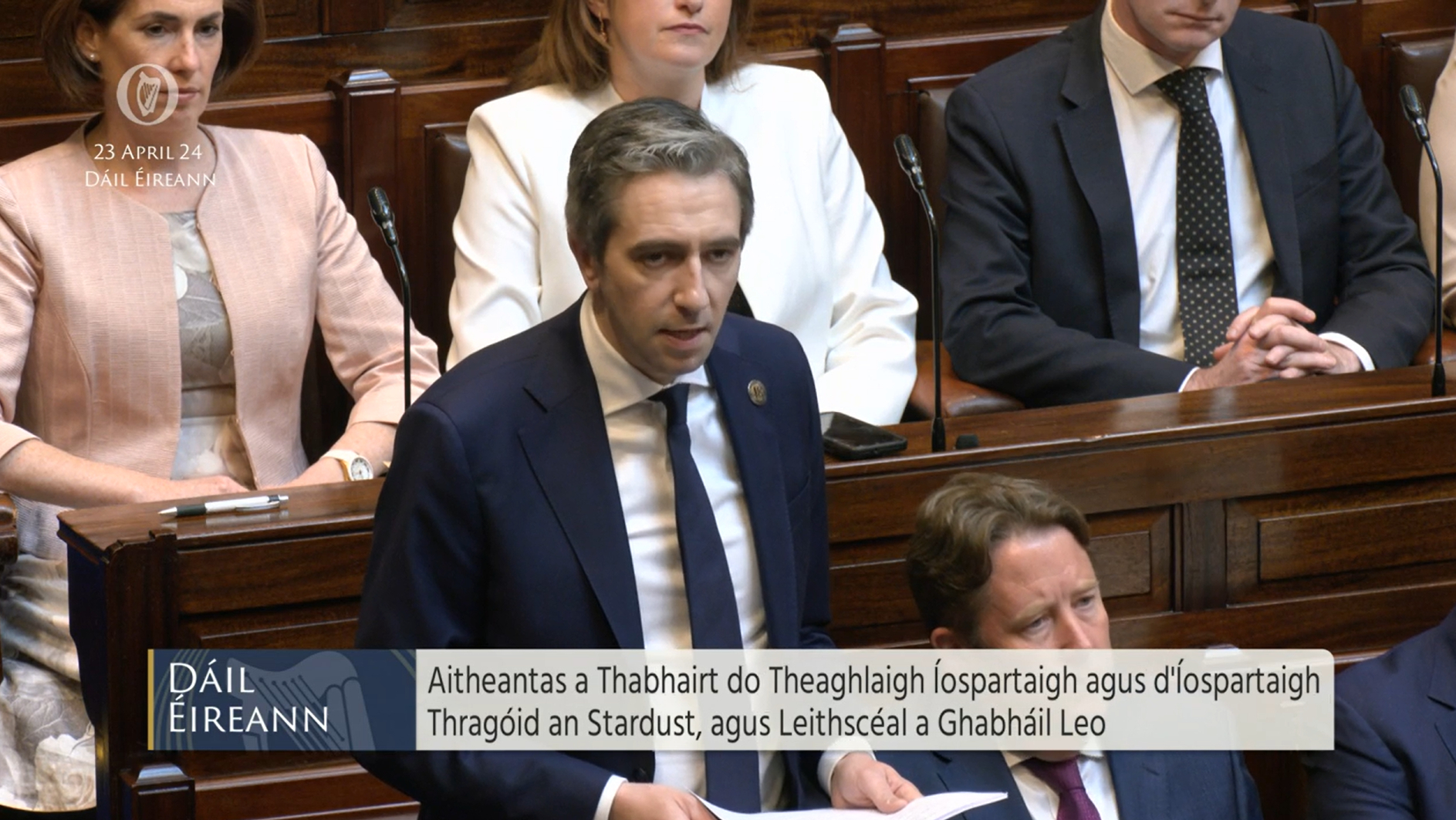
Taoiseach Simon Harris issues a State apology to the families of the victims of the Stardust fire. Picture: Oireachtas TV/PA

At times, the proceedings in the Dáil took on the character of a memorial service. 

While Taoiseach Simon Harris delivered brief pen pictures of the Stardust victims, it was as though they were being remembered in the immediate aftermath of the tragedy that took their lives. 

Personal details were recalled as if lifted from recent memory. 

Jimmy Buckley was 23. He “loved hurling and had won a competition for his Elvis impression”. 

Caroline McHugh was 17. She was “an avid reader, Irish dancer and swimmer, and a member of the local CB radio club”. 

There was also, in Mr Harris’ contribution and that of others, the kind of emotion that is usually felt in the shocked state of sudden bereavement.

However, it was the little details that betrayed that these young people died not recently, but over 40 years ago. 

The cult of Elvis impersonators and the proliferation of CB radios is from a time that is alien to today’s youth. However, the remembrances were entirely appropriate and delivered with due solemnity by An Taoiseach. 

The final rite of passage for deceased persons, from bereavement into memory, had been suspended for the 48 who died in the Stardust. 

As far as their families were concerned, their memory would not rest in peace until the manner of their deaths was finally acknowledged and it took all this time to arrive at such a station.

“I hope this is a moment when the State, which rubbed salt in your terrible wounds, starts to help you heal,” Mr Harris told the Dáil. 

He delivered an apology that sounded heartfelt, whole, and pregnant with regret on behalf of his Government and all those that went before, since the night of the tragedy in February 1981.

The survivors and the families of the Stardust victims listening in the gallery of Dáil Éireann, Dublin. Picture: Oireachtas TV/PA

He pointed out that the dead never came home after going out to a dance competition on the eve of Valentine’s Day.

“For their families, in the nightmare that was to follow, their loved ones not only lost their lives, they lost their identities,” he said. 

“They were much more than numbers. They were bright, beautiful people. They had plans and dreams, their whole lives ahead of them.” 

The families of the victims listened on.  As many as possible sat in the distinguished visitors' gallery.  This was a highly symbolic touch. 

Some 15 years ago, four of the bereaved women sat in the security hut outside Government Buildings in a protest at the refusal to publish a report that had repudiated the original, highly offensive, finding at the Stardust tribunal that arson was the “probable cause” of the fire. 

They were ignored on that occasion and, as pointed out yesterday, the heat was even turned off in the hut in the hope it would make them go away.  They didn’t.

“Their indomitable spirit in refusing to be kept out in the cold led us to this moment,” Harris said. 

He named three of them, Gertrude Barrett, Antoinette Keegan, and Bridget McDermott, who were now in the distinguished visitors' gallery. 

The fourth, Christine Keegan, had sadly died before the inquest got underway,  but she had prepared a statement in 2019 for the forthcoming inquest — which the Taoiseach relayed to the House.

“What did we, families of the deceased, victims of the Stardust fire, ever do on the government to deserve this ill treatment and constant systemic abuse we have sustained for the past 38 years?” she had asked.

“Today I want to answer that question,” Harris said. 

You did nothing wrong. The institutions of the state let you down. We should have been by your side, walking with you. We were not. For that, we are truly sorry.

The apology from the Taoiseach was suitably fitting for the occasion and the delivery was genuine. Yet,  there remains an uneasiness about the whole business. 

Without the persistence of the families, would there have been any apology — not to mind an inquest that finally returned a verdict of unlawful killing? 

Mr Harris’ apology inferred that he might have done differently than those who preceded him in high office if he, or they, had been aware of the heartache and trauma being felt by the families. There is not a scintilla of evidence that that is the case.

The reality is that the original tribunal finding of “probable arson” was a product of its time, notwithstanding that it was reached in good faith by the tribunal chair. 

TDs applaud the families of the victims of the Stardust fire. Picture: Oireachtas TV/PA

The stain that it cast on the communities from which the deceased were drawn was neatly ignored,  because it had been handed down from a High Court judge, whose judgment was considered infallible. 

Its result was that the owner of the Stardust would not be financially ruined and could claim compensation for his loss, because of the cause of the fire.

Addressing that stain was never going to be easy, but the general approach thereafter was to ignore the trauma. 

Not for the first time, the State apparatus — both elected and permanent Government — preferred to bury the past rather than resurrect it for fear of financial liability, scandal, or just plain distraction from the affairs of the day. 

That indifference informed the treatment of these families, and there is very little to suggest that much has changed in that respect. 

Those who have access to the centres of power, those who simply refuse to give up like the Stardust families, can overcome such obstacles at an often huge cost. 

Others, without such resources, never have their concerns or their sense of injustice addressed. 

Notwithstanding the genuine sorrow expressed in the Dáil, there is little to suggest that much has changed in that respect.

x

More in this section

Revoiced

Newsletter

Sign up to the best reads of the week from irishexaminer.com selected just for you.

Cookie Policy Privacy Policy Brand Safety FAQ Help Contact Us Terms and Conditions

© Examiner Echo Group Limited