The Irish language needs to be kept in our schools for its survival
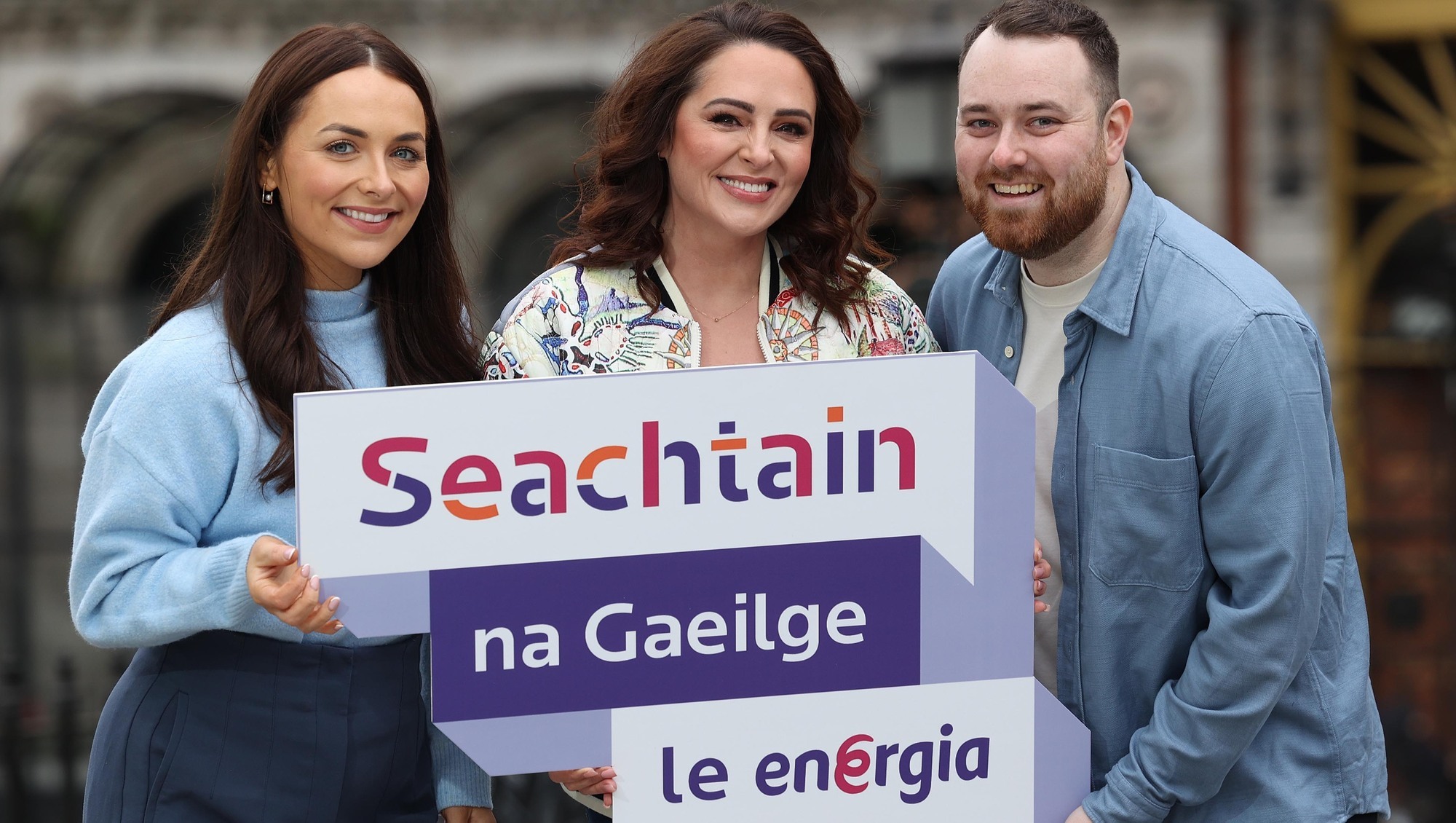
(Left to right) Kayleigh Trappe, Gráinne Seoige and Aindriú de Paor, the 2024 ambassadors of Seachtain na Gaeilge le Energia at the announcement launch in the Mansion House, Dublin recently. The festival is the biggest annual celebration of our native language and culture in Ireland and in many other countries, and this year it is running from March 1 to 17. Picture: Robbie Reynolds
Seachtain na Gaeilge is upon us, a fabulous, fortnight-long, celebration of Irish language, culture and heritage.
The festival is the biggest annual celebration of our native language and culture in Ireland and in many other countries, and this year it is running from March 1 to 17.
The culture and heritage are important elements of the knees-up though, because fêting the Irish language in and of itself could be confronting for the many of us who cannot actually converse in it. Although my name may reasonably suggest otherwise, I am not proud to be one of that number, someone for whom conversation as Gaeilge would be very stilted indeed.
We have a relationship with our native tongue that at the very least raises questions. Opinion polls show a consistently high level of public support for the Irish language. A 2022 poll by Ireland Thinks showed that a clear majority (65%) would like to see people using it more on a daily basis.
We value it, but that doesn’t mean we are willing to learn it. How often have you heard someone say they don’t like how it is taught, or, that we shouldn’t be forced to sit it for the Leaving Certificate?
Census 2022 tells us that the number of Irish speakers has grown since it was last measured in 2016. Almost 1.9 million, 40% of us, stated that we could speak it, an increase of 112,577 since 2016. Those who wish to see our native language survive and thrive might want to hold the celebratory bubbles though, because the number who said they could speak Irish but never did so, grew to almost 473,000. In short, more of us can but we are speaking it less frequently, if indeed at all. That doesn’t sound like a win.
There were other discouraging Census findings, including a 2% decrease in the number who speak Irish daily, despite a 7% increase in the population of An Ghaeltacht. Late last year, the Department of Education released figures which showed a sharp rise in the number of second-level students being granted Irish exemptions; up 33% at Junior Cycle and 22% at Leaving Certificate. These increases, due to changes in exemption eligibility criteria, sparked an interesting debate on RTÉ recently.
Speaking on the current affairs programme Upfront, barrister and journalist Brenda Power said she loves Irish, but believes it should be scrapped for State exams. Her argument is this; if the success of a language is measured by the ability to speak it, then its compulsory nature in schools has been a failed experiment. She argues that obliging us to study it up to Leaving Certificate hasn’t kept the language alive.
It has surely contributed considerably to doing exactly that? By keeping and prioritising it in education, we acknowledge its importance. It is difficult to imagine how or where else that could meaningfully be done. Left to choice, how many would pick Irish for a highly competitive State exam that dictates entry to Third Level?
It would undoubtedly be spurned for subjects perceived to be more ‘points-friendly’. As the Leaving Cert changes, it’s likely that it would eventually be cast aside as more ‘useful’ subjects emerge, subjects we think might train us for a job; coding, cryptocurrency, influencing, or whatever happens to be trendy and trending by that time.
Julian de Spáinn, General Secretary of Conradh na Gaeilge, agrees that if we were put in a situation where Irish had to be chosen, it wouldn’t be. Languages became optional in the UK in 2004 and Mr de Spáinn points to the subsequent dive in their uptake as a warning for what would happen here.
He also suggests that a social divide would likely emerge. In 2023, the British Council Language Trends survey found that in private schools, three in 10 pupils take a language for GCSE (Junior Cycle equivalent) compared to just one in 10 in state schools.
Comedian and actor Michael Fry is not a native speaker but as he learnt Irish, he eventually grew to love it. He believes studying our language enriches our understanding of our culture, history and identity but observes that we have a different emotional response to being required to study it, than we do to say Maths, or Shakespeare. He has since school availed of free Irish classes and feels that if you give people more opportunities to learn and use Irish, they’ll take them.
Those Census figures belie the enthusiasm for Irish that I’m sure I’ve noticed more of in recent years; growing attendance at Pop Up Gaeltachts, our collective pride at Paul Mescal’s interview as Gaeilge on the Bafta red carpet, Bambie Thug singing an Irish refrain when interviewed after becoming our Eurovision hopeful. Irish language productions such as the film ‘An Cailín Ciúin’, programmes like ‘Grá ar an Trá’ and the radio show and podcast ‘Beo ar Éigean’ (Just About Alive) are getting plenty of water cooler airtime too.
And I’m sure you heard the one about the former politician and the television presenter who spoke disparagingly about Irish on television last month? Their pre-teen like dissing and high-fiving seemed to get quite the berating from the public at large, and on social media in particular.
Our pride in and support for the Irish language is justified, not least because the turn of phrase and emotion within it is uniquely beautiful. Comedian Tommy Tiernan describes this well, seeing in it ‘a connection between the heart and the mouth’, that is less evident in other languages. He feels there’s a spirit in Irish that is ‘mischief orientated’, that it has ‘a fish of devilment swimming through it’ and a defiance that perhaps comes from having survived against the odds.
To say its survival has been against the odds may not do justice to the centuries of hard work, and unpopular decision-making, on the part of those who valued it and knew how easily it could be lost.
To keep Irish alive, it needs to be kept it in our schools and making it optional would mark the true beginning of its end. If we genuinely want to tackle the issue of being better able to speak it, perhaps primary education delivered entirely through Irish should be seriously considered?
Doing it in school alone is never going to be enough to make us líofa (fluent) for life though, we have an active part to play too.
A part that involves taking a look at our attitude to it, considering whether or not it is as hard as we make it out to be, and acknowledging the need to actively put into Irish, the time and effort that’s required to be good at anything. I’ve been lazy to the point of neglect about maintaining and using my own chuid Gaeilge but would be devastated if the language were lost.
Seachtain na Gaeilge is a good opportunity for us to stop and think about opening our minds, and letting go of our baggage, when it comes to learning it, and speaking it.
- Una Ni Mhaoldhomhnaigh is a French teacher and part-time broadcaster


CONNECT WITH US TODAY



Be the first to know the latest news and updates