Arson marks a new era of extremism in Ireland
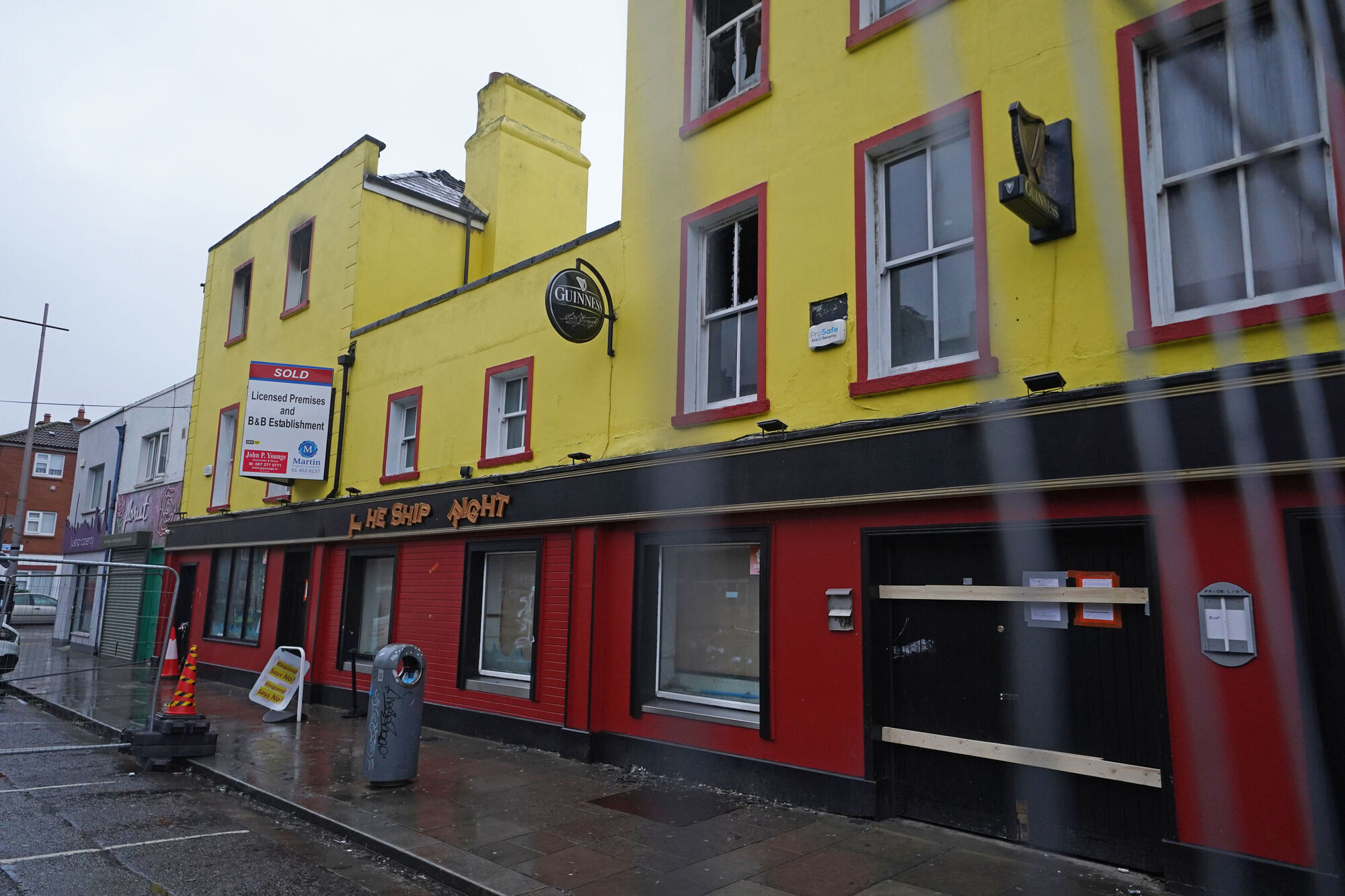
On December 30, amid speculation a former pub, the Shipwright in Dublin's Ringsend, was going to be used to provide accommodation for International Protection applicants, the vacant building was set on fire. File Picture: Brian Lawless/PA
Almost 103 years ago, a British general stationed in Athlone was travelling to a tennis party when he was ambushed by a local IRA company and killed. In retaliation, the Black and Tans combed the surrounding countryside in search of arms and suspects, ransacking a number of farmhouses in south Roscommon and Westmeath.
In response to that, in the early hours of July 3, 1921, volunteers with the Athlone IRA brigade arrived at the grounds of the nearby Moydrum Castle, owned by Lord Castlemaine, a member of the House of Lords and symbol of British rule in the locality, and burned the stately house to the ground. Almost 300 country ‘big’ houses were burned down or destroyed during the revolutionary years.
Fire and arson, at different stages in this country, have been used as a language of revolution, reprisals and retribution. Once more, fire has become the language of choice for some in this country who believe they’re revolting against a new tyranny, though this perceived uprising is one suffused with hate, racism and reactionary nativism.
On December 30, amid speculation a former pub, the Shipwright in Dublin's Ringsend, was going to be used to provide accommodation for International Protection applicants, the vacant building was set on fire. Far from being an isolated incident, this is but one of a growing list that marks a new era of extremism in this country.
Since 2018 there have been almost 20 arson attacks against properties proposed to house asylum seekers around Ireland. In November of that year, a disused hotel in Moville, Donegal, was firebombed and plans to accommodate 100 asylum seekers in the building were soon abandoned.
The family who owned the hotel said they received threats and were harassed when it was announced their property was to be used as a direct provision centre. The property was sold in 2020.
Two arson attacks targeted a hotel in Rooskey, on the Roscommon-Leitrim border, in January and February 2019. Later in the year, local Sinn Féin TD Martin Kenny reported receiving death threats after he spoke about asylum seekers in the Dáil and his car was set on fire outside his home, amid proposals to accommodate asylum seekers in nearby Ballinamore.
The issue subsided for much of the pandemic period though there was then a sharp rise in arson attacks in 2023. Properties in Cork, Wexford, Kildare and Galway have been the subject of suspected arson attacks linked to their role as proposed accommodation centres for asylum seekers.
Following the December 30 arson attack in Ringsend, the Department of Integration said there were no plans to use the building to house asylum seekers and the Dublin Region Homeless Executive (DRHE) confirmed it planned to use the property “for emergency accommodation for families”.
False, misleading and inflammatory claims played a significant role in stoking anti-immigrant sentiment in Ringsend, fostering hatred against asylum seekers and inciting an act of arson that has removed an accommodation centre from operation at a time when homelessness figures have, yet again, broken records.
Offline, in mid-December a local publican was confronted in his pub and falsely accused of owning the Shipwright and turning it into an accommodation centre for asylum seekers. Video from the incident showed someone telling the publican “you’re a liar… I’ll be back to see you.”
Online, in the weeks preceding the fire, social media platforms were awash with misinformation about asylum seekers and migrants, describing their proposed arrival in the area as a “new plantation.”
Plantations have obvious deep historical connotations in this country and the phrase is used deliberately to equate the arrival of asylum seekers to something akin to an enemy force invading an area seeking to harm locals.
The plantations of the 16th and 17th century were a major factor in igniting the Irish Rebellion of 1641 and those who use the phrase in a pejorative sense today see themselves as combatants in their own uprising. In reality, references to a “new plantation” here are but a localised conception of the ‘Great Replacement’ conspiracy theory.
Part-time political commentator, Conor McGregor, has not shied away from revolution-tinged pronouncements when discussing immigration and asylum seekers with his adoring followers: “Do not let any Irish property be took [sic] over unannounced. Evaporate said property. It's a war.”
When news broke of the Shipwright pub going up in flames, online chatter evoking similar imagery followed. Comments posted on various social media platforms imagined the fire stopping a “battalion of invaders,” praised “Irish people fighting back” and proclaimed “war they want, war they get.”
This rhetoric serves to normalise hatred and hostility against migrants and has been a core component of anti-immigrant mis- and disinformation in Ireland in recent years, as documented in our analysis at the Institute for Strategic Dialogue, a non-profit that researches disinformation, hate and extremism online.
The same sentiment was evident in the aftermath of the horrific stabbing incident in Dublin in late November, when calls to action urging people to rise up against the government, politicians and migrants were shared openly in the hours after the attack. We know what happened next.
Violence targeting migrants illustrates the downstream effect of years of escalating extremist activity that has poisoned the well with myths and misinformation, and by whipping up misdirected resentment against asylum seekers and migrants.
Five years on from the beginning of this spate of arson attacks targeting buildings earmarked for asylum seekers, there have yet to be any arrests or charges against those responsible. Condemnation and calls for solidarity rightly follow any attack but what is the State’s response if it cannot guarantee the safety and security of these buildings or their proposed residents?
Most people who have qualms about immigration voice these concerns peacefully, though polls suggest immigration is becoming a major issue ahead of elections this year. We know debates and discussion regarding this topic will feature falsehoods, lies and misleading statements.
This is an immediate challenge for the new State bodies in the Electoral Commission and media regulator Coimisiún na Meán.
What will be the response of social media platforms, when prior evidence suggests glaring enforcement gaps fail to tackle such harmful and misleading content? In the echo chambers and information vacuums that endure online, anger and distrust prosper and the danger of radicalisation is real.
Across Ireland, those motivated by hatred, suspicious of the State and powered by a belief they are on the front line in their own nascent uprising are increasingly taking matters into their own hands.
Extremists speak of rising up; advocate for a lethal strand of ethnonationalism; flood information environments with lies designed to deceive; and regularly use intimidation and violence to achieve their aims. This threat to society, security and democracy should not be taken for granted.
When IRA volunteers arrived at Moydrum Castle in 1921, they gave Lady Castlemaine and her daughter 15 minutes to collect their belongings and exit the building before they torched the house. No warnings have preceded any of the arson attacks since 2018. If these attacks continue, someone is going to be killed.
CONNECT WITH US TODAY



Be the first to know the latest news and updates