Jurassic Park: Why we’re still struggling to realise it 30 years on
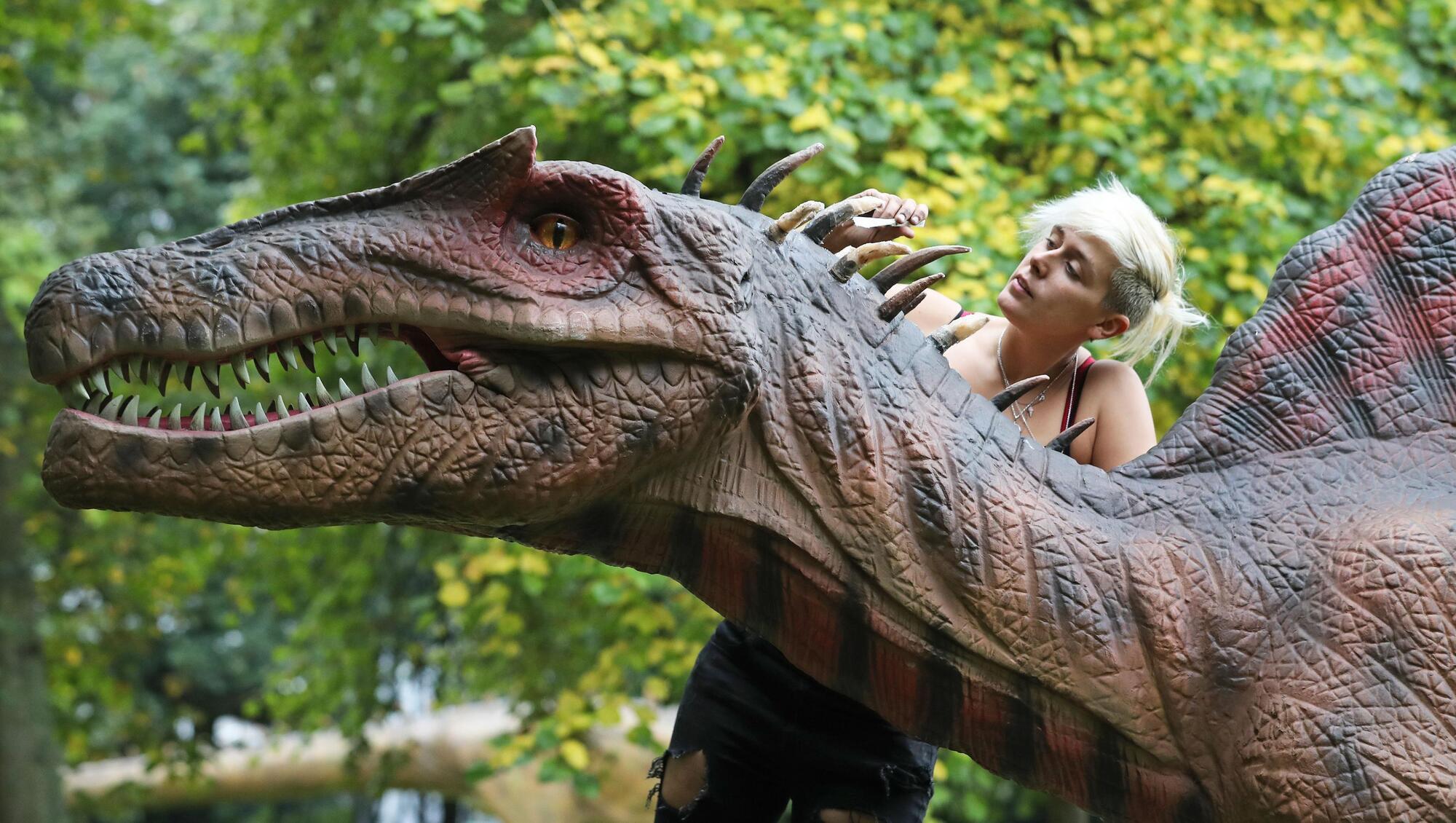
Chloe Mai Napier puts finishing touches to a Spinosaurus at the Jurassic Kingdom exhibition in Leazes Park, Newcastle.
is arguably the ultimate Hollywood blockbuster. Aside from the appeal of human-chomping dinosaurs, tense action sequences and ground-breaking cinematography, its release in 1993 was a movies-meet-science milestone.
As global audiences were soaking up the gory action, the premise of the movie — extracting DNA from fossil insects preserved in amber to resurrect dinosaurs — was given the credibility of publication by several high-profile studies on fossil amber. The authors recovered ancient DNA from amber, and even revived amber-hosted bacteria. The world seemed primed for a real-life Jurassic Park.

But since then, the science has taken many twists and turns. An increasing number of palaeontologists are reporting evidence of DNA and proteins, which also give genetic information, in fossils. These chemical traces could provide unprecedented insights into ancient life and evolution. However, such reports are the source of ongoing debate and controversy among scientists.
Our recent study, published in the journal , offers new insight.
DNA yields the most detailed information, compared to other molecules, on how closely species are related. However, DNA is extremely fragile and decays rapidly after an organism dies.
That said, DNA can sometimes survive in polar climates because the freezing temperatures slow down decay. Geologically young DNA (thousands of years old) therefore has the potential to resurrect extinct animals from the last ice age through to the recent past.

Commercial companies such as Pleistocene Park, Colossal and Revive & Restore are working on projects to bring back the woolly mammoth and passenger pigeon.
There is a long time gap between these mammoths and dinosaurs, which went extinct 66 million years ago. There is some evidence, though, that genetic material may survive in fossils even on these timescales.
For example, fossil chromosomes — fragments of DNA smaller than a cell — have been found in plants up to 180 million years old and a 75 million-year-old dinosaur.
Scientists have yet to find evidence, however, that actual DNA can survive for tens of millions of years.
Proteins also code information (in the form of amino acid sequences) that can shed light on the evolutionary links among species.
Scientists believe that proteins can survive for longer than DNA. Indeed, researchers have found many examples of fossilised proteins, most notably intact amino acid sequences of collagen (a protein found in connective tissues), but these are at most a few million years old.
Scientists don’t expect large protein fragments to survive for as long as these smaller ones. So the scientific community was electrified in 2007 by the report of 68 million-year-old collagen fragments in a Tyrannosaurus rex bone.
Controversy soon followed though as concerns mounted about the team’s methodology, such as the potential for contamination and the lack of rigorous controls and independent verification.
Similar debate surrounds more recent reports of degraded proteins and collagen fibres in fossils as old as 130 million years.
These studies highlight the difficulties of working with fossils, especially using analytical methods that may not be appropriate to use on ancient tissues. The evidence for survival of fossil protein remnants, however, has proved compelling.
These studies are also stimulating other researchers to explore new methods and analytical approaches that might be better suited for use with fossils.
Our new study explores one such approach, using a focused beam of light plus X-rays to irradiate samples of ancient feathers. These techniques reveal which chemical bonds are present, providing information on the structure of proteins. In turn, this helps us to detect traces of proteins in fossil feathers.

Our analyses of the 125 million-year-old feathered dinosaur Sinornithosaurus revealed abundant corrugated protein structures, consistent with a protein called beta-keratin, which is common in modern feathers. Spiral protein structures (indicative of another protein called alpha-keratin) were present only in small amounts.
When we simulated the process of fossilisation in laboratory experiments, we found that corrugated protein structures unravel and form spiral structures when heated.
These findings suggest that ancient feathers were remarkably similar in chemistry to modern-day feathers. It also suggests that spiral protein structures in fossils are probably artefacts of the fossilisation process.
Ultimately, our findings suggest traces of proteins do survive for hundreds of millions of years.
Palaeontologists today can test fossils for evidence of ancient molecules using an arsenal of techniques that were not available 30 years ago. This has allowed us to identify fragments of molecules in fossil animals that are tens to hundreds of millions of years old.

Scientists have discovered haemoglobin, a protein in red blood cells, in 50-million-year-old insects, and melanin pigments in the ink sacs of 200-million-year-old squid.
Ultimately though, we need intact DNA to resurrect species. So although scientists have made a lot of progress, the prospect remains in the realm of science fiction. All data from fossils and experiments to date suggests that DNA is simply unlikely to survive for tens of millions of years.
Even if scientists did find DNA fragments in dinosaur fossils, these would probably be very short. Short fragments of DNA are unlikely to give us useful information about a species. And we don’t yet have the technology to validate such rare DNA fragments as original rather than random combinations of amino acids, generated during fossilisation.
Better lab protocols and fossilisation experiments are helping us to make more accurate interpretations of fossils. This is paving the way for more rigorous studies of ancient molecules.
In the future, these studies may challenge what we think we know about how long molecules can survive, and may even reshape our understanding of the evolution of life on Earth.

Tiffany Shea Slater is a Postdoctoral Researcher, Palaeobiology, University College Cork, and Maria McNamara is Professor of Palaeobiology at University College Cork
CONNECT WITH US TODAY



Be the first to know the latest news and updates