Q&A: How Ireland will contribute to this year's UN General Assembly
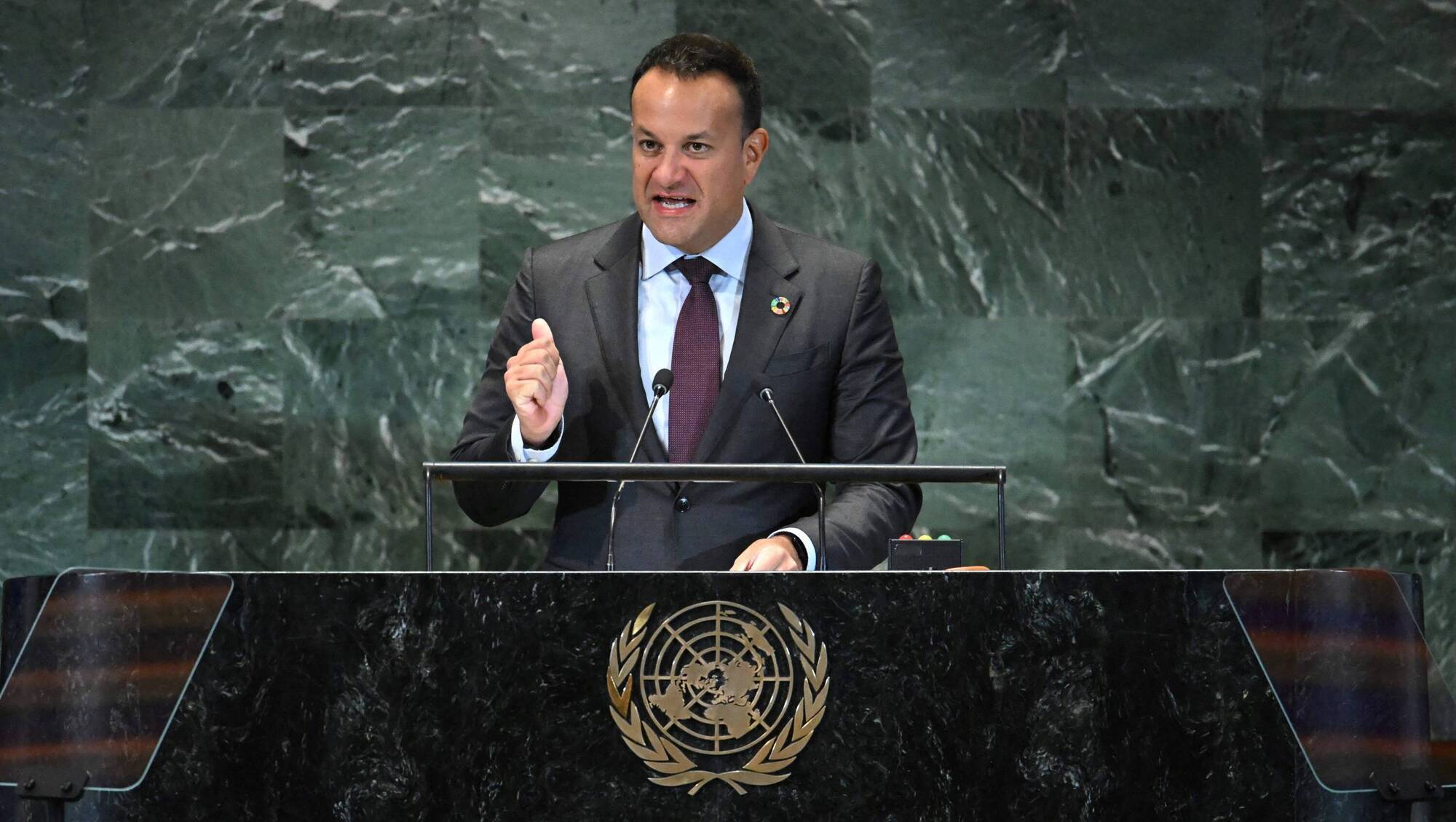
Taoiseach Leo Varadkar speaks at the opening session of the second Sustainable Development Goals summit on Monday ahead of the 78th UN General Assembly. Picture: Timothy A Clary/AFP via Getty Images
The UN General Assembly (UNGA) is where almost every country in the world (193 in total) comes together once a year to debate and discuss issues that affect us all. Every member state — from the largest to the smallest — has a voice and a vote on issues around peace, stability and sustainability.
It provides Irish politicians with a chance to get in the room with other foreign leaders and to press our own policies and agendas, with Taoiseach Leo Varadkar, Tánaiste Micheál Martin, Green Party leader Eamon Ryan and Health Minister Stephen Donnelly all over in New York this week.
Ireland will be engaging in key debates on climate, conflict, global health and many more global challenges.
The Taoiseach will also give our national statement to the UN General Assembly on Friday.
With both US President Joe Biden and President Volodymyr Zelenskyy in town, a large chunk of attention will be directed towards Ukraine.
There will be a specially-convened meeting of the Security Council scheduled to discuss Russia’s unlawful invasion and crimes of aggression.
As the world emerges from the shadow of covid-19, UNGA will see political leaders from around the world gather to discuss how to be better prepared for future pandemics. The world’s collective experience during covid-19 demonstrated why joint preparedness and joint response are so vital.
This year’s UNGA is particularly important as it marks the half-way point of the Sustainable Development Goals (SDGs). In 2015, Ireland and Kenya were tasked by the UN secretary general to bring the world together to agree a plan to tackle global challenges by 2030.
The SDGs are 17 goals with 169 targets that all 191 UN member states have agreed to strive to achieve by 2030. Among the goals are the elimination of poverty, ending hunger, securing gender equality, and ensuring education is available to all.
The centre-piece of UNGA this year is the SDG Summit, which will review progress to date and agree a way forward for the second half of the project. Ireland, alongside Qatar, has been given the role of securing a political declaration to chart a path towards achieving the SDGs by 2030.
With only seven years remaining, and with many of the goals off track, this coming together at UNGA is a vital moment for renewing political energy and commitment to the SDGs.
Having co-chaired the commission for the creation of the SDG’s in 2015 (with Kenya) Ireland has again been selected to co-chair (with Qatar) this major international SDG summit at UNGA.
Speaking at the UN, Mr Martin said countries around the world now need to "re-energise" and "reboot" to achieve the SDGs.
"In terms of the Sustainable Development Goals, we can't surrender to fatalism in respect of the achievement of those goals. If you keep delaying targets and setting them back, that in itself creates an atmosphere or an environment where you even get a slower implementation of those targets."
CONNECT WITH US TODAY



Be the first to know the latest news and updates