‘Some women had an awful life’: How the marriage bar affected women’s lives
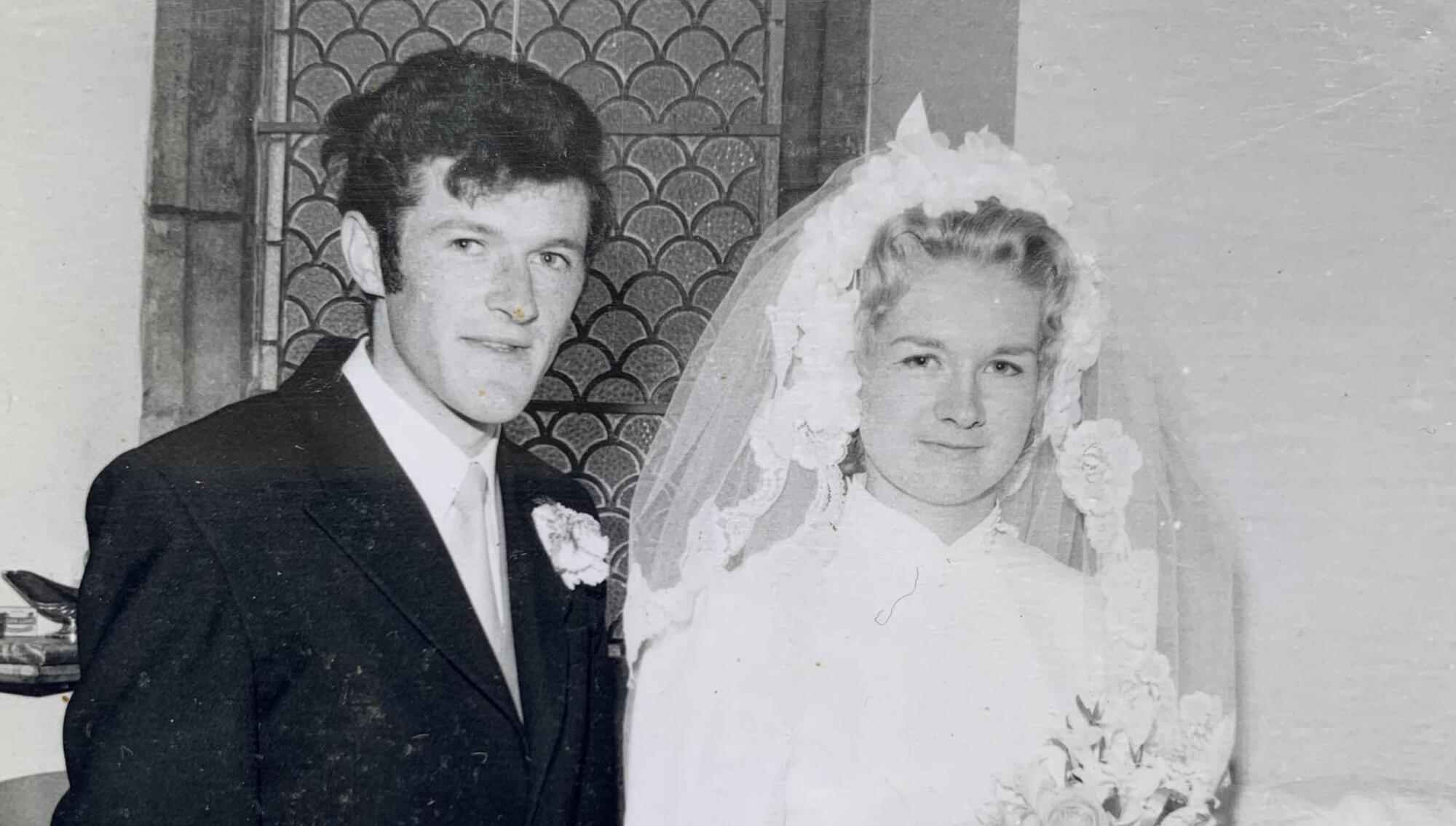
Maura Corcoran (nee Kelleher) and her husband Noel on their wedding day June 16, 1971. Maura worked as a shorthand typist with General Accident Insurance in Cork. Pictures: Sorcha Crowley
No one ever asked you if you liked your job back in 1973.
“You had a job. What’s not to like?” says Bernie Flynn, recalling the holy grail of employment back then — a permanent, pensionable job in the civil service.

Bernie and her two colleagues, Terri Tiernan, 77, and Martina*, 76, were among a half dozen bright young women who had secured exactly that in the finance section of Sligo County Council in the late 1960s/early 1970s, working as clerk typists under a male accountant.
Ironically, for the three pals, all either engaged to be married or “doing a steady line”, it was anything but permanent and pensionable thanks to the marriage bar.
Fifty years ago this summer — thanks to the European Economic Community’s Treaty of Rome — the Irish Government was forced to abolish this 19th-century law which required women (only) to resign from civil and public service jobs once they got married.
As unbelievable as it seems today, back then, Irish society didn’t bat an eyelid at the forced removal of thousands of women from the workplace. Married men were the breadwinners and were given priority for jobs over married women.
Women knew when they were offered jobs that they came with a bittersweet pill.
“You didn’t query it. It was part of your contract. We knew we had to leave on getting married,” Martina tells the .
“You knew when you got married that that was the end of your independence,” says Cork native Maura Corcoran, 75, a former shorthand typist with General Accident Insurance in 49 South Mall, Cork City.

The job had its perks however: It paid as much as teaching and offered 90% mortgages with low interest rates. She worked there for four years up until her wedding in June 1971.
“You went down automatically to one salary.
“We didn’t think it was such a great loss because you were delighted to be getting married and go home and have children. That was the attitude,” she recalls.
“It was taken for granted that you were leaving and that was it. There was nothing about it. We thought totally different that time to the way we think now, totally different,” she adds.
“Women weren’t assertive that time and we paid a lower rate of PRSI as well. Why, I don’t know,” she says.
The marriage bar was sweetened somewhat by the fact that after five years’ service, women received a marriage gratuity of one month’s salary for each year of service up to a maximum of a year’s pay.
It often went towards a deposit for a home for the newlyweds, when only men were allowed take out a mortgage.
“It was a nice lump sum, you know, when we were going and we obviously got a refund of our pension contributions, or you could have kept them up yourself if you wanted,” says Terri. While the lump sum was attractive, it was in lieu of a pension which would have long-term consequences even today for up to 57,000 women.
Looking back now, the women are unanimous in how unfair it was. “It wasn’t fair,” says Maura.
“You lost out on an awful lot of years, pension-wise. I had no pension from work,” she says. Her work in later years was “just about” enough to secure her a contributory pension.
The marriage bar was just one aspect of a gaping inequality for women in late 20th-century Ireland.
“Back long ago, if a mother and child were in danger, the baby was kept alive and the mother was allowed die.
“When you think of it, things were so bad. Women had no say. Some women had an awful life, particularly out the country,” says Maura.
One woman who stands out for Maura from that time was a 45-year-old colleague who rose up through the company ranks because she was single and wasn’t forced to resign. But she couldn’t get a mortgage because she was unmarried.
“Eventually they decided that she wouldn’t be getting married, and they gave her the mortgage. That really sticks out in my mind,” she recalls.

Did it put anyone off marriage?
“No, you didn’t even query it. That was the way it was,” says Martina, who got married on November 7, 1973. “You didn’t even question it,” says Pauline, 76, who worked for the Department of Agriculture until her wedding in 1972.
“You just had to leave. I thought it was terrible, really terrible.
“Because if you worked in a shop you didn’t have to leave — it was just the civil service.
Amazingly, none of the women resented their male counterparts at the time.
“We knew they were the terms of our employment.
“At the time, we were considered lucky to be in a permanent pensionable job.
“That was the way the councils were looked on at the time,” says Martina.
“You didn’t think that way at the time,” adds Maura. “There was totally different thinking to the way we think now. We did what we were told. When I think of it,” she says, shaking her head.
This widespread acceptance of the marriage bar can be explained by how society was shaped in the preceding decades according to University College Cork researcher Deirdre Foley.
“People were much more subservient. They’re going from harsh convent school environments, straight into civil service, with harsh managers as well.
“So, there wasn’t as much of an atmosphere of sort of questioning or independence,” she says.
The disparity between the forced resignations among civil servants and the shop workers points to another class divide according to Foley.
“The other thing to remember about the marriage bar is that even though it created a lot of difficulty and a lot of people are angry about it, is that it is very much a middle-class problem.
“It applied to middle-class people in middle-class jobs, mostly educated women.
“There was never a marriage bar for the cleaners of Government buildings because they were all women,” she points out.
Change was in the air by 1973 with several unions calling for the abolition of the marriage bar.
“We were saying how ridiculous it was, that the guys working with us went off, got married, and came back, just resumed their jobs and we were just out on our ears,” says Terri.
“We knew it was coming down the line, that it would be lifted. It was very contentious at the time,” she says, adding that the unions pointed to the fact that nurses and primary school teachers were already exempt.
“We were using that in the union as a basis for us not having to leave. There was no rhyme or reason why women had to resign.
“The Government and the Church were trying to keep women in the home. The money would have come in very handy,” she adds.
While she felt aggrieved about it at the time, she knew the work was going on to get it lifted.
“It was too late for me, but it was absolutely ridiculous that it went on for so long.
“I know the 70s might seem like ancient history, but the country was moving along fairly nicely at that time and there was something about making way for new jobs, but it didn’t make sense.
“If you wanted to create new jobs, throwing out people that were in jobs didn’t make sense.
“The only thing it did do was bring in people who were on basic pay instead of the higher rates of pay,” she claims.
Out of the three pals at Sligo County Council, Bernie postponed her wedding to August 1974, giving her the chance to hold on to her job. She became the first woman who wasn’t a widow to work for the council. As with all change, it wasn’t easy at first.
“There was concern there wouldn’t be jobs for younger people,” she says, adding that she got “huge support” from her boss, a single woman in her 40s.
Even after the marriage bar was lifted, returning to work was almost impossible for young mothers. Childcare was practically non-existent in the 1970s, forcing most women like Martina, who had her first baby in August 1974, to remain at home.
“I wouldn’t have been able to stay on. I didn’t have anyone to look after my baby so I had to do it myself,” she says. Pauline would “definitely” have continued working if allowed, but has made peace with the past and is “quite content now”.
“It would have depended on your financial circumstances. It wasn’t the done thing,” agrees Maura.
For Terri, the poor career prospects for women at the time meant career ambition was pointless anyway.
“Promotional outlets would have been very, very limited.
“The most you could possibly aspire to would be to go up the step to clerical officer. It wasn’t like there was a career path in the county council at that stage.

“I think our expectations were lower.
“We were working to get it changed,” she says, adding that her own mother worked in the council also, but like her daughter, had to resign on getting married in 1943.
The marriage bar had long-term impacts for thousands of women. Some never returned to the workforce, some did once their children were older and childcare was less of an issue.
“After I got my gratuity, I lost my own income. The five of us were living off the one income,” says Martina, who got a job when her eldest was 17, heading for college.
“To be able to afford to send her to university I got a job locally here and I was quite happy,” says Martina.
It was the end of office work for Terri, who ran a B&B at one stage while she reared her children. She says:
Maura is only sorry she didn’t return to work sooner, having spent 22 years at home rearing her family.
“I had four children; I only went back to work when my youngest started secondary school. I enjoyed going back to work when I did go back to work. When I returned to work, it changed my life altogether.
“I did a return-to-work course. The course itself was hopeless, but it was meeting all the different people that opened our eyes for us.
“Only for it, I wouldn’t have had the confidence in myself to go back out to work.
“When I went back to work again it was lovely to have your own money,” she laughs. Martina also secured office work when her children were older and has “no regrets”.
The women speaking to this newspaper are all philosophical and while they realise how unacceptable it seems today, they knew they had little choice at the time. Not all women are as content.
“Some women get angrier as they get older, looking back,” says Foley, who has interviewed hundreds of women for her research.
“I know my granny was that way. The older she got, the angrier she was about what happened to her,” she says.
Even after the bar was lifted and women were allowed back to work, they were usually only offered work on temporary contracts and had to start back at the bottom again, regardless of the number of years they previously worked.
“You were put back at the bottom of the scale and you didn’t go anywhere with it,” said Maura.
Terri tells the same story. “Funnily enough, I was offered to come back and work in the council several months after I got married, but I would have had to go back at the basic rate of pay and I would have had no increases or anything.
“I’d only be employed as a temp,” she says.
Maura also missed out on promotions because of her forced absence from the workforce. “I know the few job promotions I went for it was my age that was the barrier but I couldn’t prove it. I was in my fifties for God’s sake,” she says.
Long after it was abolished, the after-effects of the marriage bar kept women “at the bottom of all of these organisations for a really long time,” notes Foley. She believes their case for compensation is “convincing,” while their loss of potential is “impossible to calculate.”