Elaine Loughlin: Neutrality forum already facing unfriendly fire
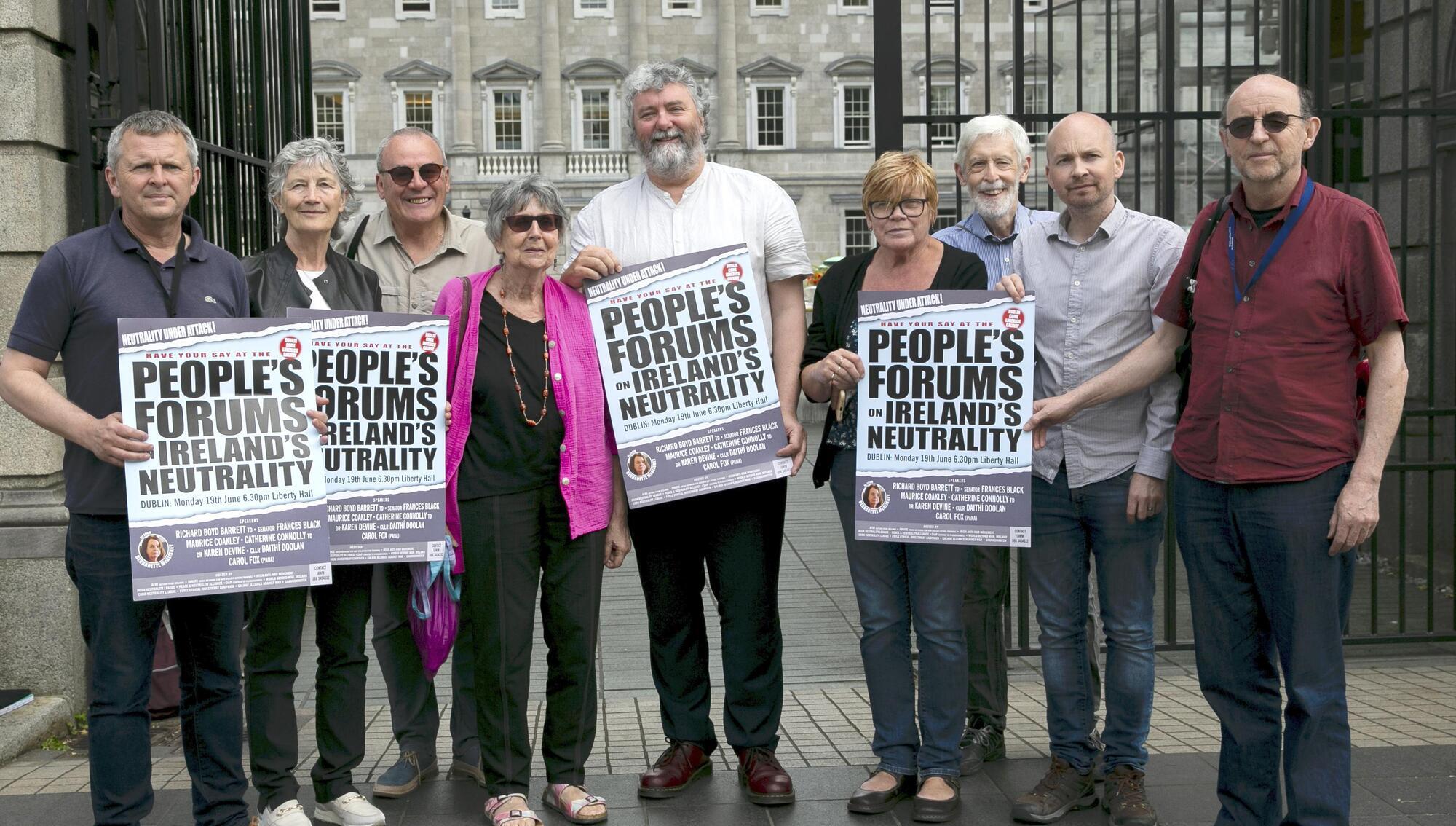
Members of the Irish Neutrality League and coalition of groups highlighting alternative forums on neutrality in opposition to the Government's Consultative Forum on International Security Policy outside Leinster House, Dublin, last week. Picture: Gareth Chaney/Collins

Is the Government's neutrality forum doomed before it even kicks off?
The State will fork out €40,000 on tea and sandwiches as Tánaiste Micheál Martin hosts the first of four meetings across the country this week, but controversial comments made by President Michael D Higgins over the weekend have already put a sour taste on the event.
While the President has since apologised for the remarks aimed at the chairwoman of the forum, he is not alone in his strong criticism of the speakers who will address the meetings in Cork, Galway, and Dublin.
There were spikey exchanges in the Dáil last week when People Before Profit-Solidarity TD Paul Murphy said the forum has been "rigged" with panelists "stacked up" in favour of one side of the argument.
"These consultative forums are an absolute farce," said Mr Murphy. "They are part of a managed process designed to say that the great and good have come together and have decided that Ireland is now too mature to stick with these old notions of neutrality and we are going to ditch it."
It led Mr Martin to claim that members of the opposition would "put the jackboot on people who might have views different to them" if they were ever to enter government, a comment he later withdrew.
The President's questioning of the make-up of the forum has only further cemented the notion that it is simply an exercise with a pre-determined outcome.
Mr Martin in recent days has insisted that the forum will examine the State’s foreign, security, and defence policies in a fair and comprehensive manner.
The need to discuss where we stand as a country and our views on joining a European force or possibly even Nato has been floated since the outbreak of the war in Ukraine.
Just a week after the Russian invasion in early 2022, then tánaiste Leo Varadkar opened up the discussion around our neutrality, signalling that we will have to increase military investment in the coming years as Ireland cannot assume it is under no threat of attack.
"We make the assumption that even if we are attacked, the British and the Americans will come and save us anyway. And I'm not sure that's the kind of assumption a sovereign country like ours should make," he told the Dáil.
Since, Mr Varadkar has gone on to say Ireland must have an evidence-based reflection on its military neutrality, adding that he is confident a referendum on Irish involvement in an EU army would be passed here.
Mr Martin, who has been known to take a more cautious approach than his Fine Gael counterpart in Government, has also made a number of strong contributions on what is a very divisive issue.
In announcing the forum last month, he said the “full spectrum” of options would have to be considered as part of the review of Ireland’s military neutrality.
He warned that the country can no longer rely on its geographic isolation for security nor “isolate” itself from world events.
It is in this context the forum has been established. New and emerging threats will also be discussed, including cyber and hybrid attacks, the use of disinformation, and growing concerns over the protection of critical offshore infrastructure.
It will also look at Ireland’s efforts to protect the rules-based international order through peacekeeping and crisis management, disarmament and non-proliferation, international humanitarian law, and conflict prevention and peace-building.
The more controversial side is, of course, the discussion that will be had around Ireland’s policy position of military neutrality and an exploration of definitions, options, and implications of the policy of neutrality.
In her role as chairwoman, Louise Richardson has been asked to produce a report based on the learnings of the consultative forum which will be delivered to the Government.
But with so many, including the first citizen of this country, already lining up to cast doubt over whether the forum will be a balanced study of what is a very controversial topic, the Government could find it hard to act on any recommendations.
Will Prof Richardson's work become yet another report that simply gathers dust?

CONNECT WITH US TODAY



Be the first to know the latest news and updates