Laura Harmon: A united Ireland referendum is possible before 2030 but we must plan now
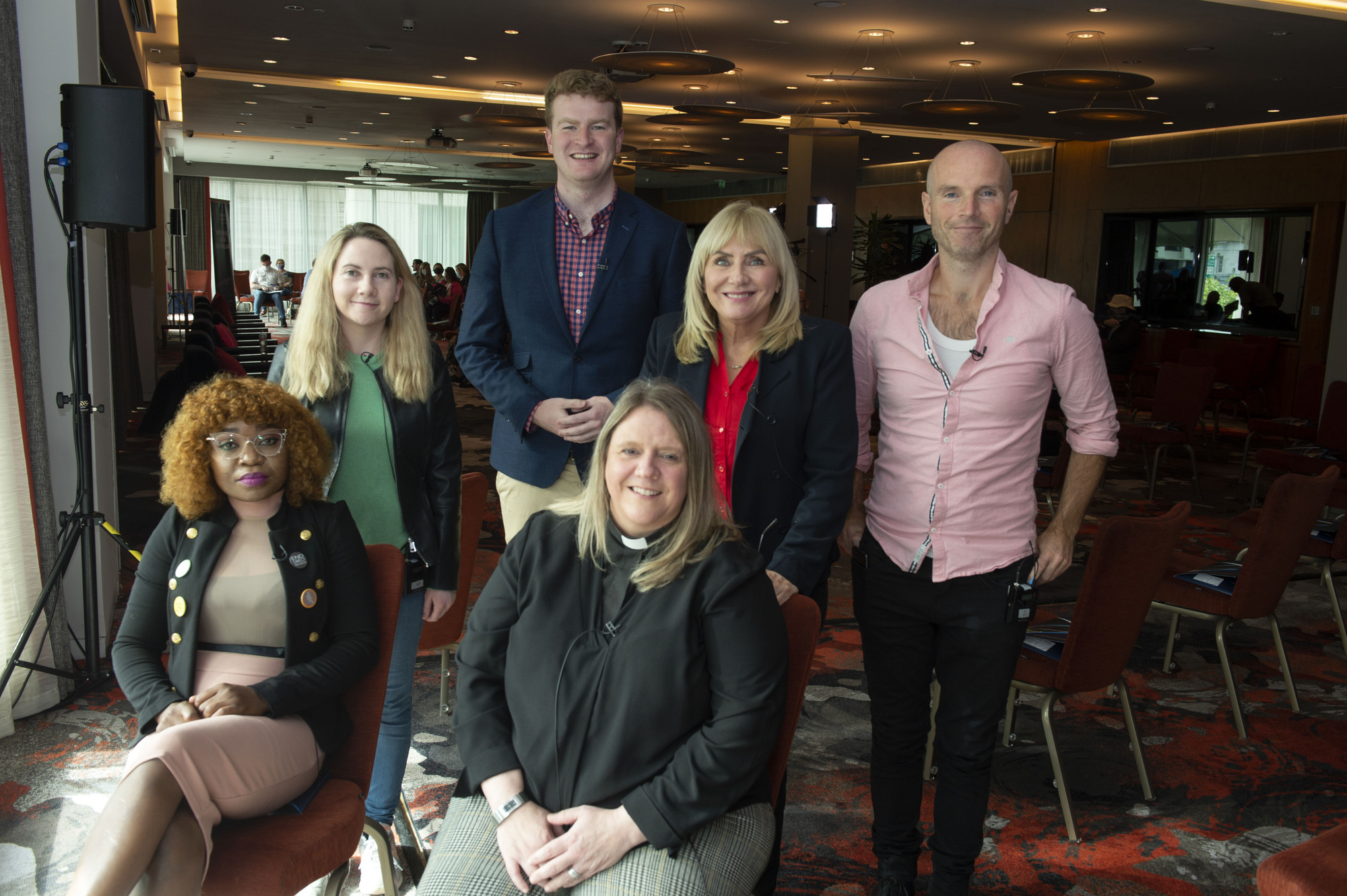
Senator Frances Black, comedian Tadgh Hickey, Fianna Fáil TD James O’Connor, equality activist Laura Harmon, founder of Ballyhaunis Inclusion Project Owodunni Ola Mustapha, and Ireland’s first female Baptist minister Rev Karen Sethuraman. Picture: Michael Mac Sweeney/Provision
As the 25th anniversary of the Good Friday Agreement approaches, it’s appropriate for us to look to the future and see what an integrated, reunified Ireland would mean for the citizens of this island.
A lot has changed since 1998. Northern Ireland voted by 56% to remain in the European Union in 2016. Support for a border poll has grown among voters in Northern Ireland since 1998.
The Good Friday Agreement provides for the right of the people of our island to self-determination.
The timing of a border poll is in the control of the British secretary of state for Northern Ireland.
Failure to plan by the Irish Government for future constitutional change, as allowed for under the terms of the Good Friday Agreement, is an unacceptable shirking of responsibility.
The next Government should appoint a Minister to oversee preparations for a border poll and to initiate all-island citizens’ assembly.
This must include citizens from across the island and be representative of minority groups, geography and gender. Every effort must be made to include unionists in all discussions.
The Shared Island Unit established in the Department of the Taoiseach is a start but it is nowhere near adequate.
We can’t sleepwalk into a situation like Brexit, where ‘leave’ was allowed to mean so many things and the British public had no real knowledge of what the consequences would be.
The public need to know what unification would mean for them. Brexit showed the chaos that occurs when the facts have not been put properly to voters.
The Government urgently needs to prepare for concurrent referendums north and south and provide a clear picture of what a reunified Ireland could look like.
Partition was a failure economically. David McWilliams has pointed out that ‘before partition the north was twice as rich as the south and it is now twice as poor.’
Ireland's Future has already published several papers, including one which addresses the cost of unification. The estimated costs are nowhere near what opponents of a united Ireland would have us believe.
The British subvention bridges the gap between taxes raised in the north and expenditure. £10bn (it was £9.637bn in 2019) is often stated as what it would cost the Irish Government.
This is a lazy price tag to put on unification as Brendan O’Leary outlines in his book ‘Making Sense of a United Ireland.’
O’Leary cites the figure of €2.85bn, referring to political scientist John Doyle who names items which the Irish Government should not be liable for.
These include the British public sector pension liability before unification, Northern Ireland’s share of Britain's national debt and the NI contribution to the British defence budget.
This doesn’t include international assistance which may come from the EU or US.
Nor does it account for opportunities to expand tourism, new urban growth centres, health and education policy decisions and new transport and trade links.
Whether devolved or integrated, unification would mean examining our political structures.
All structures will need to be looked at but the Seanad is one example.
We narrowly voted to keep the Seanad in 2013 and I was proud to campaign for its retention. However, many of us who voted did so with the expectation that it would be reformed.
In a united Ireland, the Seanad should be completely overhauled to allow every citizen to have a vote and to ensure that minority communities are represented.
Much has been said about what the flag would look like or what the national anthem would sound like in a unified island.
The substantive debate cannot be allowed to be derailed by an over-emphasis on these issues.
Provisions can be made in advance of any vote to deal with these issues and these are topics which could be discussed as part of a citizens’ assembly.
Preparing for a united Ireland is a mammoth task and we need politicians who can rise to it. It will require diligent research and planning, involving senior civil servants across multiple departments.
This is not an issue that can be voted on with 6 months’ notice — the public need facts and a roadmap on how the transition would occur. A conscientious Government would work to ensure that we are prepared if the UK initiate a border poll.
I believe that this is likely to happen before 2030. Scotland may hold another vote on independence in the coming years and this is sure to propel further discussion here.
If done properly with ample discourse and debate, and with clear planning, a united Ireland could hugely benefit citizens across the island economically, socially and culturally.
The timing of a border poll is not in the control of the Irish Government but planning for one is and right now they are failing at the task.


CONNECT WITH US TODAY



Be the first to know the latest news and updates