Avatar's $2 billion vanishing act

Avatar: The Way Of Water is the first in a series of four long-delayed sequels that will transform Avatar into a franchise.
First it was said that James Cameron was no match for reality. In late 2009, before Avatar came out, sceptics warned that the visual-effects behemoth would never recoup its unearthly budget, estimated to be upward of $237 million.
In just over two weeks, it grossed $1 billion, quieting doubters, at least temporarily. After that, the story reversed: Reality was no match for Avatar.
The condition went by different names: Avatar Syndrome, Post-Pandoran Depression or PADS (Post-Avatar Depression Syndrome). It was marked by despair and suicidal ideation, brought on by the insurmountable gap between real life and Cameron’s C.G.I. Eden.
This was at the dawn of the era when a small group of people acting weird online could set off a days-long cycle of news. Here, the source was a multipage thread on the independent fan site Avatar Forums — “Ways to cope with the depression of the dream of Pandora being intangible.”
By that point, January 2010, even certain well-adjusted people had seen the movie two or three times, lured back to theatres by the all-consuming tale of an ex-Marine fighting to save the Na’vi race from the venal designs of a mining corporation.
For the people posting on the thread, watching was not enough; they wanted to live inside Cameron’s world, to fly through Pandora as a 10-foot-tall blue alien, in perfect symbiosis with nature.
One of the afflicted, Ivar Hill, told CNN:
Hill was 17 at the time, living with his parents in Borås, Sweden. He first saw Avatar at the local cinema and woke up the next day feeling empty and lost. On Avatar Forums, he found others who felt trapped, who yearned for a chance to start over on Pandora or dreamed of leading a Na’vi lifestyle here on Earth.
Hill saw Avatar four times, once even traveling an hour to Gothenburg, at the time the nearest city with a 3-D-equipped theatre. Eventually, with two friends he met online, he started his own fan forum, Tree of Souls, named for the holy site where the Na’vi go to experience the interconnectedness of all things.
In the chat room, he met a woman named Heather, who had also experienced post-Avatar depression. In 2012, the pair met for the first time at an in-person Avatar event in Seattle.
Two years later, they were married in Sweden. The couple now lives in the Pacific Northwest, where Hill, who became an American citizen last year, works as a video-game developer.
Hill still operates Tree of Souls, one of the few surviving Avatar fan forums. The site today is mostly speculation about Avatar: The Way of Water, the first in a series of four long-delayed sequels that will transform Avatar into a franchise.
The Way of Water, which was shot simultaneously with a yet-to-be-titled third film (and part of a fourth), arrives in cinemas this weekend.
When asked about his plans for the premiere, Hill was nonchalant. Though Avatar altered the course of his whole life — arguably more than even James Cameron’s — he doesn’t really think there’s anything that special about the movie.
Of all the questions raised by Avatar: The Way of Water, the most pressing seems to be: “Who asked for this?”
Though the first Avatar was the world’s top-grossing movie not once, but twice, reclaiming the title from Avengers: Endgame after a 2021 rerelease in China, its most oft-cited claim to fame is its surprising lack of cultural impact.
While films of similar scale and ambition — Star Wars, Jurassic Park, Iron Man — have spawned fandoms and quotable lines and shareable memes and licensed merchandise, Avatar has spawned mainly punch lines.
On the fifth anniversary of the film, Forbes announced, “Five Years Ago, Avatar Grossed $2.7 Billion but Left No Pop Culture Footprint.”
A few years later, Buzzfeed ran a quiz titled, “Do You Remember Anything at All About ‘Avatar’?” challenging readers to answer basic questions like, “What is the name of the male lead character in ‘Avatar’?” and “Which of these actors played the male lead?”
Even if you cannot answer these questions, chances are high you have seen Avatar. To jog your memory, a quick rundown of the plot: The year is 2154. Earth, as you might expect, is a husk. Four light-years away on an inhabited moon called Pandora, an outfit called the Resources Development Administration extracts a mineral called unobtanium.
This is not an in-and-out mission. The air on Pandora is toxic to human lungs and mining operations are resisted by the Na’vi, an Indigenous group that lives off the land and is rightly distrustful of “the Sky People.”
To learn the Na’vi mind and protect its own investments, the R.D.A. funds a side project called the Avatar Program, in which scientists create Na’vi clones that can be piloted by humans. Each of these “avatars” is matched to a single researcher’s DNA.

When one researcher dies before his avatar is fully formed, his twin brother is tapped to take over his role. Jake Sully, played by Sam Worthington, is a paraplegic ex-Marine. In this avatar body, he discovers a new freedom. What follows is basically what you would expect: Guy goes native, has a change of heart, saves the local race from his own kind.
Avatar was first mentioned in the press in 1996. Before a single frame was shot, the film was foretold as a kind of prophecy. A headline in The Tampa Bay Times announced, “Synthetic Actors to Star in Avatar.” At that point, motion-capture was practically science fiction, and C.G.I. had mainly been used to render non-human creatures or effects.
After Titanic in 1997, Avatar was set aside as Cameron began to work out the technological kinks. Work on Avatar officially began in 2005. Cameron contracted a linguistics consultant at the University of Southern California to begin development on Na’vi — a lexicon of more than 2,800 words, drawing on the rarest structures of human language.
From there, the anecdotes only got more insane: a team of botanists advising on imaginary flora; a bespoke head rig to record facial expressions; a motion-capture stage in Howard Hughes’s airplane hangar, six times larger than any seen before. Each new detail fed a tornado of hype, a low-pressure system of buzz so rapacious that it grew to encompass everything from the film’s tech — a 3-D camera system, invented by Cameron, which could mimic the spread between the human eyes — to its budget, estimates of which ranged from $237 million to $500 million.
Avatar premiered on December 18, 2009, at No. 1, bringing in a respectable, if not astounding, $73 million. By the first week of January, Avatar surpassed $1 billion, setting a record for reaching that milestone. By the end of the month, it was the first movie to ever gross $2 billion.
In April 2010, when two sequels were announced, it came as no surprise to anyone.
These sequels would be repeatedly delayed, reportedly on account of: two sequels expanding into three (2013); delays in script delivery (2015); three sequels ballooning to four (2016); the epicness of this quadripartite undertaking, which Cameron at one point likened to “building the Three Gorges Dam” (2017); Disney’s acquisition of 20th Century Fox, which demanded a shake-up in the rollout strategy, to better harmonize with the Star Wars release schedule (Disney, by then, also owned Lucasfilm) (2019); and finally, the novel coronavirus (2020). (Disney disputed some of these accounts but declined to directly address the cause of the delays.)
Over this 13-year period, the entertainment industry underwent a transformational shift, the beginning of which almost exactly coincided with the moment that Avatar was released.
In 2008, Iron Man came out, the first of the 30 (and counting) movies that today make up the Marvel Cinematic Universe. As Avatar promised one future for film — original world building, envelope-pushing effects, the theatre as the site of cinematic innovation — Marvel, and other endeavors that would follow, went on to develop a very different one.
In this vision, any given movie was merely one installment in a more complex cultural product called the franchise. A franchise is an ecosystem oriented toward an infinite horizon, in which a common set of characters and stories are constantly refreshed and reworked across platforms.
From 2008 to today, entertainment brands, old and new, turned themselves over to the new model. The ascent of this networked form of entertainment has had far-reaching cultural effects on everything from the tone and plot structure of movies, to what it means to be a fan, to how we calculate success.
If Avatar feels irrelevant today, it has less to do with the film itself and more to do with how the world has changed around it.
In July, when I first started working on this article, a search on Amazon for “Avatar” returned only products for “Avatar: The Last Airbender,” an unrelated franchise owned by Nickelodeon.
Today just one major vestige of the fandom still survives, Pandora: World of Avatar, a detailed 12-acre simulacrum rising from the flatlands of Orlando, Florida. The theme park offers the most fleshed-out look at how Avatar might remake itself in the age of the franchise.
Pandora is inside Disney’s Animal Kingdom, an attraction that combines the pious conservationism of a zoo with the wacky extremity of a carnival.
On Pandora, there are three major attractions: Flight of Passage, a 3-D-simulator ride; an “It’s a Small World”-style boat tour called Na’vi River Journey; and a scale replica of the Valley of Mo’ara, the massive floating mountain range that Neytiri, Jake Sully’s love interest, calls home. (The range didn’t have a name until after the park was built.)
As I entered the park, these mountains loomed above me, held aloft by steel supports disguised to look like mossy vines. The pristine green of this false Amazon was interrupted only by the teals and magentas of plastic sprayer fans and sun-protective T-shirts and quick-dry bucket hats.
Families all around posed for photos. Most of the children, I guessed, were not yet born at the time the first Avatar was released. Conventional wisdom about Avatar’s cultural irrelevance notwithstanding, the park was swamped. I walked around in desperate search of a Na’vi.
As it turns out, a 3-D simulacrum of a 3-D movie kind of cancels itself out. Divorced from the dazzle of visual effects, I could see the aesthetic universe of Avatar for what it was: a glorified World Market sale section.
Six weeks later, on September 23, Disney rereleased Avatar into theatres, in an ostensible effort to prime the viewing public for The Way of Water.
I went to see it with a group of 20 friends. I worried that I would not make it three hours, but from the first moment Jake Sully appeared, my skepticism slipped away, replaced with sudden, overwhelming understanding of why people once lost their minds for Avatar.
Here is probably a good place to disclose that when I first started working on this article, I had never seen Avatar. I ended up watching Avatar for the first time on a laptop screen in my hotel room in Orlando.
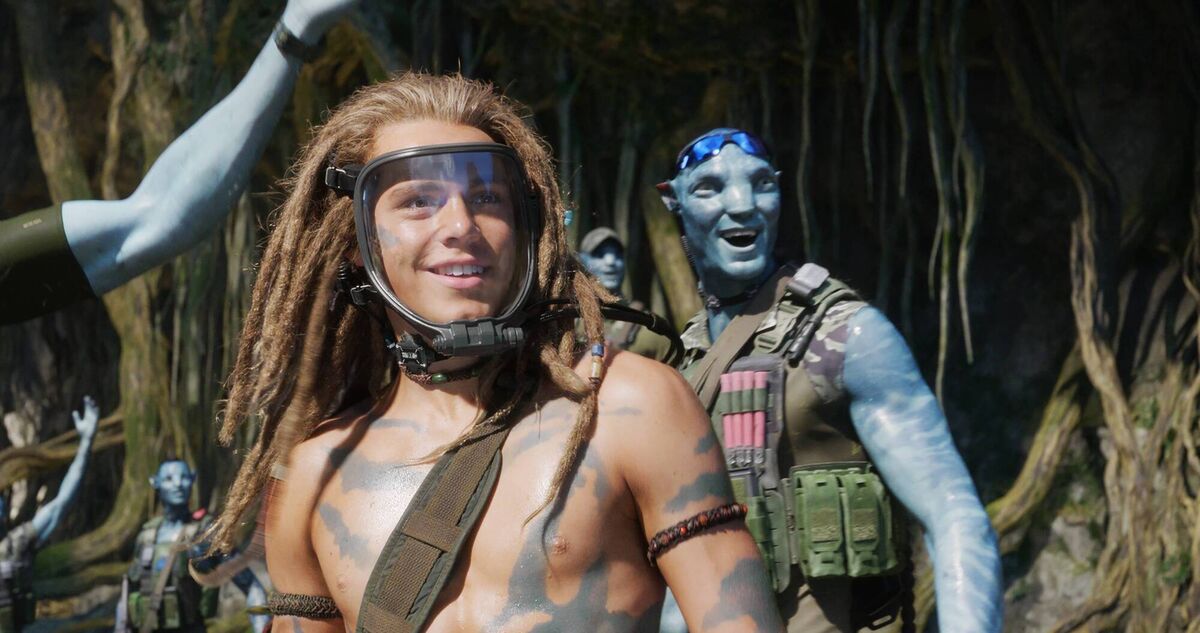
The experience was so unremarkable it left me questioning my own humanity: Was the movie’s success a global mass delusion or was I lacking in some fundamental trait that would let me even understand why it was loved?
Watching in 3-D was a different experience. As Jake and Neytiri darted through the forest, the special effects brought me into their world. The action did not just come forward as one frame, but instead wove me into the movement onscreen, the tendrils of plants and falling drops of water each reaching out from a different point in space.
It was hard to discern what was real or C.G.I., which led me to wonder, 'Why even distinguish?' This, in turn, produced a twisted surge of delight at the prospect of man’s becoming God.
This is not to say that Avatar is good. The movie is basically a demo tape, each plot point reverse-engineered to show off some new feat of technology. The awe it inspires was not just about itself but rather the hope of new possibilities.
The year 2009 was a relatively optimistic one: Obama had just won on the audacity of “hope". Avatar pointed toward a widening horizon — better effects, new cinematic worlds, new innovations in 3-D technology.
It did not yet seem incongruous to wrap a project based in infinite progress around a story about the perils of infinite growth.
Watching that day, I could still access these feelings but they were tied to a sense of melancholy, knowing that The Way of Water will emerge into an almost total deferment of that dream.
Today, 3-D is niche (at best); digital effects are used to cut costs; home streaming is threatening the theatre; and projects of ambitious world-building are overlooked in favor of stories with existing fanbases.
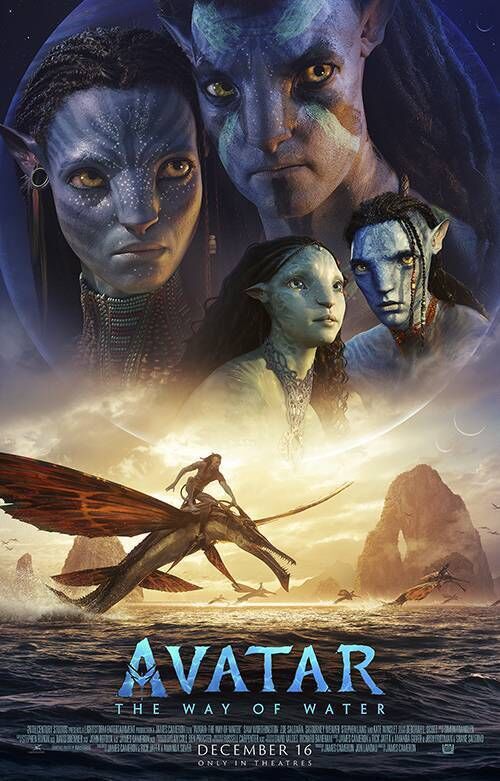
Pulling a tactic from the franchise playbook, the screening ended with a post-credit sequence previewing The Way of Water. The movie takes place 15 years after the events of the first film (but still before the world of the theme park), following Sully, Neytiri and their children on some sort of partly undersea adventure.
Most of what we know about the movie comes from a decade of tabloid oddities — it was shot in a 265,000-gallon ocean simulator! Sigourney Weaver plays a teenager! Kate Winslet trained to hold her breath for seven-and-a-half minutes!
The preview showed a young Na’vi splashing alongside a whale-like creature. It felt obvious that the clip had been chosen to show off Cameron’s latest innovation: underwater motion capture. The ocean was rendered so effectively it was hard to remember I was seeing something new.
The story of Avatar, however hacky it may be, still suggests that humanity can save itself in the face of rapacious profiteering. This is something we have a moral imperative to keep believing.
In today’s franchise movies, visions of the future are inherently constrained by the mandate to keep the franchise up and running — a project that forecloses any story line critiquing growth, consumerism or globalization.
If the business of the franchise points toward an ever-widening horizon, the movies produced within its logic must do the opposite. Their vision of life is necessarily circular, always pointing back to itself.
- Adapted from an article that originally appeared in The New York Times Magazine.

CONNECT WITH US TODAY



Be the first to know the latest news and updates