Busting myths about food and the climate crisis – and the inequality driving hunger
Ahead of the Cop27 climate conference, it’s high time to address the inequality driving hunger
Busting myths about food and the climate crisis – and the inequality driving hunger

We don’t need to produce more food, we need to fix a broken food system so that people in places such as Somalia and Kenya are not starving. Picture: Ed Ram/Getty Images

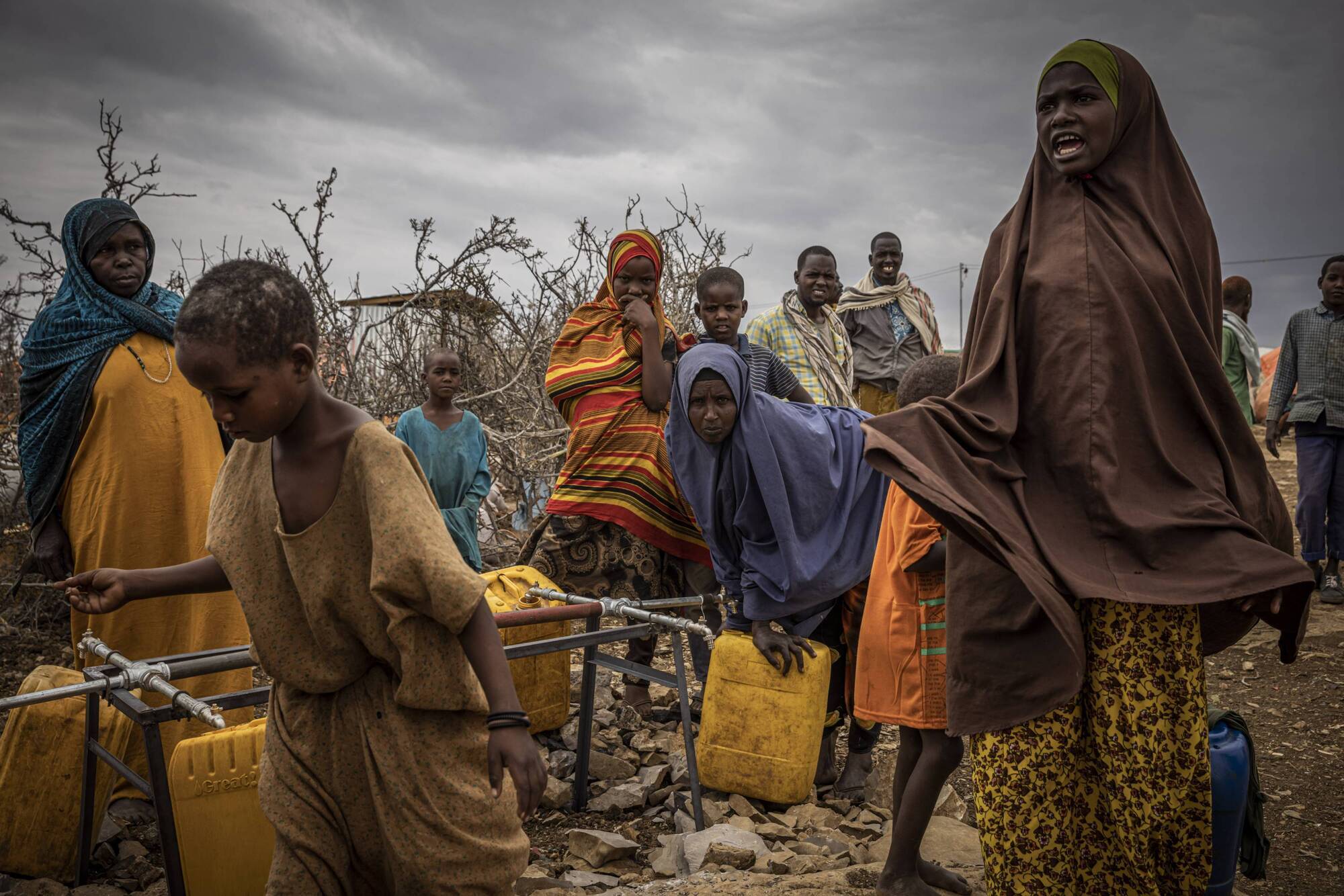
On a recent trip to East Africa, I witnessed life on the brink of famine where one person is likely to die of hunger every 36 seconds between now and the end of the year.

One reason was clear in a parched landscape dotted with dead livestock. The way we live, particularly in rich, polluting countries, has pumped carbon into our overheated planet. In Kenya, Ethiopia, and Somalia, this has led to a devastating drought with over 23 million people experiencing extreme hunger, and many dying.

Imagine our shock as we drove just 60km from the arid, dusty landscape around Isiolo in Northern Kenya into the lush fertility of the Rift Valley. Polytunnels stretched as far as the horizon on huge industrial farms. 

Casual day laborers are bused in and green beans, cherry tomatoes and white and pink roses are bused out to Nairobi airport and onto a supermarket shelf near you.

The land holdings here are based on the colonial past. Some of these have been taken over by new elites and some have the names of famous food brands. 

Kenya's Great Rift Valley where casual day laborers are bused in and green beans, cherry tomatoes and white and pink roses are bused out. File picture

This is big business with the sort of cash that can drill deep and keep water flowing.

Ahead of the Cop27 Climate Conference, it’s time to bust some myths about food and the climate crisis — and the inequality driving hunger.

Myth 1: The world doesn’t produce enough food to feed everyone

Reality: Farmers already produce enough food to feed the whole planet in 2022. Both expected harvests and current stock levels are more than enough to meet global demand. The problem is one of inequality, distribution and lack of access.

Despite the UN setting out to eliminate world hunger as Strategic Development Goal 2, world hunger has been on the increase since 2017. Hundreds of millions of people do not have enough to eat.

The reasons certainly involve climate change but also growing global inequalities and some old-fashioned profiteering. Let’s look at that first.

In May, Oxfam published a report, Profiting from Pain, that showed billionaires in the food and energy sectors were increasing their fortunes by $1bn every two days — 62 new food billionaires were created in the past two-and-a-half years alone.

Where there are big winners there are also big losers and we don’t have to look past our own weekly grocery basket to feel some of the pain.

But in a global context — we’re the lucky ones. This year, it is expected that 263 million more people will fall into extreme poverty worldwide — with less income to spend on food that is getting more and more expensive due to the cost-of-living crisis. 

This means people are starving in places such as Somalia and Yemen. Nationally, it means the queue lengthens for Cork’s Penny Dinners and for the Capuchins’ food parcels in Dublin. There is plenty food — it’s just that some people can’t afford it.

Myth 2: We need to increase food production and turn to hi-tech solutions to feed ourselves into the future.

Reality: We don’t need to produce more food — we need to fix our broken food system.

We can make a comparison with our water supply here in Ireland. We produce plenty of clean, drinkable water but our distribution system is Victorian and leaky. The solution isn’t to produce more water.

Producing more food using our current methods and distribution systems will only produce more profits for a select few. It won’t contribute to less hungry people.

The further industrialisation of current models of farming is not sustainable. About 21–37% of total greenhouse gas emissions are attributable to the food system. This is bad news for all farmers. 

Small-scale family farmers, both in Ireland and around the world, need to be supported to make a transition to greater sustainability which will pay climate and food dividends.

The solutions lie not so much in a utopian high-tech future but in sustainable approaches that can be implemented now. The experts here are small-scale family farmers. 

They provide more than 70% of the food supply in Asia and sub-Saharan Africa. These farmers are increasingly marginalised by an industrial, globalised agriculture. 

These farmers, both in Ireland and around the world, need to be supported to make a transition to greater sustainability which will pay climate and food dividends.

Myth 3: The world is facing a new food crisis caused by the war in Ukraine.

Reality: Before the war started, there were already an estimated 828 million people around the world who suffered from hunger — almost a tenth of the global population.

Food prices were rising rapidly for many months before the war, in part due to the disruption caused by Covid-19. For example, between April 2020 and December 2021, global wheat prices increased by 80%.

Across the globe, existing vulnerabilities have already resulted in 193 million people facing acute hunger. The effects of the war in Ukraine are expected to push a further 47 million people into acute hunger.

The war in Ukraine may be fuelling the global food crisis but it is also showing it for what it is — an unequal, broken system. Market concentration is so severe that just 1% of the world’s farms control 65% of the agricultural land, and four big traders carry out 70% of global trade in agricultural commodities by value.

The rules favour the powerful and wealthy. A country such as Somalia relies on Ukraine and Russia for 90% of its grain. This simply wouldn’t be allowed to happen in the EU.

Myth 4: The free market can be relied on to feed everyone.

Reality: The war in Ukraine’s impact on the global food crisis shows us this isn’t true.

Supporting local production to be more resilient is the solution. We also need to reign in speculation, break up monopolies and create fairer and more flexible trade rules for low- and middle-income countries.

Remember the example of the Kenyan polytunnels? Green beans flown halfway around the world aren’t good for anyone in the long run. 

Numerous studies have shown that shorter food chains are better all-round.

Myth 5: Funds are limited and therefore we need to make tough choices about where to direct support.

Reality: There is more than enough money to respond to all crises if billionaires and big business are taxed properly.

In the first half of 2022, just six fossil fuel companies made enough to cover the cost of major extreme weather- and climate-related events in developing countries and still have nearly $70bn left over in profit.

Billionaires involved in the food and agribusiness sector globally have seen their collective wealth increase by $382bn (45%) over the past two years. At home, the nine Irish companies on the Forbes 2000 list, which include companies from the agri-food industry and tech sectors, record excess profits of €2bn.

We are facing extreme weather, but let’s not forget about extreme wealth. Taxing it and corporations’ excess profits would enable governments worldwide to alleviate poverty and hunger and tackle the impact of the climate crisis.

The introduction of an Irish wealth tax as well as a broad-based windfall tax across all industries generating extreme excess profits, not just the energy sector, could generate billions in new revenue.

Cop27 begins against a backdrop of climate-fuelled hunger exacerbated by inequality. For the families I met facing famine in East Africa, the stakes have never been higher.

  • Clare Cronin is external communications manager at Oxfam Ireland
x

CLIMATE & SUSTAINABILITY HUB

More in this section

Revoiced

Newsletter

Sign up to the best reads of the week from irishexaminer.com selected just for you.

Cookie Policy Privacy Policy Brand Safety FAQ Help Contact Us Terms and Conditions

© Examiner Echo Group Limited