Is Trinity College right to fear plans for greater oversight?
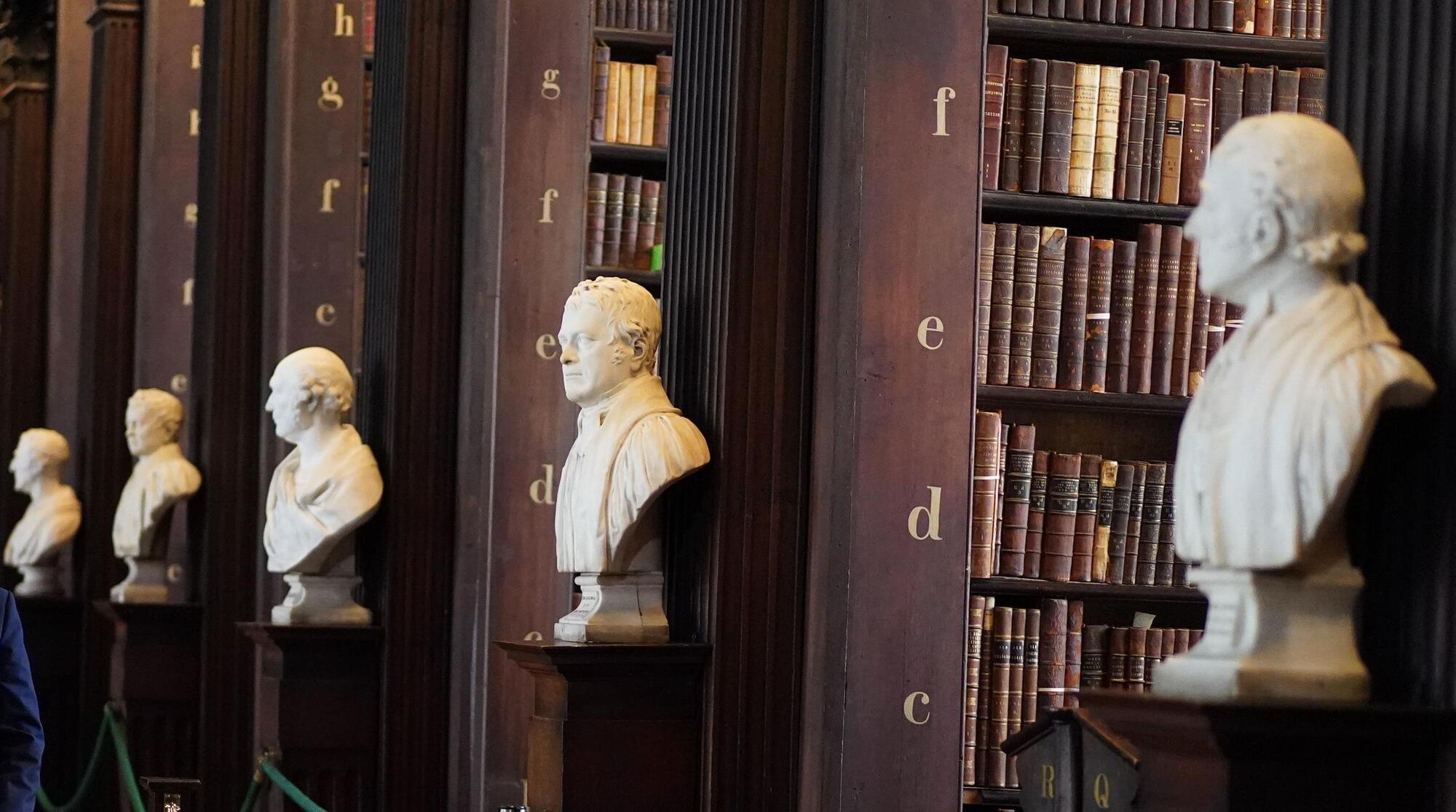
The Long Room in Trinity College. Trinity has sought exclusion from the upcoming legislation on grounds that the reforms could threaten its autonomy and independence.
The first duty of a university is to teach wisdom, not trade; character, not technicalities, so wrote Winston Churchill. There is a value to universities that exceeds their ability to transfer specific skills and stimulate economic growth.
As reported by Daniel McConnell in this paper recently, a new Higher Education Authority Bill 2022 working its way through the Oireachtas which plans to reform university governance represents the greatest overhaul of how colleges are governed since 1971. The new bill which will make universities more accountable to the state is ruffling some academic feathers.
Trinity College Dublin, which has just climbed back into the world’s top 100 universities, according to the latest global rankings, has sought exclusion from the upcoming legislation on grounds that the reforms could threaten its autonomy and independence.
The proposed changes, which increase the accountability of universities to the State, include slimming down the university governing authorities with “smaller boards, with more external appointees and an external chairperson” and providing a legal framework for carrying out reviews into the performance of colleges.
In a Dáil debate on the bill, Sinn Fein TD Rose Conway-Walsh said that limiting the governing boards of universities proposed under the bill to 17 members would reduce “the representation on the board of different institutions and the wider communities.”
Under the proposed legislation, regulators could carry out audits. State funds in the form of grants could be withheld or have to be refunded where it was found that they had been misused. Observers could sit on the governing board of a college where there were concerns. Last year, €1.7m, or 69% of the University of Limerick’s capital budget, was withheld over concerns about the university’s financial governance.
Trinity has sent a submission to Government requesting that it be excluded from these reforms and be allowed to implement its own board reforms which it says would not undermine its long-standing independence as a higher education institution.
Higher Education Minister Simon Harris has said: “We don’t think it’s good governance and in fact, it’s not good governance to have the idea that effectively the chief executive of the university can also be chair of the board. That is the case here in Trinity. And it’s got to change and it’s got to change by law.” Doubtless, some will think that comparing the provost of a university to a CEO is problematic but is there a case to be made for running a university that is both a corporate entity and a public body more like a company?
To put it simply a CEO runs a company overseeing its day-to-day operations while a chairperson evaluates the company’s performance. The chairperson oversees the board of directors and together they maintain an overall business plan and set long-term goals for the company. If the CEO isn’t living up to expectations, the board headed up by the chairman organizes a replacement. But it is often the case that one person fulfils both roles of CEO and chair of the board.
Famous examples include much-feted banker Jamie Dimon who since 2005 has occupied both roles at JP Morgan Chase & Co. Jeff Bezo formerly performed both roles at Amazon. Mark Zuckerberg does at Facebook (or Meta as it was renamed last October) although last week Wall Street was apparently uneasy at the announcement that Zuckerberg will be losing his “co-pilot” Sheryl Sandberg when she steps down in the autumn as the company’s chief operating officer.
Some would say that combining the roles of CEO and chairperson results in a more streamlined decision process and creates a clearer culture in a company. Governance watchdogs would disagree and advocate for greater separation between a board and senior management arguing that it strengthens the overall integrity of the company. Potential drawbacks to one person wearing both hats might be a struggle to find the line between their board and management roles. For example, the CEO would effectively end up discussing and voting on their own performance as chairperson of the board which could be said to be a clear conflict of interest as you are effectively asking a person to monitor themselves.
Of course, JP Morgan, Amazon, and Facebook are respectively a multinational investment bank and publicly listed companies rather than seats of learning. Universities are not run strictly for profit, nor should they be. Since the 1997 Universities Act, our seven State-supported universities have been defined as public bodies. They include UCD, UCC, NUIG, and Maynooth University which come under the umbrella of the National University of Ireland. Then there is Trinity which is the University of Dublin’s sole college. The other two established universities are the University of Limerick and Dublin City University. Practically speaking they operate as a kind of public-private partnership because they draw revenues from both exchequer and non-exchequer sources.
The minister has said that under the new legislation the academic freedom and institutional autonomy of universities will be protected while also making colleges accountable to the State and learners. In theory, this sounds good but there is concern amongst universities that their autonomy could potentially be eroded.
In June, last year President Michael D. Higgins at 'The Scholars at Risk' conference spoke of “a perilous juncture in the long history of the academy”. He spoke about moving beyond questions of mere utility. He said: “Academic courses are now viewed as economic units whose success is too often judged in terms of arbitrary quantitative outputs of graduates, as opposed to the quality of the courses”.
Labour Leader Ivana Bacik and former Reid professor of criminal law at Trinity has questioned the tone of the new bill, specifically section 9 which states that a function of the Higher Education Authority should provide value for money for funding provided to third-level institutions. She makes the point that “some of the most important discoveries by researchers in history were made as a result of what would have been seen as intrinsically less monetarily valuable projects.” She cites insulin, penicillin, and Viagra as three products of immense value to the Irish economy which was discovered accidentally.
Running a college like a business risks sacrificing intellectual pursuit, inquiry, discourse, and discovery of knowledge in favour of focusing on fields that generate revenue, but colleges must also be responsive to the world around them and adhere to sound financial practices. The bean-counting mentality associated with the financial bottom line is something that academics are understandably fearful of and let’s be honest, often positively hostile to. An august institution like Trinity would inevitably resist change and want to protect its turf.
If the measures went through, Trinity’s provost Dr Linda Doyle would no longer be able to chair the college’s governing body as is the case say in world-class universities like Oxford and Cambridge because the chairperson would have to be an external appointee.
In 2021, Dr Doyle, one of Europe’s most respected engineering academics and a professor of engineering and the arts, was appointed as provost making her the first female provost in Trinity’s 430-year history which was an exciting and historic development. Over a century before the former provost of Trinity George Salmon reputedly said: “Over my dead body will women enter this college.”
A graduate of UCC, Dr Doyle’s campaign manifesto for the position of provost included creating “a re-energized democracy” and included plans to redistribute provostial power. She also pledged to introduce an independent chair of the College Board.
Trinity, asserting what it sees as its unique position in Irish life, says that the type of accountability envisaged under the new bill would dilute its unique character and principles and long tradition of resolving disputes internally.
However, Trinity did not instigate an internal inquiry into the failed secondment of Chief Medical Officer Dr Tony Holohan as Professor of Public Health Strategy and Leadership. The university was offered a €2m ringfenced funding arrangement as part of the secondment although it appears that Health Minister Stephen Donnelly and the Health Research Board were unaware of what was described as “an interinstitutional collaboration.” While the Trinity board discussed the matter it said it would not be commenting further despite the anger of senior Trinity academics as to the fallout from the saga and what they perceived as the negative effects on the reputation of the college. The botched secondment is now the subject of an external review and could perhaps be said to have raised issues of governance.
In April 2021 the outgoing provost of Trinity, Patrick Prendergast said that Trinity could survive without government funding. He made this statement in the context of Trinity’s desire to be excluded from the new bill. However, in June 2021, Trinity’s chief financial officer Peter Reynolds warned that “exchequer income has declined from 70% of the university’s total income in 2008 to 39% in 2020 and the financial outlook for the university will continue to remain uncertain unless the Government commits to long-term funding or lifts the cap on undergraduate fees.”
In 2020, the number of staff at Trinity earning more than €300,000 per annum more than doubled to 13. Its operating losses also more than doubled due to various factors including the impact of the Covid-19 pandemic. However, losses were also attributed to soured investments which were attributed to the volatility of the market, and its balance sheet was further shrunk by capital expenditure made.
Mr. Reynolds also raised the more general and important question of a sustainable funding model for the higher education sector. Last week in a Dáil debate on the costs of Higher Education, Minister Harris said: “The student contribution fee, while being retained, will be reduced over time.”
Jim Miley, director-general of the Irish Universities Association, has said that the third-level sector has been underfunded for years and that any reduction to the annual student contribution charge would create a need to be met with more Government funding. It is believed that over a decade of underfunding of the third-level sector and climbing student enrolment has led to a very high student-staff ratio by international standards and has contributed to Irish universities falling generally in international university league tables. Most Irish universities, including UCC, lost ground in the latest rankings.
On the face of it, rigorous accountability procedures where public finances are concerned sound positive for taxpayers, many of whom will never walk through the hallowed gates of a university but must subsidise them. Where public bodies receive taxpayers’ money good corporate governance and good financial housekeeping may reasonably be expected but striking the right balance between the autonomy of universities and the governing oversight will be key.
Deputy Conway-Walsh from Mayo has made the point that Trinity isn’t the only college “with its own unique history and governance structure” pointing to the multi-campus “newly formed Atlantic technological university” in Castlebar which she says is “very distinct from most other colleges” but unlike Trinity is being given no flexibility under the legislation which “looks unfair and elitist”.
She refers here to the proposal that provisions specific to Trinity would be dealt with by way of private legislation in tandem with the main piece of legislation in a kind of hybrid approach. Some might dispute Deputy Conway-Walsh’s analogy. Whether Trinity ought to be able to entirely opt-out of the proposed legislation is another matter. It is hoped that the legislation will pass later this year. We shall see.
CONNECT WITH US TODAY



Be the first to know the latest news and updates