Macron and Le Pen face French runoff with Europe-wide impact
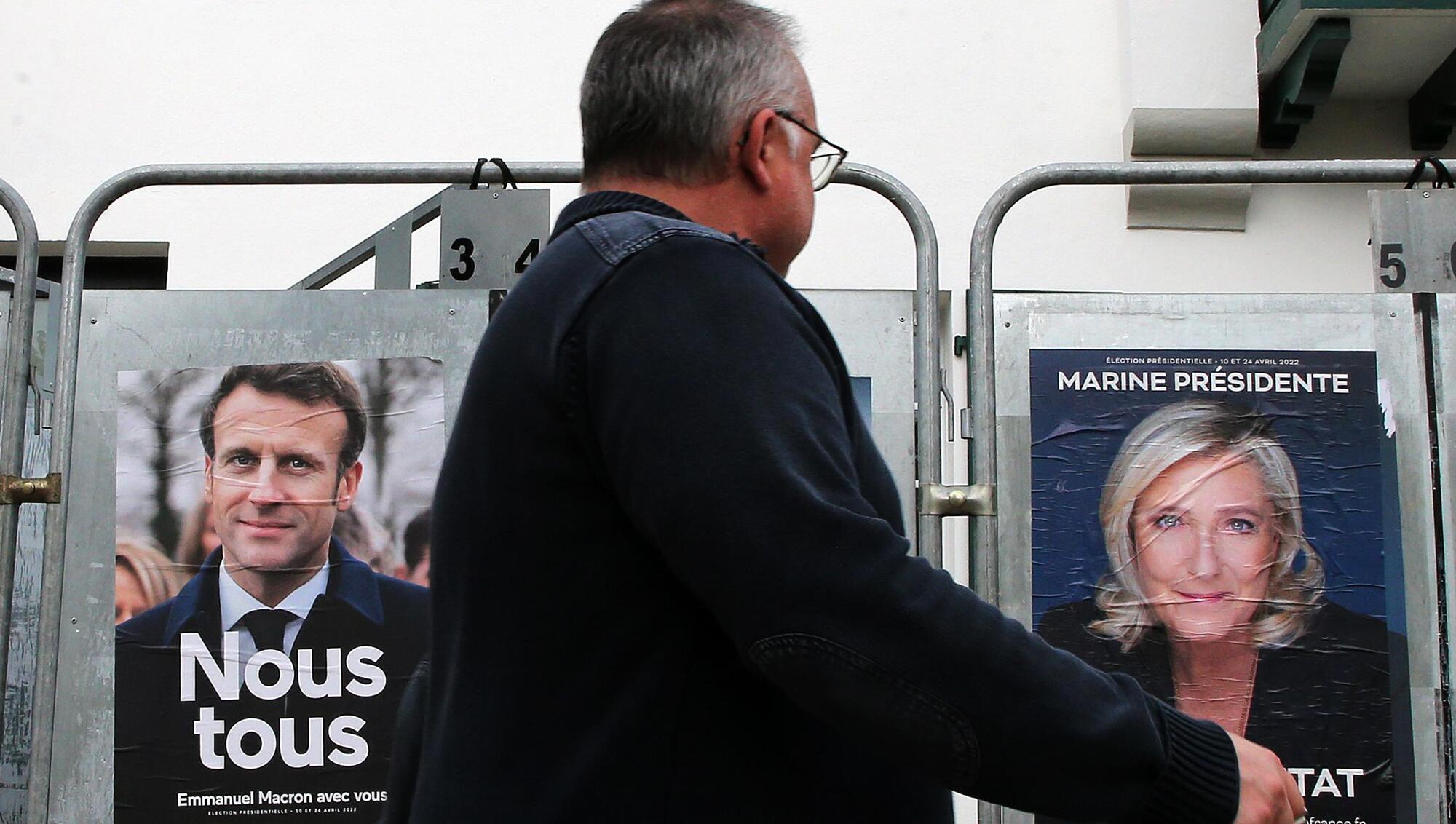
A man walks past presidential campaign posters of Emmanuel Macron and Marine Le Pen in Anglet, southwestern France, on Wednesday, April 8, 2022. Picture: Bob Edme/AP.
President Emmanuel Macron is set to face his nationalist rival Marine Le Pen in the final round of the French election in a rerun of their 2017 contest that will reverberate across Europe.
Macron got 27.6% of the vote compared with 23.4% for Le Pen, according to Interior Ministry figures based on 97% of registered voters counted.

Snap polls taken after voting ended gave the 44-year-old president a narrow advantage heading into a runoff on April 24.
Three surveys showed him leading by at least 54% to 46%, while others showed a narrower lead. European stock futures dropped on polls showing a tight race.
“The game isn’t over yet,” Macron told his supporters in a short speech on Sunday night.
While the president’s perceived arrogance turns off many voters and helped Le Pen to frame him as “the president of the rich”, he’s made France a favoured destination for foreign investors and pushed employment to the highest on record.
He’s also been at the forefront of efforts to halt the war in Ukraine, to deepen economic ties between European Union members, and, as leader of the bloc’s most powerful military, to forge a common defence policy.
All that may unravel if he is defeated by Le Pen.
As the polls narrowed before the first round of voting, French equities, bonds, and the euro all came under pressure on concern that a Le Pen presidency would make France less business-friendly and more eurosceptic.
Macron had avoided explicit campaigning until close to the vote, instead casting himself as a safe pair of hands during unstable times as he focused on the Ukraine crisis. A strong economic record is his key asset heading into the election.

However, Le Pen campaigned hard on the cost-of-living crisis, tapping into concern about inflation.
Her supporters were buoyant on Sunday night, singing the French national anthem as the initial projections were released showing she had eclipsed her first-round result from 2017.

“All of those who didn’t vote for Emmanuel Macron today, of course, should join this movement,” she told the cheering crowd.
Jean-Paul Garraud, a politician in the European Parliament who switched allegiance from France’s traditional centre-right party, the Republicans, to back the nationalist, said: “I am persuaded Marine Le Pen can win.
“Macron is now on the defensive.”

Republican candidate Valerie Pecresse, who got 4.8%, called on her supporters to back Macron in the second round, even as she criticised the president for driving voters toward Le Pen. Green Party leader Yannick Jadot, who got 4.6%, backed Macron, as did a handful of other candidates.
Eric Zemmour, a former TV pundit convicted three times for hate speech who had also pitched for the far-right vote, urged his supporters to back Le Pen.
Zemmour came fourth with 7.1%.

“The extreme right has a lot of support in our country,” Macron’s junior minister for Europe, Clement Beaune, said in an interview.
The critical pool is likely to be the 22% of voters who backed Jean-Luc Melenchon, the far-left firebrand who came third. In a concession speech, Melenchon told his supporters they should give “not one vote” to Le Pen, but he did not endorse Macron.
Le Pen’s protectionist stance on economic issues has allowed her to reach some voters who have traditionally backed left-wing candidates and have been angered by Macron’s support for business and investment.
“Melenchon’s voters won’t want Macron to be re-elected,” said Garraud. “What will they do?”
A presidential debate scheduled for April 20, will be key. Le Pen’s 2017 campaign was effectively sunk by a disastrous performance in that year’s televised head-to-head, and she has been working with advisers to ensure she is better prepared this time around.