The pressure is on for Kerry rescue volunteers
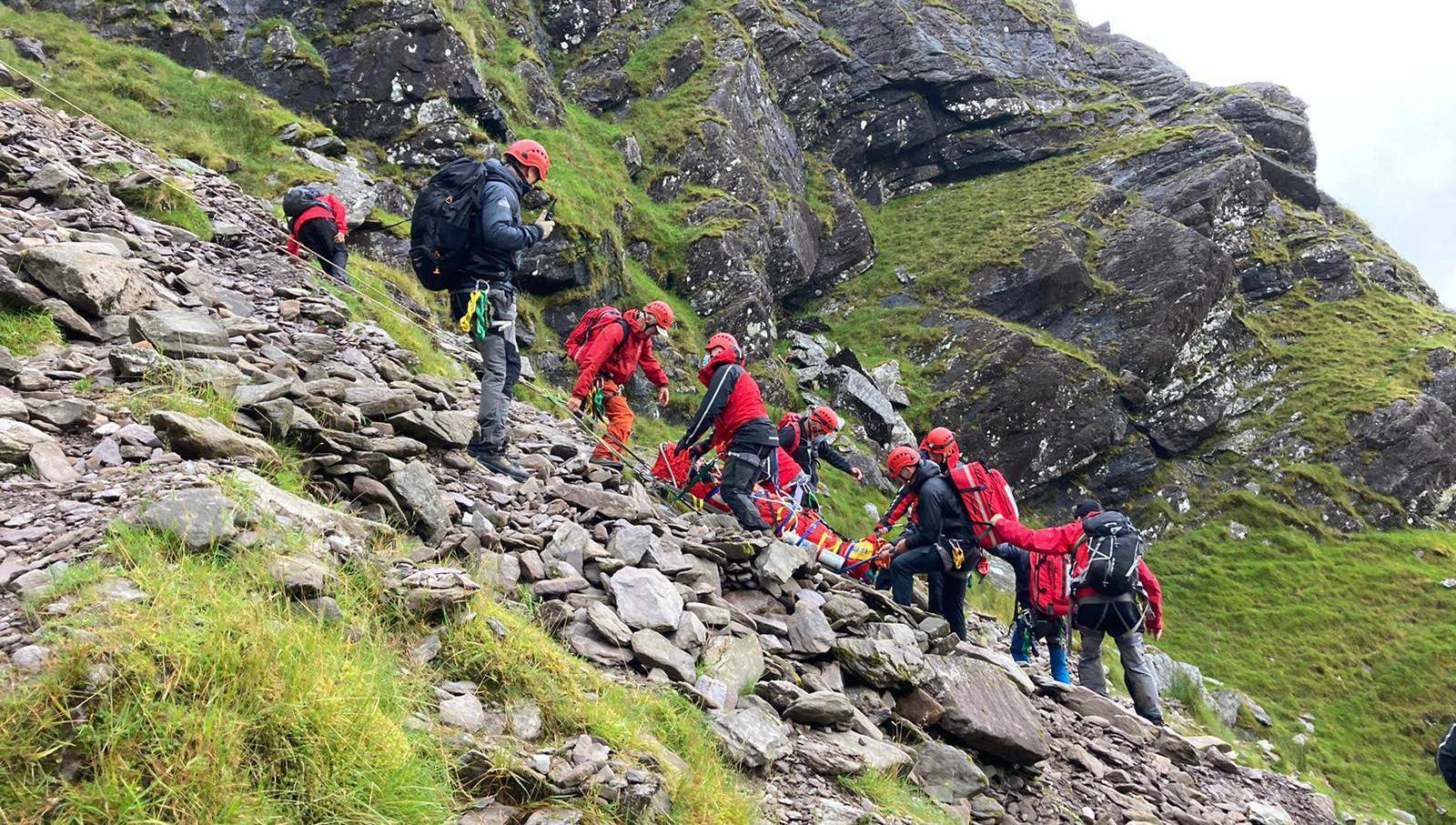
The Kerry Mountain Rescue Team is totally volunteer-based with members not even receiving travel expenses when using their own vehicles. Picture: Kerry Mountain Rescue Team
As Ireland celebrated the 50th anniversary of the Easter Rising in 1966, Myles Kinsella, a UCD student set off for an ascent of Ireland’s highest mountain.
Tragically, his day ended with a fatal fall from the east face of Carrauntoohil. Soon after, a member of an English school party also died while climbing in the same area.
In the light of these events and with increasing numbers going to the McGillycuddy’s Reeks, Frank Lewis of Cork-Kerry Tourism assembled a team of volunteers willing to provide search and rescue services to fellow hillwalkers on the slopes of Ireland’s highest mountains. The renowned Kerry Mountain Rescue Team (KMRT) was born.
In the intervening years, much has changed in terms of equipment, search management, remote first-aid and climbing competencies. In contrast to the informality of the early years when the volunteers had no specific training, mountain rescue has now become a complex undertaking.
All rescuers are qualified in Remote Emergency Care, with ongoing first-aid training to maintain these skills.
Each team member is obliged to undergo training in a wide range of skills such as casualty care, ropework, stretcher lowers, rescues by cableway, helicopter winching, search management, navigation and radio communication.
But one factor remains unaltered from the early days: the mountain rescue service is provided on a totally volunteer basis with members not even receiving travel expenses when using their own vehicles. Such altruism is not universal.
In most European countries mountain rescue is a commercial service and must be paid for. As a result, most climbers and hillwalkers see it as prudent to insure against the extraordinarily high bill that can follow if things go wrong.
In the past there was little need for such a system in Ireland. Mountain accidents and subsequent callouts were rare since relatively few people had recourse to the Irish uplands.
Also, hillwalkers tended to be cautious and well-equipped because, in the era before mobile phones, they knew safety was in their own hands. The most common reason for rescue callouts in the past was when someone failed to return from the hills.
Now, in the mobile phone era, rescuers can become aware of an incident soon after it happens but are often hampered when the phone dies. The only option then is a manual sweep of the mountainside, which is the most labour-intensive and demanding task that can face a rescue team.
For years, the volunteer system of rescue worked well, with KMRT never failing to respond to a callout. This summer there was, however, a sharp increase in the number of requests for assistance and this has put added pressure on the rescue service.
During the first three weeks of August, KMRT were called, on average, once a day to upland accidents. While the situation did not reach a point where the team was unable to respond when called upon, the pressure is undoubtedly growing on the rescue volunteers.
This pressure mostly arises from careless walkers who see mountain rescue, not as a last, but as a first resort when a problem arises.
According to Alan Wallace, Assistant Pro at KMRT, “being called on successive days places a huge strain on volunteers who are seriously committed to what they do. Volunteers who must juggle day jobs and family commitments.
"Volunteers who are increasingly exhausted and worn down by sequential callouts. Volunteers who are loathe to judge the sequential errors that underlie serious accidents.”
And most of this trauma, and time-consuming rescues, could be avoided if those heading into the hills took the time to prepare properly. Wallace urges those heading out to plan their route in advance and have the skills to navigate competently even in the poorest of conditions.
“Many accidents occur when walkers stray off the trail and onto the steep ground and then become cragfast (unable to move up or down), but competent navigation skills should keep walkers on the route. They should have sufficient spare food, protective clothing and torches to stay out safely after dark and at least one person in a party should carry a map and compass they know how to use.”
Simple, sensible rules that every hillwalker should obey – yet so many are ignoring them at considerable cost. These individuals should now reflect on what a huge benefit it is to have a free mountain rescue service available to all, and show respect for our rescue volunteers by careful planning to eliminate silly and avoidable callouts.
The full story of the Kerry Mountain Rescue Team is contained in John G O'Dwyer's latest book titled 'Wild Stories from the Irish Uplands' available from currachbooks.com


CONNECT WITH US TODAY



Be the first to know the latest news and updates