We have lessons to learn from the failed policy of internment despite the passing of 50 years

Long Kesh prison camp as it was in 1971 at the start of internment. Reproduced with permission of Prisons Memory Archive.
Fifty years ago - on August 9, 1971, to be exact - the newly appointed Prime Minister of Northern Ireland, Brian Faulkner, introduced a policy of internment without trial.
Faulkner had been part of the cabinet that had previously introduced the controversial policy during the 1950s, regarding it as part of the process that ended the IRA’s border campaign of that era.
The NI Civil Authorities (Special Powers) Act 1922 was introduced one year after the northern state’s creation, allowing imprisonment without trial and without time limitations. The move inspired the apartheid South African Minister for Justice, John Vorster, to proclaim that he "would be willing to exchange all the legislation of that sort for one clause of the Northern Ireland Special Powers Act".
Operating between 1971 and 1975 the latest iteration of the policy resulted in 1,981 people being interned - 1,874 from a nationalist background and 107 from a unionist background.
Most males were interned in the newly restored Royal Air Force Nissan Huts at Long Kesh, while females were held at the Victorian built Armagh Gaol.
The decision came against the backdrop of growing civil rights marches in the North and demands for equal rights in housing, jobs and elections. These demonstrations had also grown in size and saw attendant violence. Many were attacked by the police - the Royal Ulster Constabulary - and by unionist counter-demonstrators, such as at the now infamous Burntollet bridge.
The government - who clearly felt it was losing control of the security and political situation - believed the IRA were behind many of the marches and protests and responded in 1971 with internment.
While some were taken by surprise by the first early morning raids, many republicans moved out of their homes and the raids resulted in the arrest of many who had little or no connection to the protests or the escalating violence.
The policy was quickly seen as an embarrassing failure by the security and political establishment in the UK and led to the resignation of Faulkner’s government in 1972 and the introduction of Direct Rule from Westminster.
The violence used by the security forces in the raids, the breach of human rights, the initial imbalance in communities being targeted all contributed to an escalation in alienation from the state and to political violence.
The Prisons Memory Archive has collected, and made publicly available, 150 filmed recordings at the sight of the main prisons used during the conflict known as the Troubles, the Maze and Long Kesh and Armagh Gaol.
The range of experiences captured in these films include prison officers, prisoners, teachers, probation staff, journalists and chaplains. Some of these relate to memories of internment.
John Hetherington, who served most of his adult life as a prison officer before and during the Troubles, had this to say during one of those recordings.
John’s recollection is particularly illuminating since it breaks down a simplistic binary of ‘them’ and ‘us’, with its empathy towards those whose human rights were breached and challenges the notions that all prison officers supported such a breach, and that those who were arrested were ‘guilty’ of anything.
The experience of internment, and generally of imprisonment during the Troubles, is usually told in terms of the male experience, especially if we think of popular mainstream films such as Hunger (2008) and Maze (2017).
The PMA has attempted to address this imbalance, by including the female experience, whether as prisoners and prison officers in Armagh Goal (Armagh Stories: Voices from the Gaol 2015), or as teachers and visitors in the Maze and Long Kesh (We Were There, 2014).
Angela Devlin, who later served as a Belfast City Councillor, described her experience of internment in one of those films.
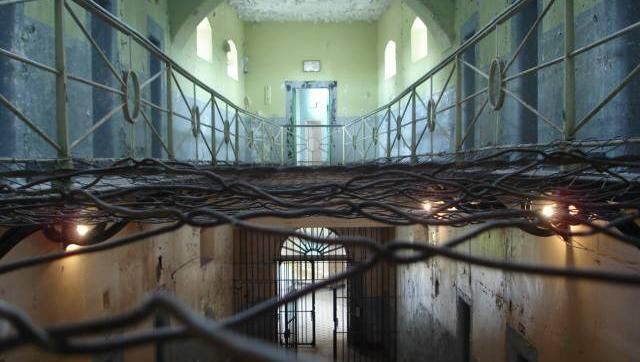
Another internee, Sinn Fein activist and writer, Jim Gibney, described being arrested and interned when he was interviewed at the Long Kesh site.
Another experience less represented in the media to date is that of members of the loyalist community. Although the numbers were significantly less in the early days of the conflict, and none were interned until 1973, the numbers increased considerably over time.
William Mitchell was one of those men and he is now the Project Director of the ACT Initiative in Belfast, supporting the transformation of those categorised as former combatants.
Listening to all the stories that have been collected in the Prison Memory Archive make it clear to me that as we move through anniversaries of this nature it is important as a society to fully understand and face up to the experiences of those who experienced the trauma of political violence.
In the PMA we try to be inclusive, including avoiding the simplistic division of ‘innocent’ and ‘perpetrator’. While such categories do exist, many do not fit into such easy categorisation, and many into both, and much nuance is required when addressing the conflict known as the Troubles.
The amnesty around Troubles’ related incidents suggested by the NI Secretary of State, Brandon Lewis, is not only unhelpful in addressing the complex issues of truth, justice, and reconciliation but insulting to those who are attempting to address the painful past in order to manage its legacy of trauma on contemporary and future generations.
Internment was one of the policies which was introduced to address the conflict but ended up escalating it. Perhaps its primary lesson is that we must all face up to the reality of those policies and learn from them, as a failure to do so will only mean a growing likelihood that future generations will repeat those mistakes.

CONNECT WITH US TODAY



Be the first to know the latest news and updates