Dorcha Lee: Could Belarus be drawn into the Russo-Ukrainian conflict?
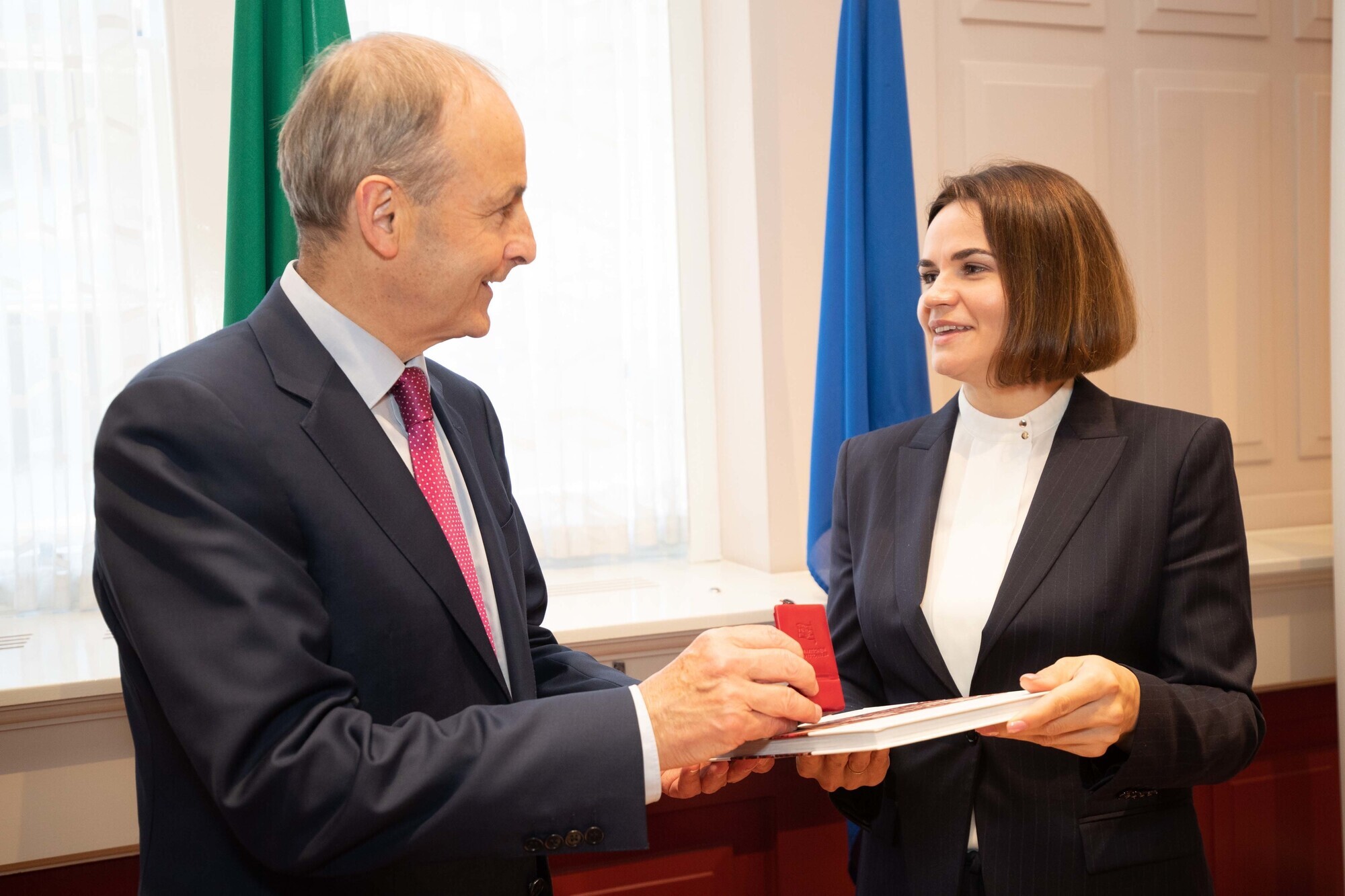
Taoiseach Michael Martin meeting with Belarusian democratic opposition leader Sviatlana Tsikhanouskaya at Government Buildings in Dublin last month. Photo: Julien Behal Photography/PA Wire
As the Belarus Opposition Leader, Sviatlana Tsikhanouskaya, did the rounds recently of capitals seeking support for free and fair elections in her country, Ireland was always high on her list.Â
As a âChernobyl kidâ she had come to Ireland sponsored by Adi Rocheâs charity organisation and stayed with an Irish host family in Roscrea, Co Tipperary. She returned again several times. This time the âhomecomingâ was serious. She was looking for support, essentially for the EU to increase sanctions on President Lukashenkoâs regime, and modest practical help for the Opposition itself.
When she is asked about Belarusâs possible EU Membership and future ties with Russia, she picks her words carefully. These issues will be for Belarusians to decide. The future Belarus "will seek to have good relations with everybodyâ.
Prior to the August 2020 Presidential Election, President Lukashenko was just about balancing Belarus relations between East and West. He had succeeded in blocking further pressure from Russia for closer ties and, at the same time, he allowed UK NATO troops to conduct training exercises in Belarus.
As EU embassies in Minsk produced credible evidence supporting the Opposition claims that the 2020 election had been stolen, the EU called for a re-run and denounced the brutal measures taken by Lukashenko against Opposition protesters. Using the Belarus security services, and repressive legislation, he held on to power without having to accept significant Russian assistance.
However, there are clear signs of Russian intentions to extend its influence over Belarus. Belarus is already dependent on Russia for energy supplies, and Russia is extending its support to pro-Russian factions within the Belarus Parliament. Deutsche Welle quoted political analyst Olga Kharlamova on the founding congress of the new pro-Russian âSoyuzâ (Union) Party held in Minsk on March 6.
Other pro-Russian factions have been pressing for constitutional changes. These factions want a shift of powers from the Presidency to Parliament. Clearly, while Russia has backed Lukashenko, its strategic plans are not dependent on his regime remaining in power. However, the area of greatest increased contact between both countries is in the defence area.

Russian strategists have long acknowledged the importance of Belarus on its Western flank to guard against NATO, and the perceived threat from NATO to the Russian exclave of Kaliningrad on the Baltic. This year, there has been a dramatic increase in Russia-Belarus relations in the area of defence and military cooperation. Back in March, before the region was distracted by the build-up of Russian forces on the Ukrainian Border and in Crimea, joint Russian-Belarus military exercises were already taking place in both Russia and Belarus.
On March 6, a five-year Strategic Partnership Agreement was signed, which includes the setting up of three permanent joint Russian Belarus Training Centres, one each in Russia, Belarus and Kaliningrad. The Belarus location chosen is in the Grodno (Hrodna) region, right on the Borders with Lithuania and Poland. The distance from Grodno City to Kaliningrad is only about 100km. Kaliningrad has long been acknowledged as a likely flashpoint in any future tensions between NATO and Russia. On the same day, Lukashenko appeared to drop his long-standing objection to a new Russian airbase on Belarusian territory.
The Russian Defence Minister also announced that Belarus Armed Forces will take part in the coming Zapid (West) 2021 manoeuvres in late August and early September. These manoeuvres will take place primarily in Western Russia, including along the border with Ukraine. The slippage of language between military âexercisesâ and military âmanoeuvresâ is significant. Manoeuvres require force structures with at least one deployed formation involving a division or more. A division strength varies from 8,000 to 12,000+. A Russian Defence Ministry spokesperson confirmed that these manoeuvres will be âmassiveâ.
In a previous assessment, this analyst has put forward the idea that the April Russian build-up on the Ukrainian border could well be a rehearsal for a Russian military intervention in Ukraine, in September. Also, the cutting of water supplies to Crimea by the Ukrainians could yet end in military intervention by Russia. The timing of Zapid 2021 is just before the Duma elections. Perhaps Zapid 2021 may turn out to be just a bit of âsabre-rattlingâ, but who knows. It is noted that Ukraineâs President Zelensky is scheduled to visit the White House on August 30, but US-NATO military support for Ukraine is heavily constrained.
Because of the increased military cooperation between Russia and Belarus, it may well suit President Putin to involve his Belarussian allies to âhelp outâ on the Ukraine issue. Should Belarus get involved in the Russo-Ukraine conflict, this can only be another setback for the cause of democracy in Belarus. The charismatic Belarus Opposition Leader, who perfected her English in Roscrea without developing a Tipperary accent, could well find herself in exile for many years to come.