Michael Clifford: Construction sector faces major fire safety insurance problems
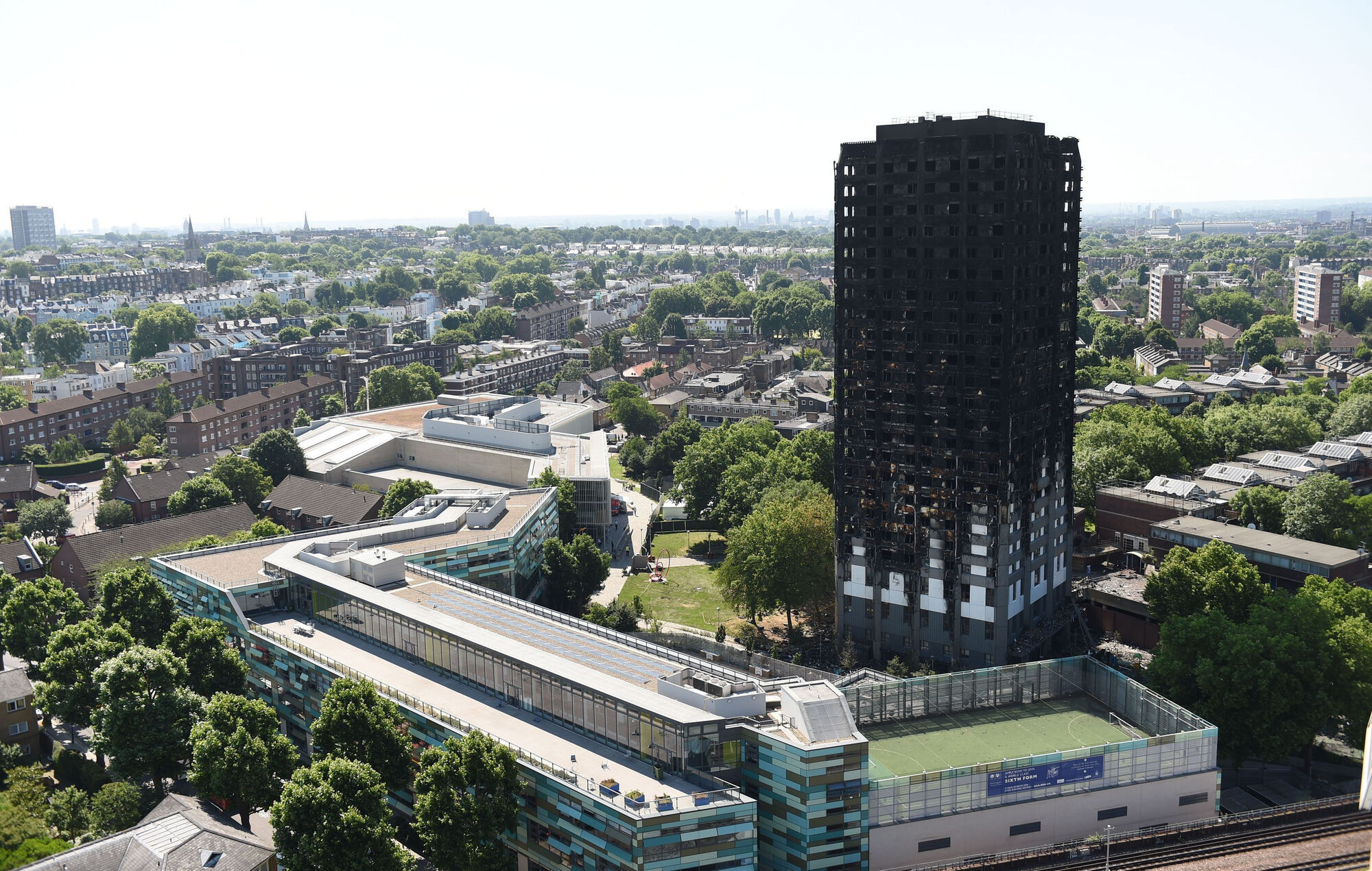
The tragedy at Grenfell Tower in London, in which 72 people lost their lives, opened up the appalling vista of a lack of fire safety control. Picture: David Mirzoeff/PA Wire
The rising cost of insurance and the fallout from shoddy and dangerous building works have loomed large in public life in recent years.
Now the two issues are merging into one to produce a scenario where engineers are finding it extremely difficult to get insurance.
If the new problem isn’t addressed, it could have a major impact on the future for major projects and housing construction.
The reports today that fire engineers, in particular, are being refused Professional Indemnity (PI) insurance cover.
Where they do get cover, it now often includes an exclusion clause.
This allows the insurance company to provide cover for one kind of work but not another.
The policy for one chartered fire engineer seen by the includes an exclusion clause for fire safety work.
As such, this engineer is not covered on any job in which he signs off on a fire safety certificate. It is highly unlikely that any client would employ him on that basis.
His dilemma is not unique.
Cork-based broker Martin Adams says that he is having major difficulty in getting professional indemnity renewal for his fire engineer clients.
“We can still get a quote for engineers,” he told the .
“But it is virtually impossible to get cover for fire safety. We have five or six clients due for renewal in May and the insurance companies are applying fire safety exclusions to the policy which basically excludes all the work they are carrying out.
Professional indemnity insurance premiums in the construction sector have been on the rise in recent years in the UK.
Ireland is, to a large extent, regarded as a province of the UK for insurance purposes in the industry.
In the last 12 years, the number of claims has risen dramatically, leading to the exit of about a quarter of insurance companies from the market, according to the industry journal, .
The result has been an increase in professional indemnity premiums of up to 800% over that period, the trade magazine reports.
Feeding into that escalating problem was the fire in Grenfell Tower in London in 2017.

The tragedy in which 72 people lost their lives opened up the appalling vista of a lack of fire safety control in the country.
Further revelations in the subsequent inquiry — including the involvement of Irish firm Kingspan — highlighted the use of untested cladding in buildings all over the UK.
The result has been a ballooning of claims and premiums and a tendency among insurance companies to write exclusion clauses for fire safety.
For instance, motor insurance kicks in if you’re covered at the time of an accident rather than when a claim relating to the accident is made.
Professional indemnity insurance is concerned with whether you are insured at the time of the claim irrespective of whether or not you had cover when, for instance, a faulty building at issue in a claim, was actually built.
Equally, if you were insured at the time of the construction, but not when the claim is made then you are not covered.
So in the UK right now, insurers renewing or writing professional indemnity policies are excluding fire safety issues in order to ensure they’re off the hook for claims that may come in for past work.
Last month, the UK government announced a £3.5bn fund to assist in remedial work with cladding as a result of the fall-out from Grenfell.
Also included in the fund was an element to assist construction professionals to obtain insurance.
Effectively, this is a State-backed insurance scheme filling the gap left by the private sector.
A fire safety review of high rise buildings in Ireland in the wake of Grenfell did not find any major problems.
Despite that, the ill wind that Grenfell blew through the UK industry has since blown across the Irish Sea.
The problem has a further dimension in this country. Building control regulations are governed by a system called BCAR.
This was brought into force in 2014 in response to the fire safety defects that resulted in the evacuation of Priory Hall in 2011.
The new system now places a huge emphasis on an “assigned certifier” who has responsibility for signing off on all construction work, with a few exceptions.
If anything goes wrong, the certifier is on the hook for liability.
This, the Department of the Environment (as it then was) concluded, would ensure that there would be somebody to sue in future if defects are discovered.
However, according to Orla Hegarty, assistant professor at University College Dublin's school of architecture, the way it is designed ensures that if the assigned certifier does not have professional indemnity at the time of a claim, “the whole system grinds to a halt”.
Ms Hegarty says that she and others warned the department of this looming problem when the system was being introduced.
“The BCAR system was built on sand to an extent because it anticipated that whoever signed the final certificate could be sued for negligence and that would cover defects,” she says.
“But there was no guarantee that this person would be around or will be able to get insurance. That gets the insurance companies off the hook but could leave the certifier personally liable.”
Construction industry bodies have made representations to the Government about the growing problems around professional indemnity insurance.
The response of the UK government was to partially underwrite the insurance industry.
Any similar move here would cause major controversy.
Some creative thinking will be required if the issue is to properly addressed before it impacts on the delivery of construction projects and homebuilding.