From solo runs to unwise golf gatherings, 2020 earned its place in the history books
While it is often said, but this has been a year like no other. A milestone General Election, a historic Coalition formed, a global pandemic, Brexit and countless controversies have combined to make it a political year not to easily forget, Daniel McConnell rounds up 2020
From solo runs to unwise golf gatherings, 2020 earned its place in the history books

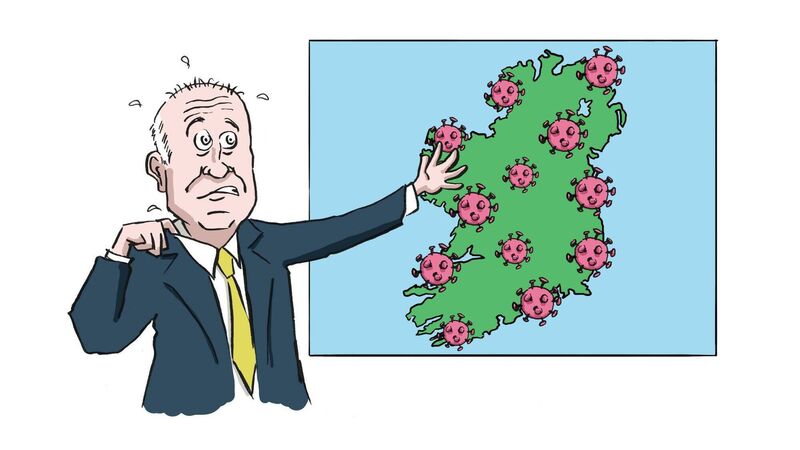
Dr Tony Holohan. Cartoons by Harry Burton

Charlie Flanagan’s RIC solo-run:

On January 7, the outgoing government decided to cancel its proposed commemoration for those who served in the Royal Irish Constabulary (RIC) and the Dublin Metropolitan Police (DMP) prior to Irish independence that had been due to take place later in the month.


The proposed event “was not cleared by the Cabinet” and was seen as a solo run by then Justice Minister Charlie Flanagan, who was roundly criticised by his own colleagues as well as the Opposition.

Indeed, it emerged that the expert advisory group for the government’s Decade of Centenaries programme did not recommend the planned commemoration event for the RIC, according to one of the group’s members Diarmaid Ferriter.

Amid some ludicrous suggestions that the event was to commemorate the Black and Tans, nonetheless, the government come under sustained criticism, with a number of politicians stating that they would not attend the event.

Fianna FĂĄil leader MicheĂĄl Martin said that scheduling the event was an “error in judgement” while the Sinn FĂ©in leader Mary Lou McDonald said it “should be cancelled”.

Many Fine Gael TDs have since said the row cost the party many votes in the election and Flanagan’s successor Helen McEntee has “no plans to reschedule the event”.

The gig is up:

The year 2020 began with election fever thick in the air. Having barely survived a motion of no confidence in Eoghan Murphy in late 2019, when a similar motion of no confidence was tabled against then Health Minister Simon Harris, Leo Varadkar and his minority government had run out of road. 

Therefore, to little surprise on January 14, Varadkar cancelled all normal meetings for that day and travelled to Áras an Uachtaråin to seek the dissolution of the 32nd Dåil. 

Speaking to reporters ahead of his trip to the Phoenix Park, Varadkar said: “We have a deal on Brexit and Northern Ireland. Our economy has never been stronger, there are more people at work than ever before, incomes are rising, poverty is falling and the public finances are back in order. As a nation we have every reason to be hopeful and positive about the future.” 

President Michael D Higgins duly granted that request and General Election 2020 was underway. The country went to the polls on February 8, the first time a General Election was held on a Saturday.

General Election 2020 – The campaign:

As it kicked off, the campaign was billed as the race between Leo Varadkar and MicheĂĄl Martin as to who would be Taoiseach.

MichĂĄel Martin, Leo Varadkar and Mary Lou McDonald during an election debate.

Fine Gael, suffered a horrendous start with a series of missteps and their “A future to look forward to” was insipid and pedestrian. 

“Between a homeless man being assaulted in his tent on the Grand Canal and suffering serious injuries as a result, all under a poster of housing minister Eoghan Murphy, and Leo Varadkar facing the wrath of the marginalised childcare workers and VAT-payers of Co Cavan, day one of the 2020 General Election couldn’t have gone much worse for them,” was how the Irish Examiner described it.

Fianna Fáil’s slogan “An Ireland for All” was a restating of their previous mantra and while catchier, representing change it did not.

And change was the mood of the electorate.

Sinn FĂ©in who only weeks before were shedding candidates off their tickets after their mauling in the local and European elections, caught the imagination with their call to stop the pension age rising. With their ‘Manifesto for Change’ they too won a huge boost after RTÉ were forced to reverse their decision to exclude Mary Lou McDonald from their main leaders’ debate.

A succession of polls indicated a surge for Sinn Féin but the big question was would it materialise on the day, as it had failed to in previous elections.

Seamus Mallon RIP:

Amid the campaigning, sad news emerged of the death of Seamus Mallon who played such an instrumental role in the establishment of peace on this island.

The former Deputy First Minister died at his home in Markethill on January 24, aged 83, having battled cancer.

A former member of Seanad Éireann and MP, Mallon and his chief political partner John Hume had a notoriously difficult person relationship but their desire for peace united their at the forefront of moderate nationalism.

Leaders, north and south and from across the globe paid tribute to the man who famously described the Good Friday Agreement as “Sunningdale for slow learners,” a reference to the doomed power-sharing agreement in the 1970s.

Former US president Bill Clinton said of Mallon: “Seamus never wavered from his vision for a shared future where neighbours of all faiths could live in dignity, or from the belief he shared with John Hume and the entire S.D.L.P. that nonviolence was the only way to reach that goal.” 

General Election 2020 – The result:

The result of this year’s general election failed to leave any party with a clear or significant majority resulting in a prolonged negotiating process which was drawn out even further by the Covid emergency.

Fianna FĂĄil’s 38 DĂĄil seats provided them a margin of just one on Sinn FĂ©in, who cleaned up across the country, taking 37 seats.

Far from running too many candidates, McDonald’s clear regret was not running more to capitalise on their surge. Had they done so, the party could have easily secured in excess of 45 seats. For example, nine of the ten poll-toppers in the election were Sinn FĂ©in candidates, some getting double quotas.

To illustrate the extent of the Sinn Féin surge, the previously anonymous Denise Mitchell romped home with 21,344 votes when all she needed was 11,935 to be elected.

A highly chastened Fine Gael returned humiliated in third place with just 35 seats.

Such was the reversal for both of the old big parties, it is somewhat remarkable that Leo Varadkar and MicheĂĄl Martin remained at their posts, but perhaps a sign of the unprecedented time the country found itself.

Sinn Féin were left scrambling for support from the smaller parties and Independents after both Fianna Fåil and Fine Gael refused to do business with them.

Varadkar also appeared to rule out leading his party into any type of Government, stating he would “relish the challenge of leading the opposition, providing good, robust, detailed, and forensic analysis to the next government”.

But as the days and weeks wore on, Mr Varadkar’s party began to reassess.

Once all the votes were counted, the Dåil make-up was: Fianna Fåil 38 seats, Sinn Féin 37 seats, Fine Gael 35 seats, Green Party 12 seats, Labour 6 seats, Social Democrats 6 seats, Solidarity/People Before Profit 5 seats, Aontu 1 seats, Independents 20.

The high-profile casualties:

A high number of established TDs were swept aside only to be replaced by Sinn Féin first timers.

Five sitting Cabinet ministers – Shane Ross, Katherine Zappone, Regina Doherty, chief whip Sean Kyne and super junior Mary Mitchell O’Connor all lost their seats.

For Fine Gael, those rejected by the people included Kate O’Connell, Pat Deering, Pat Breen, Noel Rock, Catherine Byrne, Kyne, Mitchell O’Connor, Marcella Corcoran-Kennedy, Tom Neville, Doherty, Michael D’Arcy and Andrew Doyle.

For Fianna Fáil, their losses included Bobby Aylward, Timmy Dooley, Kevin O’Keeffe, Margaret Murphy O’Mahony, Pat ‘the Cope’ Gallagher, John Curran, John Brassil, Fiona O’Loughlin, Declan Breathnach, Lisa Chambers, Shane Cassells, Eugene Murphy, Eamon Scanlon, Malcolm Byrne and Pat Casey.

Others who lost out included: Ross, Zappone, Joan Burton, Ruth Coppinger, Jan O’Sullivan, Kevin ‘Boxer’ Moran and Seamus Healy.

Between rejections and retirements, 48 TDs who were in the 32nd DĂĄil are now not in the 33rd.

David Cullinane and ‘Up the Ra’:

Having just been re-elected with 20,596 first preference votes, which amounted to a double quota, Sinn FĂ©in’s David Cullinane got himself into hot water after he was recorded saying “Up the republic, Up the Ra and Tiocfaidh ĂĄr lá” at a celebration event.

Appearing on Matt Cooper’s Last Word show on Today FM the day after, Cullinane was confronted by this reporter about the language he used and his support for the IRA.

"Yesterday was a very emotional day for me . . . It was a long count and obviously we were very excited and very proud of the vote we got yesterday in Waterford. The 30-second clip was part of a longer speech that I gave where I was reflecting back on the hunger strikes, reflecting back on the fact that Kevin Lynch stood in the Waterford constituency in 1981. He was someone who inspired me and inspired I think many republicans. The comments were made in that context,” he said in defence.

A short time later, standing beside his party leader, Cullinane issued a conditional apology to anyone who may have been offended.

Alan Kelly becomes Labour leader:

Following its disastrous General Election in 2016, the becalmed Labour Party plumped for veteran minister Brendan Howlin as their hope to revive their fortunes. 

Ending the 32nd Dáil with just seven seats and with several retirements, Labour had hoped to return with double digits in terms of seats, but alas it wasn’t to be. In fact, they lost a seat. 

Howlin’s exit was inevitable and a contest between Alan ‘AK-47’ Kelly and newly returned TD Aodhan Ó Riordain. Kelly, having been denied four years previously, was not to be overlooked this time and was duly elected leader.

Soc Dems rise:

Aside from Sinn Féin, the big winners of the 2020 election were the Social Democrats who jumped from two Dåil seats to six. 

Newcomers included Holly Cairns, Gary Gannon, Jennifer Whitmore and Cian O’Callaghan who were elected largely on the backs of large unused Sinn FĂ©in surpluses. 

Whether they can retain any of those gains next time out is the big question along with the continued questions about when the merger with Labour will happen.

Covid-19 Part 1:

On January 16, Irish media outlets publish reports about a mysterious pneumonia outbreak in the Chinese city of Wuhan. We were told symptoms may include a cough, a shortness of breath, breathing difficulties, or a high temperature. The virus can also cause more severe illness, including pneumonia.

In late February, the first report of Covid-19 on Irish shores was in relation to a woman who travelled through Dublin Airport on her way home to Northern Ireland from northern Italy. March began with the Irish Examiner revealed the identity of the Dublin school associated with the first confirmed case of Covid-19, to some controversy. The person in question had returned from a trip to Northern Italy.

Dr Tony Holohan
Dr Tony Holohan

Dr Tony Holohan, the Chief Medical Officer became a daily presence on our screens as case numbers rose from single digits to scores. On March 9, the Government takes the inevitable decision to cancel the St Patrick’s Day festivities.

Three days later, on March 12, from the steps of Blair House in Washington DC, acting Taoiseach Leo Varadkar announced the closure of schools and colleagues until March 29. In his first of many televised addresses, he also said indoor gatherings of more than 100 people and outdoor mass gatherings of more than 500 should be cancelled.

Covid-19 Part 2 - Government vs Nphet:

At a time of crisis, in political terms incumbency is key. The people seek to rally around their leaders for direction and leadership. Varadkar and Co, albeit in their acting capacity responded with some agility in introducing an extraordinary set of supports for workers, businesses, renters, artists and carers.

Budgets were busted several times over and the approach of austerity was rejected in favour of Keynesian style stimulus.

Weekly TV announcements, delivered from Government Buildings allowed Fine Gael to dominate the news agenda, aided by This was despite major scandals around the failure to adequately protect nursing home residents, failure to contain outbreaks in meat plants and the tolerance of incoming air travel from the United States.

As the crisis went on, tensions arose within Cabinet as to the predominance of Dr Holohan and Nphet in the setting of public policy.

Several ministers, who were not on the ‘Covid Army Council’ — which comprises of Varadkar, Donohoe and Harris — complained that Cabinet has been “effectively side-lined” while a smaller group have made all the decisions.

There too were “significant tensions” between the politicians and the “permanent government” in the civil service as to who is in charge, ministers say.

“I make that point clear at NPHET meetings and at Cabinet that politicians need to make the decisions. Yes, you listen to the advice but it was for the politicians to make the decisions,” says one minister.

“There is a significant tension at the moment between the civil service and the current or outgoing government. There is a tension by the fact that you hear senior civil servants say certain decisions are a matter for the next government which does annoy us,” admitted another.

The Slow Bicycle Race to Power:

Doing a deal with another party is always a fraught process, as sharing power with others doesn’t come naturally in politics. But for Fianna Fáil and Fine Gael to even consider a deal together required a new level of pride- swallowing.

While Ms McDonald’s party made half-hearted attempts to assemble a government of the left, increasingly the attention turned to the old Civil War enemies.

In April, with the country in lockdown, both parties agreed to put their fractured past behind them and entered into a ‘shared future’ agreement.

The document, which was finally hammered out four months after the country went to the polls and involved a rotating Taoiseach, bridged a century of rivalry between Fianna FĂĄil and Fine Gael. The Green Party was added into the mix to make up the numbers.

For the Greens, negotiations on entering power with Fianna FĂĄil and Fine Gael had left the party bruised and battle weary, with many coming away extremely disappointed.

The internal party discussions around the programme for government had sparked lengthy and at many times fractious debates between those who wanted to do a deal and those who believed the party would be better placed in opposition.

Two distinct groups emerged — the environmental side and the social justice group.

These arguments around policy and the party’s future became the catalyst for the creation of a splinter group of members who wanted to stick with the green agenda, but couldn’t stomach many of the decisions that were being made in their name.

A Historic Coalition – Full of Surprises:

After 139 days of agonising delay, obfuscation and silly game playing, on June 27, a historic three-party government made up of Fianna Fáil, Fine Gael and the Green Party was elected by Dáil Éireann.

In the surreal and soulless vast auditorium of Dublin’s Convention Centre, without his family present, Micheál Martin was nominated and voted in as the Taoiseach of the 33rd Dáil by 93 votes to 63.

Eamon Ryan, Leo Varadkar and MichĂĄel Martin.

Almost immediately, there was rancour as to who would be appointed to Cabinet and more importantly who wasn’t.

Martin surprised many by appointing Stephen Donnelly as health minister and first-time TD Norma Foley to the Education portfolio, but frankly there was shock when his own deputy leader Dara Calleary was omitted from the top Cabinet ranks.

His omission was not communicated to Fine Gael and so ultimately there was no West of Ireland Cabinet minister, a point seized upon by the Opposition.

Fine Gael later made clear that Leo Varadkar made his selection on the basis Calleary was a dead cert to be included.

While the Government was approved by Dáil Éireann by 91 votes to 66, Martin also came under fire for the lack of women and a regional spread.

Michael Moynihan, who had been a long-time supporter of Mr Martin accused the new Taoiseach of “disrespecting both him and his community”.

Such was his anger that the Cork North-West TD demanded a meeting with the leader.

“It was a full and frank discussion,” said Mr Moynihan. “I gave it to him both barrels. We had a very fraught discussion; I explained a few home truths to him. It was a very frank discussion.” There was disappointment among the Fine Gael ranks too with a number of heavy hitters including seasoned ministers Michael Ring, Richard Bruton, Eoghan Murphy and Michael Creed getting the axe. However, Leo Varadkar’s party was more gracious, or at least less public, when it came to expressing their anger.

It wasn’t all rosy in the Green Party either, as the lack of female representation was raised.

Deputy leader Catherine Martin said that the Green Party junior ministerial appointments were a “missed opportunity to promote women”.

Green party leadership:

Despite rescuing the party from oblivion after its wholesale rejection by the people in 2011, delivering it to its greatest ever level of representation at all levels of politics, leader Eamon Ryan found his position under challenge.

A new generation of party members, who he had actively sought out now sought to oust him, in favour of his deputy leader Catherine Martin.

As the party expanded, rumblings began to grow and an increasing rump of younger and more radical members put their support behind Martin.

Covid forced the contest online and the four leadership debates were held over Zoom, but this did not dilute the deep divisions that emerged and came to a head, often with pointed and personal attacks.

Allegations of bullying within the party swirled, with Mr Ryan telling one of the online hustings that the party had been “swamped” by this issue.

In the end, Mr Ryan retained his position as Green Party leader by a margin of just 48 votes.

Catherine Connelly elected Leas Ceann Comhairle:

Amid a difficult start for the Coalition, despite it seeking to have Fine Gael TD Fergus O’Dowd elected to the position of Leas Ceann Comhairle, government TDs had other ideas.

Independent TD Catherine Connolly won out after what was a shock victory.

She became the first woman to hold either the role of Ceann Comhairle or Leas-Cheann Comhairle in the 101-year history of the House, winning by a margin of 77 votes to 74 in a secret ballot.

The result marked the first Dáil defeat for the Fianna Fáil-Fine Gael-Green Party coalition and is being seen as an embarrassment given its majority in the House. An estimated 15 Government TDs voted against Mr O’Dowd.

Barry Cowen – minister for 17 days:

Fianna Fáil’s difficulties escalated significantly less than two weeks in office.

Losing a vote in the DĂĄil was embarrassing, but to lose a minister after just 17 days in office is a disaster.

Agriculture Minister Barry Cowen was sacked by the Taoiseach after refusing to make a second public statement about a drink driving ban imposed on him four years ago.

On Tuesday July 14, Mr Martin rose to his feet in the DĂĄil shortly before 9pm to announce he had sacked Mr Cowen.

While Mr Cowen had made an unreserved apology in the DĂĄil the week before, new disclosures had come to light since then over the Garda report of the incident which suggested Mr Cowen might have tried to avoid a Garda checkpoint.

Mr Martin seemed to give Mr Cowen strong backing in the DĂĄil in the DĂĄil when questioned by Opposition leaders.

However, less than seven hours later, he announced that he was sacking the Offaly TD from the Ministry, a little over a fortnight after he was appointed to Cabinet.

Mr Martin replaced him with Dara Calleary in a bid to heal the wounds over his initial snub. Jack Chambers was in turn appointed as Calleary’s replacement as Chief Whip.

A nation mourns the loss of John Hume:

In early August, the extremely sad news emerged that John Hume, the greatest politician of his generation had passed away at the age of 83.

Often regarded as Derry’s favourite son, his life long efforts to achieve peace made him an icon not just in Ireland but across Europe.

Marking his death, Aoife Moore of this paper who herself is a Derry native said of Hume: “As he began to deteriorate, the people of Derry in an unsaid promise, began to look after John. He was often joined on his walks by strangers, who’d walk with him, asking about his health and steering him in the direction of home. John Hume looked after us, so Derry looked after him. John Hume may be the father of the peace process, but he will always be one of Derry's greatest sons. Rest in peace, John.” 

GolfGate:

Without question, the biggest political gamechanger of the year was the Oireachtas golf event in Clifden on August 19.

The story, broken by Aoife Moore and Paul Hosford in the Irish Examiner, revealed that up to 80 of the great and the good gathered for a dinner after a two-day golf event in breach of the Government’s own guidelines.

They reported that the Oireachtas Golf Society event to celebrate its 50th anniversary was held at a function room at the Station House Hotel, Clifden, Co Galway even though public health advice clearly states "no formal or informal events or parties should be organised in these premises".

The table plan listed 82 people for the sit-down function, with up to 10 people per table, even though guidelines state no more than six people should be seated at any one table.

The guest list included: Calleary and his wife Siobhan, Galway TD Noel Grealish, Senator Jerry Buttimer, Senator John Cummins, Senator Paul Daly, Senator Niall Blaney, former Fine Gael Senator Cáit Keane, Judge and former Attorney General Seamus Woulfe, the Moroccan Ambassador Lahcen Mahraoui, former Labour Party senator Lorraine Higgins, former Fine Gael Senator and TD for Sligo–Leitrim Gerry Reynolds, former Fine Gael senator Imelda Henry, Circuit Court judge and a former Workers' Party TD Pat McCartan, who serves as the vice-captain, and a number of others.

It is fair to say all hell broke loose.

Dara Calleary resigns:

Within 12 hours of the Irish Examiner story breaking and 36 hours on from the event, Dara Calleary withdrew from breakfast radio interviews on RTÉ and Newstalk.

Within an hour, his resignation after just 37 days in office was confirmed.

On local radio, Calleary conceded that attending the dinner undermined the work of the health service in tackling COVID-19.

Seen as a most honourable politician, Calleary said he understood the anger that was expressed towards him, and that the resignation was his decision. He said: "I needed to put my hand up, I needed to stand up, and I needed to say 'I've messed up here, and damaged the national effort to try and take on COVID. It was my call and my judgement at the end of the day." Jerry Buttimer resigned his post as vice-chair of Seanad Éireann later that day and he and other five senators lost their party whips on foot of their attendance at the event.

The fall of Phil Hogan:

Calleary’s swift resignation saw pressure shift to the other political heavyweight present in Clifden – Phil Hogan.

After more than three decades in national and European politics, Hogan was the EU’s Trade Commissioner, by any standard a heavyweight position.

His presence in Clifden and his movements in Ireland ahead of the event became the subject of intense media scrutiny and when inconsistencies in his narrative emerged, the Government moved on Hogan.

On August 23, Taoiseach MicheĂĄl Martin and TĂĄnaiste Leo Varadkar called on Hogan to "consider his position", heaping pressure on the EU commissioner to resign over his attendance at an Oireachtas Golf Society dinner that has outraged the nation. A Government spokesman confirmed: "The Taoiseach and the TĂĄnaiste did speak with the commissioner today and asked him to consider his position. They both believe the event should never have been held, that the commissioner's apology came late and that he still needs to give a full account and explanation of his action."

Hogan’s boss EU Commission President Ursula von der Leyen was not impressed and demanded answers and despite another apology from him and the publication of a dossier of his movements in Ireland, his position was deemed to be untenable. He ultimately resigned on August 26, insisting he broke no law, thus ending his political career.

Seamus Woulfe:

The presence of the newly turned Supreme Court judge and former Attorney General Seamus Woulfe was the slow burner of the golf-gate controversy.

An initial “full and sincere” apology was forthcoming, but his court colleagues wre not impressed to say the least.

The visceral public reaction to the controversy led to an examination of his role by former Chief Justice Susan Denham was put in place.

Reports emerged that Woulfe was “digging in” and seeking to remain on in his post.

Denham’s report, published in September, found that his removal from office would have been “unjust and disproportionate” while concluding he was wrong to have gone to the dinner.

However, the subsequent publication of the transcripts of his conversation with Denham did huge damage to Woulfe’s credibility, primarily because he undermined the sincerity of his public apology.

He too gave the media a kicking. “Before I went to bed that night I was back to my news addiction, and I flicked on the news headlines on, I know I shouldn’t, on the Examiner newspaper and I was astonished to see that they had as a lead story something about Dara Calleary attending a golf dinner.

“I said, ‘This is the greatest load of rubbish ever now’. I thought, ‘Jesus, they’re really scraping the barrel here during the silly season in August,” Woulfe told Judge Denham.

A stand-off emerged between Woulfe and Chief Justice Frank Clarke and several attempts to convene a meeting failed as Woulfe cancelled. Eventually, Clarke put it to Woulfe that in his personal opinion, he should resign.

Woulfe refused and again dug in, knowing Clarke had no power to sack him.

The only people who could remove him were the Oireachtas and the Government killed off that suggestion.

Woulfe, who has yet to sit a day on the bench despite his €230,000 a year salary, will now take his place on the bench in February. But it was one holy mess which left everyone looking silly.

Leo the Leaker/IAGP:

Varadkar’s transition from Taoiseach to Tánaiste has been less than smooth and he has at times let himself down.

Seen as constantly undermining government at large from within, Varadkar has repeatedly put his party’s interest ahead of the government’s.

It was November’s story that he leaked a draft copy of a GP contract between the State and the Irish Medical Organisation to a rival organisation, the IAGP that did Varadkar enormous damage. The phrase “#LeotheLeaker” has gained significant traction.

While he held his hands up and admitted it was not best practice, he denied any illegality.

Internally, many in Fine Gael expressed annoyance at the events and criticised Varadkar with one minister saying the “mud is beginning to stick to Leo as it never has before.” 

Covid-19 Part 3 - Level 5/Leo dumps on Tony Holohan:

In early October, the country saw the return of Tony Holohan to his role as Chief Medical Officer in dramatic style.

Holohan, concerned at the spike in Covid-19 cases, convened an emergency meeting of Nphet which recommended an immediate move to Level 5 restrictions.

To say the recommendation caught Government off guard is an understatement.

They were furious and rejected Nphet’s call.

The following day, following face to face meetings, Varadkar launched a blistering attack on Holohan and the National Public Health Emergency Team on live TV.

He didn’t just throw Dr Holohan under the bus, he reversed the bus over him again and again. Appearing on Claire Byrne Live on RTÉ television moments after Taoiseach Micheál Martin gave a state of the nation address, Varadkar gave Dr Holohan and Nphet both barrels. 

A visibly frustrated and agitated Tánaiste said the manner and the scale of their recommendation to move the country to Level 5 or total lockdown “was not thought through” and “should not have happened”. 

Varadkar hit out at Dr Holohan’s failure to give the Government any prior notice or to hold any prior consultation which amounted to them "landing this on us as a surprise" which he said was unacceptable. Two weeks later, the country moved to Level 5 for a period of six weeks, kicking off a bleak winter.

Mother and Baby Homes:

The Government’s habit of shooting itself and drawing the public anger hit a new crescendo over its mishandling of the Mother and Baby Homes issue.

Opposition TDs described as “sickening” the Government’s decision to reject all Opposition amendments to the controversial Mother and Baby Homes bill, which will seal records for 30 years. Children’s Minister Roderic O’Gorman has confirmed to the Dáil that he will not be taking any amendments on the Mother and Baby Homes Records Bill, to Opposition anger. 

TDs during a debate in the Dáil have been left shocked at Mr O’Gorman’s decision to reject all amendments amid controversy over the provision which would seal records for 30 years. Holly Cairns, the Cork South West Social Democrats TD, said it is absolutely disgraceful that after pleas from survivors of institutional abuse and thousands of messages from ordinary people that the Government will not even consider one of the over 60 amendments from the opposition.

“Tonight, the government will vote through a bill which has had no input from survivors,” she said.

Anger dissipated when the Attorney General Paul Gallagher clarified that individual survivors will be able to access their records but O’Gorman drew the fury of government TDs who had been getting in the neck from their constituents. O’Gorman ended the year by confirming that the much-awaited 3,000-page report into the Mother and Baby Homes will not be published until the New Year.

x

More in this section

Revoiced

Newsletter

Sign up to the best reads of the week from irishexaminer.com selected just for you.

Cookie Policy Privacy Policy Brand Safety FAQ Help Contact Us Terms and Conditions

© Examiner Echo Group Limited